Ken Ham would have us believe that the modern reincarnation of the young-earth creationist movement, which he claims began only 55 years ago, is the real deal this time. Unlike previous attempts over the past 300 years to create a history of the Earth with a recent global flood as a centerpiece, this time his para-church apologetics... Continue Reading →
My Letter to the Host of a Local Creation Conference
For many pastors and their congregations, questions about the intersection of science and faith are difficult because of their unfamiliarity with the scientific evidence and the extensive theological literature on Genesis. Hence, they turn to experts to provide answers. Ken Ham and Answers in Genesis (AiG) seem to provide the answers many Christians wish to... Continue Reading →
John Ray in 1695: The Flood, Fossils, and Extinction
John Ray, one of England's greatest 17th century natural theologians, spent much time pondering the meaning of fossils or "formed stones" as they were called then. I have shared some of his thoughts about fossils and Earth's history before (See: John Ray on Flood Geology: Words that Still Apply Today). In a correspondence with... Continue Reading →
Quadrillions, Quintillions and Beyond: The Vast Fossil Record Refutes the Flood Geology Hypothesis
Young earth creationists greatly underestimate the fossil record when they tell their audiences that there are "billions of dead things buried in rock layers." The point, that there are huge numbers of fossils, is correct but billions is such an underwhelming number compared to the reality of the fossil record. The vastness of the fossil record was driven... Continue Reading →
The Ark Encounter: A Presentation at the Geological Society of America Annual Meeting
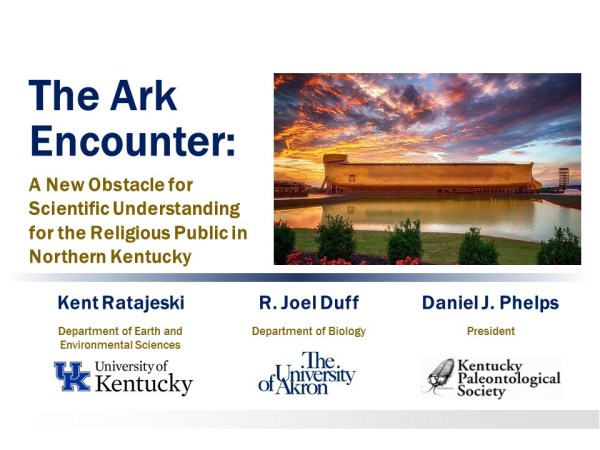
Take a tour of the Ark Encounter with a geologist, paleontologist and myself in this YouTube presentation. In July I visited the Ark Encounter with geologist Dr. Kent Ratajeski from The University of Kentucky. After that trip Kent, myself and Dan Phelps (President of the Kentucky Paleontological Society) worked together - my contribution was rather... Continue Reading →
Perceiving Age: Student’s Interpretations of the History of Craters on Mars
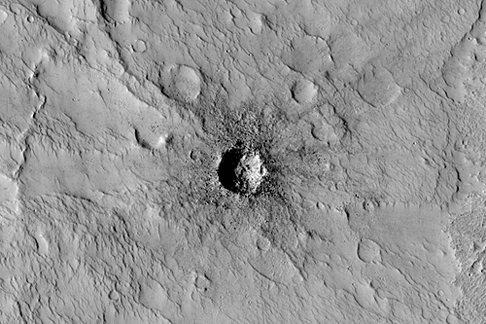
Our perceptions of the age of a subject are frequently based on our common experience with similar subjects. Most people have some ability to guess the age of children with seemingly very little prior information. We might call this ability to guess age our intuition but this "intuition" is the scientific method working automatically in our minds. Our... Continue Reading →
Walking in the Footprints of Giants: The Red Gulch Dinosaur Tracksite in Wyoming
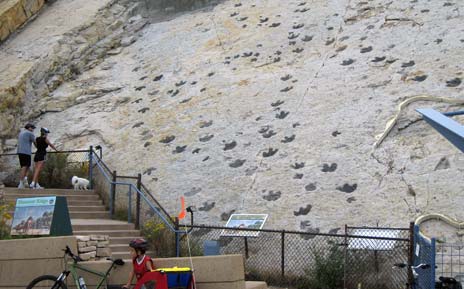
Scattered across the upper surface of a hard layer of limestone in the badlands of the Bighorn Basin in Wyoming are the tell-tale signs of dinosaur activity: footprints. Over one thousand footprints have been identified here, most of them on one exposure of rock in a small gully in the Red Gulch region. On our family vacation this... Continue Reading →
Remnants of a Shallow Sea: A Visit to Monument Rocks in Kansas
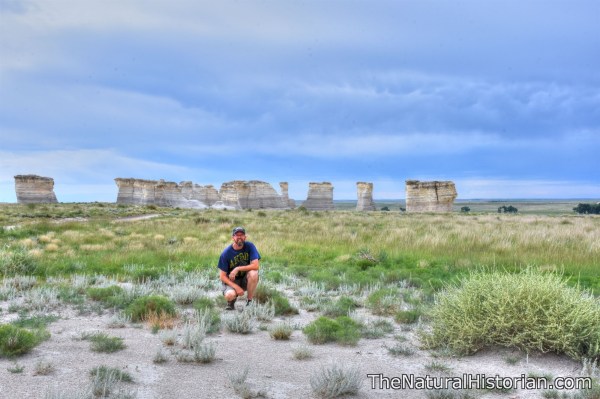
In remote western Kansas, groups of rock pillars stand like a natural Stonehenge over the grassy plains. One such group of these pillars south of Oakley is named Monument Rocks. Returning from our Wyoming and Colorado adventure, we stopped overnight in Scott City, Kansas just south of this interesting rock formation. The following morning we made our way along many... Continue Reading →
A 60,000 Year Varve Record from Japan Refutes the Young-Earth Interpretation of Earth’s History
Do places on Earth exist where annual records have been stored for tens of thousands of years and can be accessed today? Ice-cores and tree rings can preserve long records of yearly events but some of the best records come from layers of sediment underlying some lakes which, if formed under the right conditions, can be read like the annual rings of... Continue Reading →
A Creation Museum Speaker Asks: Do Animals Evolve?
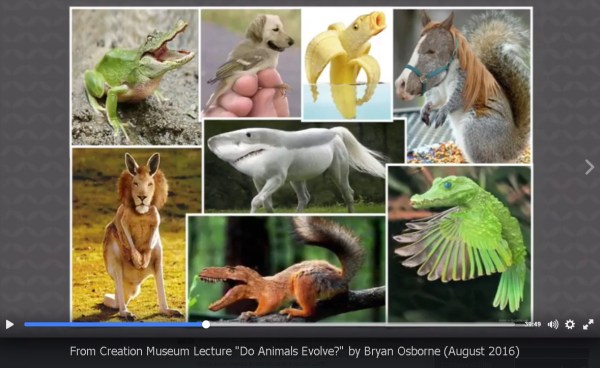
What does it mean to evolve? What is natural selection? Where did the genetic variation come from that allows evolution to happen? Why are there so many species of animals today? What can mutations do? These are some of the questions that Answers in Genesis speaker Bryan Osborne addressed at public talks given at the young-earth... Continue Reading →
The Ark Encounter: Depicting a Real Flood with Unrealistic Images
Guests at the Ark Encounter will observe many descriptions and artistic impressions of what happened before, during and just after Noah's Flood. One set of images was especially interesting to me because it visualized different stages of the Flood. One panel which explains how the Flood waters prevailed over the highest mountains was particularly perplexing because of... Continue Reading →
The Grand Canyon: Magnificent Witness to Earth’s History
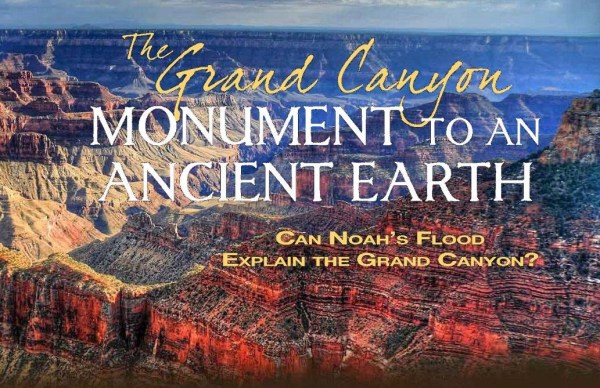
The Grand Canyon is one of the most iconic geological features on Earth. Its immensity of the canyon regularly causes those that have peered into its depths to wonder about its origins. How could such an awe-inspiring canyon have formed? This fascination with the Grand Canyon has fueled a long a history of geological research. As a result there is a wealth... Continue Reading →
2500 Year Old Human Footprints Discovered: Insight into the Formation of Fossil Footprints
Countless numbers of footprints made by hundreds of kinds of organisms are preserved in hundreds of individual layers of the geological column. Millions of these tracks have been identified from just the tiny fraction of the rocks that are exposed at the surface of the Earth. But how were so many footprints preserved? In conversations with... Continue Reading →
A Creationist Rejects Intelligent Design, Appeals to “Natural Processes” to Explain Stone Artifacts
Are billions and billions of pieces of stone found strewn across the African continent the product of intelligent design (purposeful actions) or random processes? Last year I presented a Stone-Age artifact challenge to the young-earth creationist' chronology. Dr. Mortenson, from Answers in Genesis, responded to the evidence that I presented of vast stone-tool production in... Continue Reading →
John Ray on Flood Geology in 1695: Words that Still Apply Today
Modern young-earth creationism has deep roots. The essential elements of flood geology were established in the 17th century though much of what passed as flood geology at that time might be difficult to recognize today. One thing that hasn't changed is the style of rhetoric frequently used to promote flood geology to the general public.... Continue Reading →