As someone who has spent years examining claims about science and faith, I am very concerned about the spread of misinformation on social media, particularly within Christian and creationist circles. While the intention behind sharing such content may be sincere – to demonstrate evidence for God’s creative power – the use of false claims ultimately undermines both scientific integrity and Christian witness. A recent viral post about ants and their supposed seed-cutting behavior provides a case study of this problematic pattern. I have responded to this post dozens of times in the past year. I had not seen it posted for several months but in the past few days it is again spreading across many creation/evolution/origins discussion forums and individual FB and Instagram accounts.
For my video discussion and analysis, check out my video here:
Anatomy of a Viral Falsehood
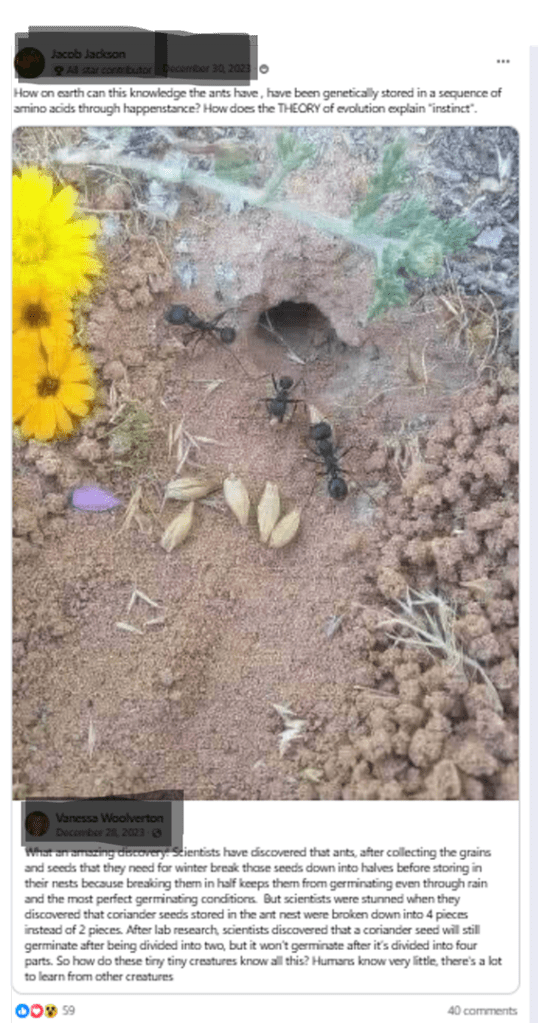
The post in question describes what it calls an “amazing discovery” by scientists: that ants deliberately cut seeds in half before storing them to prevent germination, and in the specific case of coriander seeds, cut them into quarters because halves can still sprout. The post presents this as evidence of divine design, suggesting that such complex knowledge in tiny insects could only come from God.
At first glance, it seems like a fascinating biological observation. Even I initially found it interesting enough to want to learn more about the research behind it. The post has been shared countless times across social media platforms, often accompanied by comments marveling at God’s creation and using it as evidence against evolutionary explanations.
Investigating the Claims
When I decided to look into the actual scientific literature about this behavior, I was surprised to find… nothing. Despite extensive searching in academic databases and scientific publications, I could not find any research showing ants deliberately cutting seeds in half to prevent germination. I found no studies about different treatment of coriander seeds versus other seeds. I found no evidence that this behavior exists at all in any ant species
The entire story appears to be fabricated. The earliest version I could track down originated from a creationist Facebook group, from which it has been copied and shared repeatedly, always with the same text and image.
A recent search for “ants coriander creation” on Google yielded this Gemini AI response:

And the “link” provided? You guessed it, they are to a Facebook and Reddit post of this creationist post. So this single post on a creationist sight now has Google informing us that this is unique feature of these ants.
The Broader Impact of False Claims
This kind of misinformation is particularly troubling for several reasons:
- It exploits people’s trust – Many share these posts because they come from trusted friends or respected Christian sources, perpetuating the spread of false information through networks of believers.
- It undermines credibility – When someone discovers that such confidently stated “scientific facts” are actually false, it can cause them to question other claims from the same sources, including legitimate evidences for faith.
- It creates a false dichotomy – By presenting fabricated evidence as proof of divine design versus evolution, it promotes an unnecessarily antagonistic relationship between faith and science.
Reflections and Conclusions
While I understand the desire to find and share evidence of God’s amazing creation, building arguments on false claims is like “building your house on sand” – it simply cannot stand up to scrutiny. There are countless genuine examples of remarkable design and complexity in nature that we can point to instead. We don’t need to resort to fabrication.
This case also highlights the importance of fact-checking before sharing. In today’s social media environment, it’s tempting to immediately share content that seems to support our beliefs. However, as Christians especially, we have a responsibility to truth that should compel us to verify claims before spreading them further.
I encourage anyone who has shared this particular post about ants to consider removing it and perhaps sharing this analysis instead. And for future viral claims about scientific discoveries that seem to perfectly prove a theological point, take a moment to verify the source. Truth is too important to sacrifice for the sake of a compelling social media post.
Ultimately, our witness for Christ should be built on truth, not convenient fictions. God’s actual creation provides more than enough evidence of His wisdom and power – we need only look at what’s really there rather than inventing false proofs.
As always, I’m open to correction if evidence emerges that I’ve missed something in my research. But for now, this appears to be yet another example of sharing misinformation that ultimately does more harm than good to the cause it aims to support.
 Naturalis Historia
Really significant post, Joel!
LikeLike
good content here; we hope it is widely shared and heeded.
LikeLike