What to Do with the Plants? A Survey and Critique of Young-Earth Creationist Models for the Plant Fossil Record

The young-earth creationist (YEC) theories struggle under the weight of their own inconsistencies when confronted with the ordered, global plant fossil record. With multiple contradicting models failing to account for the absence of angiosperm pollen before the Cretaceous, an outdated narrative is becoming increasingly untenable. The evidence overwhelmingly favors established geological timelines.

Talking Sense About Tree Rings: A Surprising Creationist Concession

Here I summarize my recent YouTube video about hiking in Great Basin National Park and observing ancient bristlecone pines, which challenges young-earth creationist views. Recent articles from young-earth writers show evolving openness to dendrochronology, recognizing its evidence supports timelines beyond 4,350 years, despite attempts to reconcile this with Biblical accounts.

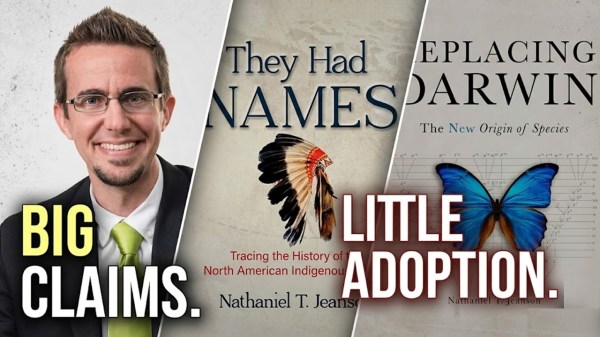
A Revolution Without Adoption: Who Is Using Jeansonโ€™s Model?

Dr. Nathaniel Jeanson's latest blog post claims to revolutionize perceptions of Genesis through pre-European American history, yet his own admissions reveal a stark reality: mainstream scientists and even his peers in young-earth creationism largely ignore his work. This self-promotion, lacking substantive peer engagement, merely highlights an ongoing pattern of overstated claims.

Falling Leaves and Failing Arguments: Why Autumn Adaptation Doesnโ€™t Prove Irreducible Complexity

Creation Ministries International's article claims leaf abscission's complexity proves divine design, but this argument crumbles under scrutiny. If the pre-Fall world was perfect, why would trees need a survival mechanism against harsh winters? The existence of both deciduous and evergreen species raises further doubts, challenging the notion of irreducible complexity. True divine design stands independent of flawed logic.

Tardigrades Evolved to Live in Space? How Creationist Arguments About Water Bears Misunderstand Natural Selection

Tardigrades, known for their extreme resilience, have become contentious symbols in debates on evolution and design. A creationist perspective claims their abilities exceed evolutionary explanations, suggesting divine intervention. However, research shows their toughness is a result of adaptations to desiccation, serving as an exaptive response, thereby aligning with evolutionary principles.

Hand-Waving at the Fall: YEC Explanations of the Origins of Defense Structures

Harry F. Sanders III's article at Answers in Genesis attempts to reconcile young-earth creationism with the existence of defense and attack structures (DAS) in nature, proposing four problematic explanations for their origin. I find these explanations scientifically inadequate, lacking empirical support and testable hypotheses while highlighting significant challenges they present within a short young-earth time frame.

How Dr. Jeansonโ€™s Rhetoric Substitutes Mockery for Methodology

Dr. Nathaniel Jeanson's response to criticisms regarding his mitochondrial DNA research reveals a rhetorical strategy that conflates scientific objections with religious dogmatism. His dismissal of established genetic principles undermines honest intellectual engagement and perpetuates a troubling narrative among his audience, who deserve a nuanced understanding of the science involved.

Ken Ham: I Am Willing to Divide the Church Over This

Ken Ham's recent video advocates for divisiveness among Christians regarding the interpretation of Genesis and the age of the earth, presenting biblical division as a mandate. My response critiques his arguments, highlighting their exegetical flaws and the harm they cause to church unity. I suggest a more nuanced approach to scriptural interpretation that prioritizes the gospel over secondary matters.

No, Science Is Not ‘The Study of Intelligent Design in Nature’

The statement "Science is the study of Intelligent design in Nature" reflects a significant misunderstanding of both science and theology. It confuses the broad theological concept of divine design with the narrower empirical claims of the Intelligent Design movement. True scientific inquiry is about understanding natural processes, while Christian faith views God's providence as inherent in all creation, not just in gaps of knowledge.

Up ↑