Ken Ham’s Ark Encounter has been a fixture in the young earth creationist landscape since opening its doors in July 2017. I have been very interested in the tracking of the attraction’s performance through public records for years. These records have been obtained by a dedicated individual who has monthly made public records requests going on 8 years. In looking at those numbers we have noticed a recent rend that deserve closer scrutiny. That data suggests significant attendance declines, coinciding with what appears to be increasingly expensive marketing efforts—including a paid partnership with Fox & Friends that masqueraded as legitimate news coverage.
Tracking the Numbers: A Methodological Approach
For those unfamiliar with how the numbers have been obtained, a bit more detail. The data comes from public records requests to Williamstown, Kentucky. Every paid ticket to the Ark Encounter includes a safety fee that goes to the local municipality to help cover emergency services for the increased population the attraction brings to the area. By tracking these safety fee payments monthly, it is possible to back-calculate the number of paid admissions with remarkable accuracy.
There are important caveats to understand. These numbers don’t capture the complete picture of foot traffic. Children under 10 have been free for a number of years and don’t pay the safety fee, so they’re not reflected in these statistics. Additionally, my understanding is that people attending special events like conferences or concerts who don’t actually tour the Ark exhibit itself wouldn’t be counted. However, these figures provide a reliable window into the number of adults, seniors, and children over 10 who purchased tickets to experience the main attraction.
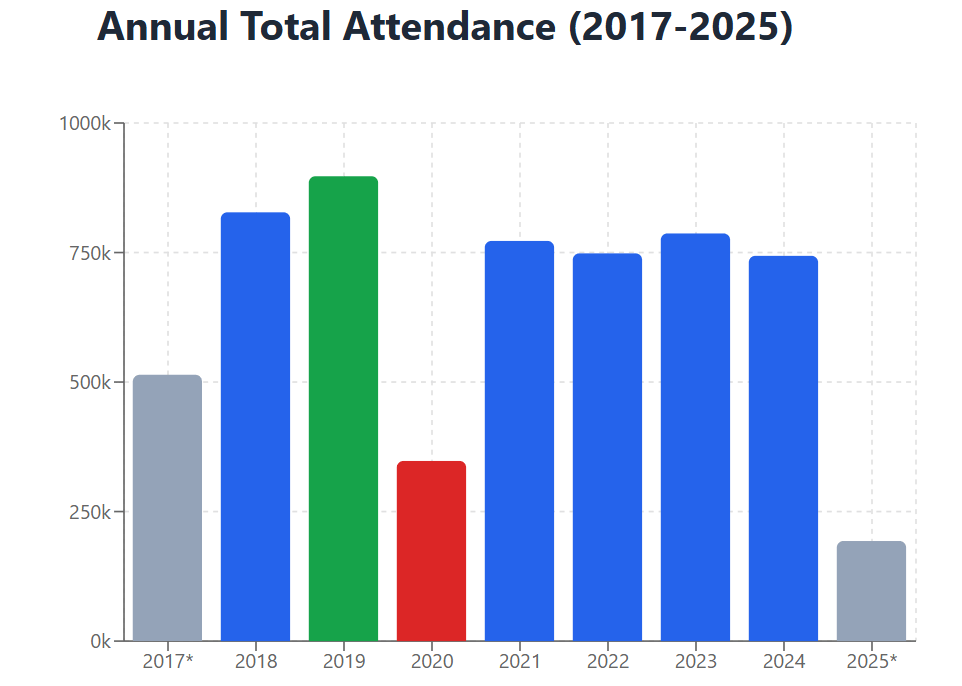
An important correction to my historical analysis in the figures below: I’ve since learned that during the first two years of operation (2017-2018), children were not free. This means the total attendance numbers for those early years would naturally appear higher in my data since they included all visitors, not just paying adults and older children. After 2018, when the free admission for young children was implemented, we’d expect to see some decline in the reported numbers simply due to this policy change, making the early performance appear even more impressive than it actually was relative to current operations.
The 2025 Decline: Cause for Concern?
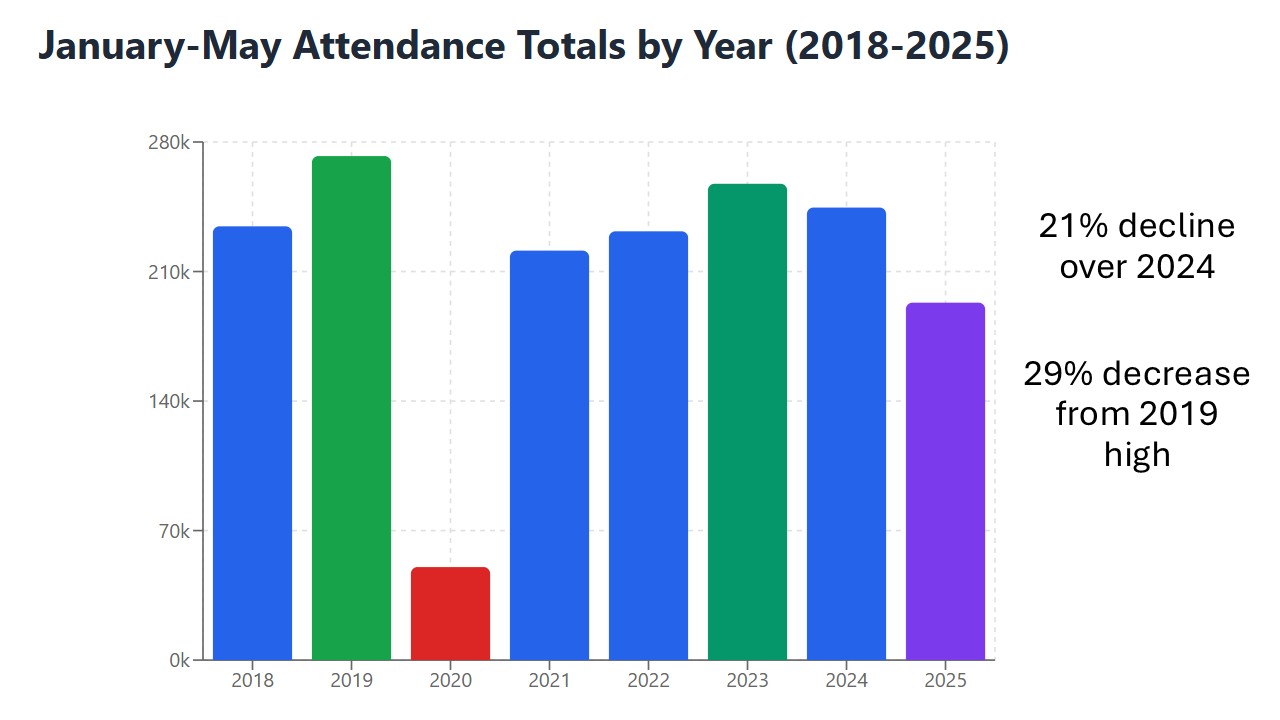
The recent numbers from spring 2025 are particularly striking. April showed approximately 45,000 paid visitors compared to 67,000 the previous year—a 35% year-over-year decline. May continued this downward trend with around 50,000 visitors, representing a 21% decrease from May 2024. When examining just the first five months of 2025 compared to the same period in previous years, we see a consistent 20% decline that translates to roughly $2.5 million in lost revenue.
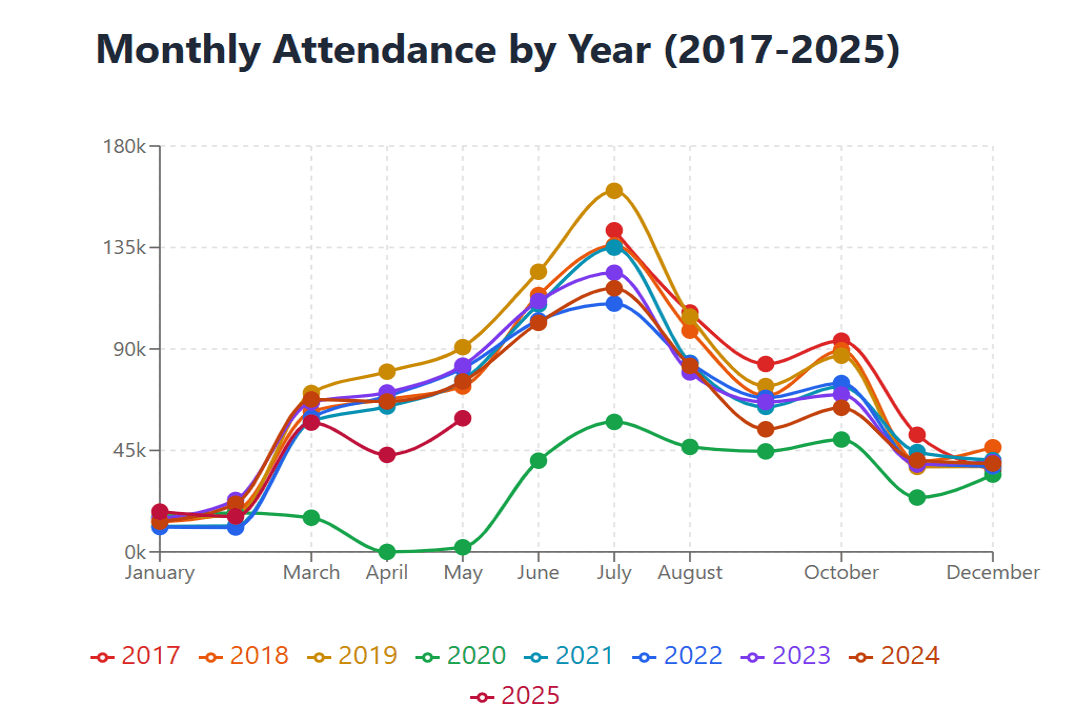
However, these dramatic decreases warrant some caution in interpretation. It’s possible that changes in accounting methods or ticketing procedures could be affecting the data. For instance, if the Ark Encounter has begun selling unified tickets to large groups and processing them as single transactions, this methodology would count these as individual admissions rather than reflecting the actual number of people entering. This could artificially deflate the apparent attendance figures without representing a genuine decline in visitors.
That said, sources familiar with the attraction suggest there does appear to be a real slowdown in foot traffic that goes beyond potential accounting irregularities. The pattern is consistent enough across multiple months to indicate genuine attendance challenges rather than mere statistical artifacts.
I should note here that the Answers in Genesis never provides any official numbers for attendance at the Creation Museum or Ark Encounter. If these numbers are wildly incorrect they could provide the verified numbers. They often talk about more than a million a year but almost always lump the Creation Museum and the Ark Encounter together and we don’t know if those are people that paid for both and actually went to both, special event visitors that don’t actually go into the main attraction, how many are there on lifetime passes that our method would not capture etc. So there are a lot of unknowns but these numbers give us some baseline for daily paying customers.
The Fox & Friends Marketing Push
Perhaps the most telling indicator of attendance concerns came in the form of a recent Fox & Friends segment featuring host Ainsley Earnhardt visiting the Ark Encounter with her family. On the surface, this appeared to be typical morning show content—a feel-good family trip to an interesting attraction. However, a closer look reveals something quite different.
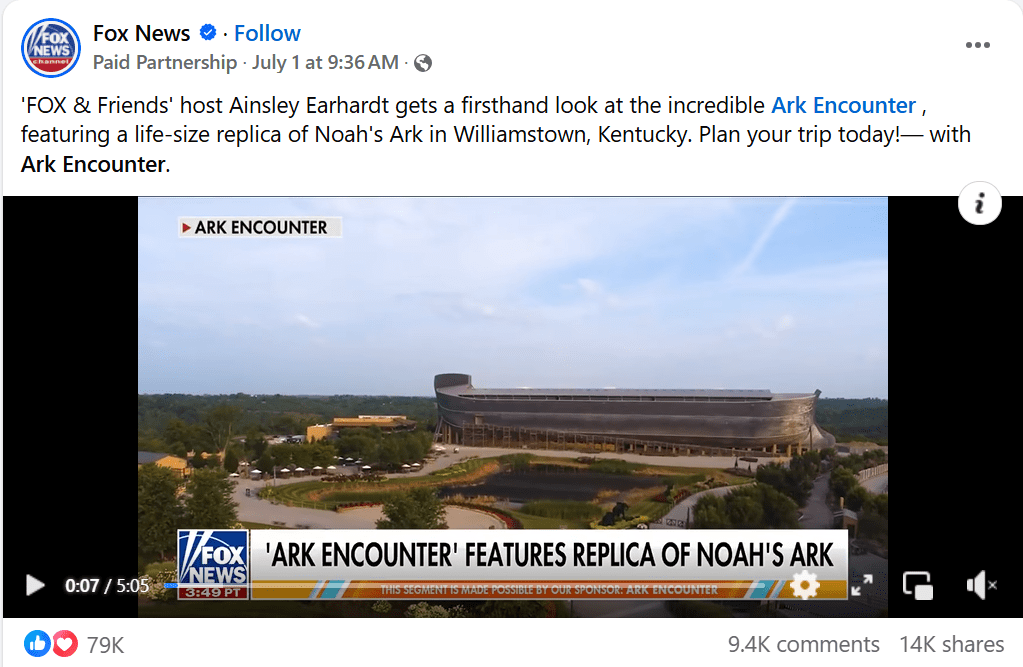
The Facebook post promoting this segment included a crucial detail that many viewers likely missed: “Fox News with Ark Encounter. Paid partnership.” This wasn’t organic news coverage or a journalist’s independent decision to feature the attraction. This was advertising, carefully crafted to look like editorial content but funded by Answers in Genesis.
The segment fits seamlessly into Fox & Friends’ typical format, making it easy for viewers to miss its commercial nature. Earnhardt and her guests offer glowing reviews of their experience, encourage viewers to “plan your trip today,” and provide the website URL for booking visits. The production quality and integration into the show’s regular programming create an impression of journalistic endorsement rather than paid promotion.
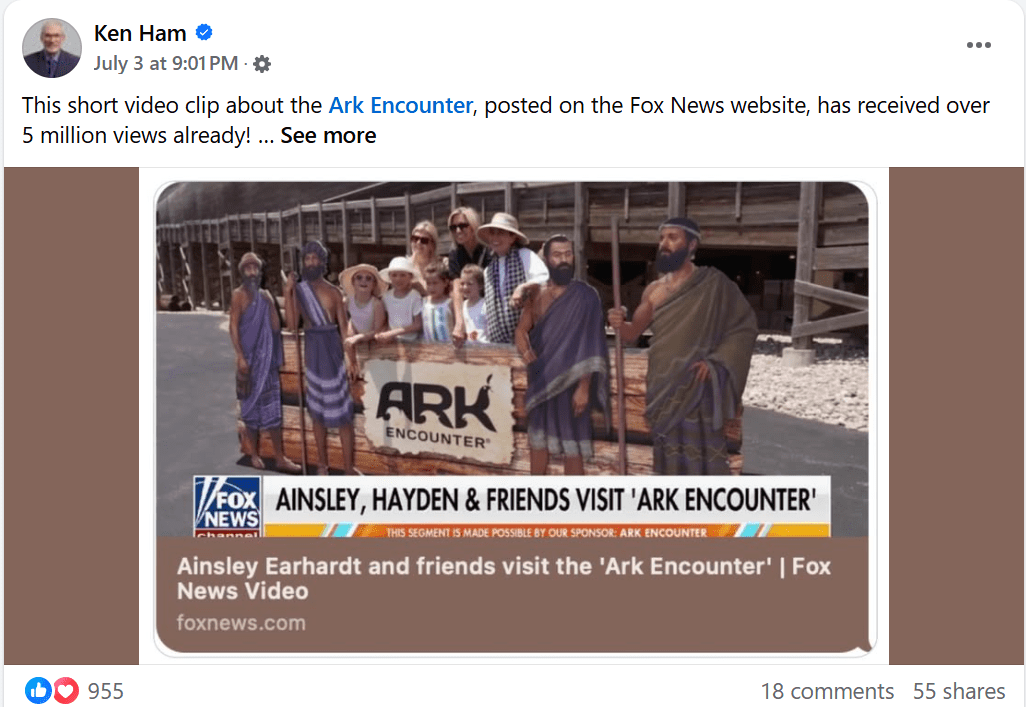
This type of “native advertising” represents a significant investment. Purchasing airtime during a popular morning show, especially one that reaches the Ark Encounter’s core demographic, likely cost tens to hundreds of thousands of dollars. The fact that Answers in Genesis was willing to make this expenditure suggests genuine concern about declining visitor numbers and a recognition that traditional marketing approaches may not be sufficient.
The Economics of Theme Park Sustainability
The financial implications of declining attendance are substantial. With adult tickets now priced at $64.99 plus $10 parking and tax, a family visit easily approaches $200-400. While the attendance numbers still represent hundreds of thousands of visitors annually, the trajectory is concerning for an attraction that originally projected 1.4 to 2.1 million visitors per year. They have never reached those numbers but I will point out that those were aspirational number also meant to encourage donors. I don’t believe they need 1.4 million visitors to remain solvent, especially given their donor base that will continue to prop up any shortfall in operating expenses.
Theme parks face a particular challenge: the novelty effect. Unlike destinations that offer genuinely unique experiences each visit, attractions like the Ark Encounter rely heavily on first-time visitors. Once you’ve seen the exhibit, the motivation to return is limited unless significant new content is added. This explains the ongoing construction projects—the mini Jerusalem, additional attractions, and expanded zoo facilities—all designed to give repeat visitors new reasons to come back.
However, these expansions require substantial capital investment while operating costs continue to rise. More buildings mean higher utilities, additional staff, and increased maintenance expenses. When attendance declines while infrastructure costs increase, the financial pressure intensifies rapidly.
Looking Forward: Sustainability Questions
The Ark Encounter’s situation reflects broader challenges facing ideologically-driven attractions. Unlike commercial theme parks that can pivot based purely on market demands, the Ark Encounter must balance entertainment value with its educational and evangelical mission. This constraint limits options for addressing attendance challenges.
The Fox & Friends partnership represents the use of modern marketing strategies. By embedding promotional content within trusted news programming (at least trusted by a segment of the population), organizations can reach audiences who might be skeptical of traditional advertising. However, the effectiveness of such approaches remains to be seen, particularly when the underlying attraction faces fundamental sustainability challenges.
Whether the spring 2025 decline represents a temporary reduction or the beginning of a longer-term trend will become clearer as more data becomes available. The summer months typically show the highest attendance, so the next few months’ figures will be particularly telling.
My YouTube video on the same subject:
 Naturalis Historia
Thanks for this update, Joel! I always appreciate the good work you do!
Re. what’s behind the drop in the numbers for 2025, I’m wondering if you’ve considered whether it’s due to Canadians not crossing the border because of recent announcements from the White House (re. tariffs; 51st state; harsher scrutiny of phones at the border). Many Americans don’t understand the impact those announcements have had on Canadian sentiments, and they may not be aware of the 30% drop in Canadians entering the US, especially from here in Southern Ontario (the closest access to Kentucky). In the monthly attendance at Ark Encounter you show above, the March 2025 number doesn’t look hugely different from March in other years (although I’d point out it’s still the lowest among those seven numbers), but then it’s April and May 2025 which suddenly show the 25-30% drop. That timing and magnitude is precisely consistent with the drop in Canadians entering the US!?
Thoughts?
LikeLike