Deep in the rainforests of French Guiana, aging worker termites of the species Neocapritermes taracua carry out one of the most dramatic acts of self-sacrifice in the animal kingdom. As these workers grow old and their mandibles wear down from years of chewing wood, they become increasingly useless as foragers. But they don’t simply retire. Instead, they have spent their entire lives accumulating a remarkable blue enzyme (a laccase called BP76) in specialized pouches on their backs. When enemies attack the colony, these elderly workers rush to the front lines, rupture their own bodies, and mix the blue crystals with hydroquinone secretions from their salivary glands. The result is a sticky, toxic cocktail of benzoquinones that immobilizes or kills attackers with devastating efficiency. They are able to neutralize over 90% of enemies in laboratory tests. The worker, of course, dies in the process.
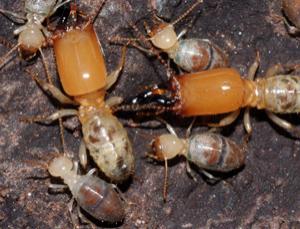
I first wrote about these termites back in 2016, shortly after the molecular mechanisms of this two-component chemical weapon were described in a landmark paper by Bourguignon and colleagues in Molecular Biology and Evolution. The science has only become more fascinating since then. In 2024, Škerlová and colleagues published the crystal structure of BP76 in the journal Structure, revealing how this enzyme remains remarkably stable in solid form throughout the termite’s entire lifespan. This is maintained by compact folding, glycosylation, disulfide bridges, and a tight dimer interface. The enzyme sits in an amorphous solid state on the termite’s back, exposed to the heat and humidity of tropical rainforests, yet remains fully catalytically active and ready to deploy at a moment’s notice. It is, to put it mildly, an extraordinary piece of biochemistry.
Recently, Creation Ministries International (CMI) published an article about these termites in their Creation magazine, using this 2024 research as a springboard to argue that the system “exhibits intelligent design.” The article dutifully catalogues the components of the defense system—the specialized glands, the storage pouches, the stable enzyme, the two-component activation mechanism—and frames the whole apparatus as a list of requirements that, by implication, could not have arisen through natural processes. It’s a familiar strategy: describe complexity, express incredulity, declare design.
But what caught my attention most was a question the article raises and then conspicuously fails to answer. The author asks whether these termite species represent “a separate created kind, created on Day 6 of Creation Week.” It’s presented as a genuine inquiry—the article even suggests that “genetic studies could help answer this question.” But no answer is forthcoming. The question just hangs there, floating in the rhetorical space between the description of the system’s complexity and the confident assertion that it reflects intelligent design.
This evasion is telling, because the question actually matters enormously for the young-earth creationist (YEC) framework, and every possible answer creates serious theological and scientific problems.
The Dilemma: Created for Death?
Consider the options. If God created Neocapritermes taracua with its exploding defense system already intact during Creation Week, then God deliberately designed an organism whose most remarkable feature is a mechanism for self-destruction. This is an organism whose elderly workers are, by design, walking chemical weapons—living bombs engineered to die violently for the colony’s benefit. The standard YEC position holds that there was no death before Adam’s sin, that the original creation was “very good” in a way that excluded predation, disease, and death. How does one reconcile a “very good” creation with an organism that was apparently purpose-built for kamikaze warfare?
To be fair, a common YEC response is more likely to be that termites are not “alive” in the biblical sense and thus self-sacrifice is not death at all. This same reason can be given for why Adam could step on an ant and “kill” it prior to death entering the world through Adam’s sin.
The CMI article seems vaguely aware of the former tension. The author notes that “it makes sense in terms of the colony’s survival that the older workers, whose worn mandibles make them less effective at foraging, become specialized in defending the colony.” This is, ironically, a perfectly good evolutionary explanation—natural selection favoring altruistic sacrifice among individuals with low remaining reproductive or productive value. E.O. Wilson’s famous quip applies: “We send our young men to war; ants send their old ladies.” But within the YEC framework, this functional elegance becomes a theological puzzle: Why would God design workers to wear out their mandibles over time and then design them to become disposable weapons as a consequence of that wear?
The Pre-Programming Problem
Another alternative favored by many YEC thinkers is what I’ve called the “pre-programming” explanation. In this view, God didn’t create the defense system directly but instead front-loaded the original termite genome with latent genetic information that could be “activated” after the Fall, when predation and competition became part of the world. This is essentially the position advocated by organizations like the Institute for Creation Research, whose Dr. Randy Guliuzza has promoted the concept of “programmed filling”—the idea that organisms contain internal engineering programs that generate new traits as needed.
But this explanation doesn’t work either, and I think the new structural data on BP76 makes the problem even more acute than when I first wrote about it nearly a decade ago. The 2024 crystal structure reveals that the BP76 enzyme employs at least four distinct stabilization strategies, including an unusually strong bond between two amino acids near the active site. The enzyme has a three-cupredoxin domain architecture with a complex active site containing four copper atoms arranged in two distinct clusters. The entire system requires specialized secretory glands, cuticular storage pouches positioned near (but separate from) the salivary glands, the capacity to rupture the pouches under mechanical stress but not during routine activity, the production of hydroquinone precursors in a completely separate organ system, and behavioral programming that makes older workers more aggressive and more willing to self-sacrifice than younger ones.
This is not a single genetic switch waiting to be flipped. This is a deeply integrated system involving novel organ development, unique enzyme biochemistry, coordinated glandular architecture, and sophisticated behavioral modulation tied to age-related physiological changes. The idea that all of this was somehow genetically pre-loaded into an original termite “kind” and then expressed within a few thousand years strains credibility past the breaking point.
The Broader Spectrum of Autothysis
The CMI article briefly mentions that “some other termite species also deter intruders by mechanically squeezing a portion of their abdomen until they ‘explode'” and acknowledges that these simpler systems are “a long way from this much more complex, integrated system.” The author seems to recognize a continuum here but doesn’t follow the thread to its natural conclusion.
In fact, self-destructive defense (autothysis) is widespread across termites and has evolved independently in multiple lineages. Workers of several genera in the soldierless Apicotermitinae use autothysis to block nest tunnels. Soldiers of the Serritermitidae employ front-gland autothysis, rupturing between the head and abdomen. Some species simply spray excrement; others release moderately toxic secretions. The Neocapritermes system with its two-component laccase-mediated chemistry represents the most sophisticated version yet discovered, but it sits within a broad spectrum of increasingly elaborate self-destructive defense mechanisms distributed across the termite phylogeny.
This distribution pattern is precisely what evolutionary biology predicts. If self-destructive defense evolves through gradual modification of existing chemical defense pathways—from mildly distasteful metabolic byproducts to actively toxic secretions to the extraordinary two-component system of N. taracua—we would expect to find exactly this kind of phylogenetic spectrum, with simpler versions widely distributed and more complex versions restricted to particular lineages. We find that spectrum.
For the YEC model, however, this distribution is deeply problematic. If each of these defense systems was independently pre-programmed or separately created, then God designed dozens of distinct mechanisms for self-destruction across numerous termite lineages. If instead they share a common origin that diversified over time, then we’re back to evolutionary change. However, the YEC timeline of a few thousand years is hopelessly insufficient for the kind of complex trait evolution required to go from generic chemical defense to the integrated BP76 system.
Colonies as Organisms: Why the Analogy Matters
As I argued in 2016, one of the most illuminating ways to think about these termites is through the lens of the superorganism concept. A termite colony functions much like a multicellular organism: workers are the body’s somatic cells, soldiers are the immune system, and the queen’s hormonal signals coordinate development and behavior much as endocrine signals direct cell differentiation in an animal body.
Under this analogy, the exploding workers of N. taracua are remarkably similar to our own neutrophils—immune cells that self-destruct when they encounter invading pathogens, releasing toxic chemicals that destroy both the invaders and surrounding host cells in the process. The pus that oozes from a wound is evidence of exactly this kind of cellular suicide on your behalf. Nobody considers this aspect of our immune system theologically problematic. Cells die so the organism lives. That’s just how multicellular life works.
But if a termite colony is functionally analogous to a single organism, then the “death” of an individual worker is no more theologically significant than the death of a white blood cell. This reframing undermines the YEC insistence that all individual death was absent from the pre-Fall world. Were neutrophils also absent from Adam’s immune system? Did his epithelial cells never slough off? The YEC position on death before the Fall has always been vague about where exactly to draw the line, and social insects with their self-sacrificing workers make that vagueness painfully apparent.
The Question They Won’t Answer
The CMI article’s refusal to answer its own question—whether these termites represent a separately created kind—is not an oversight. It’s a strategic retreat from a question that has no good answer within the YEC framework. If they were created with this system, God designed organisms for suicide. If the system developed after the Fall through pre-programmed genetic information, the biochemical and structural complexity of BP76 makes that scenario biologically implausible within any young-earth timescale. If the system evolved through natural selection from simpler chemical defenses, the YEC model lacks the time and, for many of its proponents, even the theoretical willingness to accept that kind of creative evolutionary change.
Meanwhile, the actual scientists studying these termites (Šobotník, Bourguignon, Škerlová, and their colleagues) continue to reveal how natural processes can produce systems of breathtaking sophistication. The phylogenetic distribution of autothysis across termite lineages, the molecular evolution of laccase enzymes, the structural biology of BP76’s remarkable stability mechanisms, and the behavioral ecology of age-dependent altruism in social insects all tell a coherent story of evolutionary innovation operating over deep time. Modern Termitidae arose roughly 54 million years ago, and the crown group diversified around 40 million years ago, providing ample time for the kind of incremental elaboration that transformed simple chemical defenses into the two-component explosive system we see in N. taracua today.
These termites are indeed a marvel of nature—a testament to the power of natural selection to craft intricate, integrated systems from the raw material of variation and the relentless pressure of survival. They deserve better than to be reduced to a bullet-point list of components presented as evidence against the very processes that produced them, accompanied by theological questions that their advocates dare not answer.
References:
Šobotník, J., Bourguignon, T., Hanus, R., et al. (2012). Explosive backpacks in old termite workers. Science, 337(6093), 436.
Bourguignon, T., Šobotník, J., Brabcová, J., et al. (2016). Molecular mechanism of the two-component suicidal weapon of Neocapritermes taracua old workers. Molecular Biology and Evolution, 33(3), 809–819.
Škerlová, J., Brynda, J., Šobotník, J., et al. (2024). Crystal structure of blue laccase BP76, a unique termite suicidal defense weapon. Structure, 32(10), 1581–1585.
Bourguignon, T., Lo, N., Cameron, S.L., et al. (2015). The evolutionary history of termites as inferred from 66 mitochondrial genomes. Molecular Biology and Evolution, 32(2), 406–421.
Creation Ministries article that I am responding to: https://creation.com/en/articles/suicide-termites
My previous post on this topic: https://thenaturalhistorian.com/2016/02/17/exploding-termites-sacrifice-of-an-individual-for-the-good-of-the-whole-organism/
 Naturalis Historia