Ken Ham recently took to Facebook, X and the Answers in Genesis website to answer what he clearly considers a settled question: how did kangaroos get to Australia? His answer, delivered with characteristic confidence and a dash of tongue-in-cheek humor—“They hopped”—makes for an entertaining soundbite. But when you slow down and actually examine the details of his explanation, the problems multiply so quickly that one begins to wonder whether Ham has given any thought to his own model or simply hoped his audience wouldn’t test anything that he said.
As a Christian and a biologist, I find myself continually drawn back to these biogeography questions—not because they are the most intellectually sophisticated challenges to young-earth creationism, but because they are among the most viscerally intuitive. You do not need a PhD to sense that something is deeply wrong with the idea that 140 species of marsupials, but virtually no placental mammals, all independently traveled from the Middle East to Australia within the last 4,350 years. The question practically asks itself: why only marsupials? And Ham’s post, far from resolving that question, actually makes it far worse because he has to create pretend geography which even if true would end up undermining his thesis anyway.
The Land Bridge That Doesn’t Exist
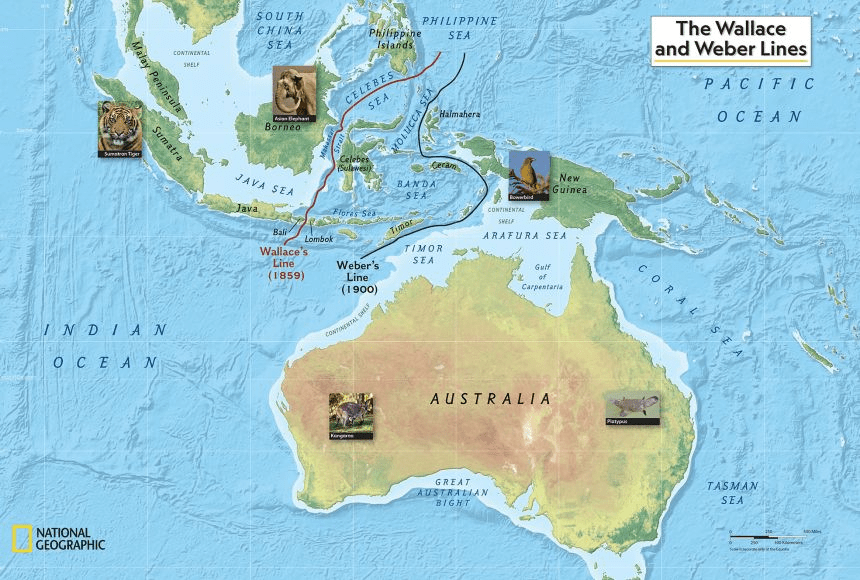
The lynchpin of Ham’s explanation is a land bridge. He writes that an ice age following Noah’s Flood would have lowered ocean levels, “forming land bridges connecting Australia with New Guinea and Indonesia to Southeast Asia.” This sounds plausible if you don’t look at a bathymetric map. It is true that during Pleistocene glacial maxima, lower sea levels exposed the Sunda Shelf, connecting the islands of Indonesia to mainland Southeast Asia, and the Sahul Shelf, connecting Australia to New Guinea. These are well-documented geological features. But between Sunda and Sahul lies Wallace’s Line and the deep oceanic trenches of Wallacea—a region where the ocean floor plunges thousands of meters below the surface. No ice age, no matter how severe, has ever produced enough sea level drop to create a continuous land bridge from Southeast Asia to Australia. The deep water channels between Bali and Lombok, between Borneo and Sulawesi, and between Sulawesi and New Guinea have persisted as oceanic barriers for tens of millions of years.
Kangaroos could never have hopped to Australia in the manner that Ken Ham claims.
This is not a minor quibble. It is the entire mechanism of Ham’s model. Without a land bridge, his kangaroos cannot hop to Australia. They are stranded in Indonesia, staring across a strait of deep ocean water with no way to hop cross. Ham might as well propose a land bridge between India and Australia—he would have exactly the same amount of geological evidence supporting it, which is to say, none at all.
The biogeographer Alfred Russel Wallace recognized this deep-water barrier in the 1850s, which is why we still call it Wallace’s Line. It is one of the most famous and well-documented biogeographic boundaries on Earth, and its existence is precisely why the fauna of Australia is so dramatically different from that of Southeast Asia. The very phenomenon Ham is trying to explain (the distinctiveness of Australian faun) is itself powerful evidence that no land bridge existed. Ham’s model requires him to deny the most basic observation that his model is supposed to account for. Ken Ham should know these basic facts and if not him, someone on his staff should have some rudimentary knowledge of ocean basins to realize that Ken Ham is spreading fake news.
It’s Not Just Kangaroos
Perhaps the most frustrating aspect of Ham’s post is the way he narrows the problem to a single group: kangaroos. He speaks of “the kangaroo kind” arriving in Australia, as if explaining how one type of marsupial got there solves the problem. It does not come close. I’ve talked about this on my YouTube channel several times. Below is a video devoted to this topic.
Australia is home to roughly 140 species of marsupials classified into at least 15 distinct families. Even by young-earth creationist standards, where “kinds” are typically placed at the family level, that means at least 15 separate marsupial lineages—plus the monotremes, the platypus and echidnas—all had to independently make the same journey from the Middle East to Australia. We are talking about organisms as different from each other as tiny insectivorous marsupial mice weighing a few grams, carnivorous Tasmanian devils and the now-extinct thylacines, burrowing wombats, tree-dwelling koalas that are dietary specialists on eucalyptus (a plant genus essentially confined to Australia), sugar gliders, numbats, bandicoots, and multiple lineages of kangaroos and wallabies. These animals have wildly different body sizes, speeds, dietary requirements, habitat preferences, and reproductive strategies.
And yet, in Ham’s model, every single one of them migrated from Mount Ararat across Iran, Pakistan, India, Southeast Asia, and then somehow across deep ocean water to Australia—and not a single placental mammal made the same trip. Not a deer. Not a rabbit. Not a wolf. Not a monkey. The only placental mammals that appear to have reached Australia before human arrival are rats. And rats, as anyone who has studied dispersal biology knows, are perhaps the single most capable overwater dispersers among all mammals. The fact that only rats made it is actually powerful evidence for how difficult the crossing was, not evidence that a land bridge made it easy.
The Competition Explanation Doesn’t Work Either
Ham vaguely gestures toward competition as a sorting mechanism: “As animals competed with each other, they moved to various areas.” This implies that marsupials were somehow driven ahead of placentals, arriving in Australia first and then being isolated there as sea levels rose. This explanation has been floating around young-earth creationist literature for decades, and it has never been convincing much less demonstrated by any experimental data.
Consider what this requires. The 15 or more different kinds of marsupials—from tiny nocturnal insectivores to large herbivores—all had to outrun, outcompete, or at least stay ahead of the thousands of species of placental mammals dispersing from the same starting point. Did wombats really travel faster than wolves? Did koalas, which today can barely be bothered to move from one eucalyptus branch to another, somehow outpace antelope across the Iranian plateau? The proposal is not just implausible—it requires us to imagine a scenario in which the slowest, most specialized marsupials consistently beat the fastest, most adaptable placentals in a transcontinental race. And then, having won that race, the marsupials all happened to cross the deep ocean—NOT a land bridge—to Australia, while every single placental competitor simply stopped at the water’s edge and went no further.
Interestingly, this problem has not gone unnoticed within the young-earth creationist community itself. It seems Ken Ham does not keep up with his own communities literature. Graham Taylor, writing in the Journal of Creation published by Creation Ministries International, recently devoted an entire article to arguing that naturalistic explanations for how marsupials reached Australia are inadequate—even by creationist standards. Taylor’s proposed solution was to invoke direct divine intervention: God supernaturally directed the marsupials to Australia. I have discussed Taylor’s article at length on my YouTube channel, and while I think his proposed solution creates as many theological problems as it solves, I give him credit for being honest about the magnitude of the challenge. Taylor recognizes, as Ham apparently does not, that simply saying “they hopped” and waving at a nonexistent land bridge is not a serious answer.
The Fossil Question Ham Raises—and Then Mishandles
Ham anticipates an obvious objection—why are there no kangaroo fossils between the Middle East and Australia?—and offers an answer that initially sounds reasonable: fossilization is rare and requires catastrophic burial. He compares kangaroos to the millions of buffalo that once roamed North America, noting that we don’t find many buffalo fossils either.
But this comparison actually undermines his case rather than supporting it. He used a false statement to support his view. We do find buffalo fossils in North America—quite a lot of them, in fact, spanning hundreds of thousands of years. We find bison fossils across Asia and Europe as well, tracing their migratory history. If kangaroos really did traverse the entire breadth of Asia over a period of decades or centuries, we would expect at least some trace in the fossil record, just as we find traces of every other major mammalian migration route. The complete absence of marsupial fossils anywhere between Australia and the Middle East is not a gap that can be explained away by the rarity of fossilization. It is a pattern—and it is exactly the pattern we would expect if marsupials never made that journey at all.
Meanwhile, we do find marsupial fossils in Antarctica—multiple species, in fact—dating to a period when Antarctica was connected to both South America and Australia. This is precisely what conventional biogeography predicts: marsupials dispersed through a connected Gondwanan landmass before deep-water barriers separated the continents. The fossil evidence does not merely fail to support Ham’s model; it actively supports the alternative.
The Real Explanation Is Simpler—and More Elegant
The conventional scientific explanation for marsupials in Australia does not require a single miracle, a single nonexistent land bridge, or a single implausible transcontinental race. It requires only the well-documented processes of continental drift, evolution, and time.
Marsupial-like mammals existed on the southern supercontinent Gondwana. As Gondwana fragmented, Antarctica remained connected to both South America and Australia for an extended period. Marsupials dispersed through Antarctica to Australia, likely as a single founding lineage, before deep-water separation isolated the Australian continent. Over the course of roughly 45 million years, that founding lineage diversified into the 140-plus species we see today, filling ecological niches that on other continents are occupied by placental mammals. Placental mammals never made it to Australia because the deep-water barriers formed before placentals had evolved and dispersed to Antarctica. Rats, the one placental exception, arrived much later by overwater dispersal—a rare but not impossible event given millions of years of opportunity.
This explanation accounts for the fossil record, the molecular phylogenies, the distribution of marsupials in South America, the marsupial fossils in Antarctica, the absence of placentals in Australia, and the presence of Wallace’s Line as a persistent biogeographic barrier. Ham’s explanation accounts for none of these things.
Revelation, Science, and Getting the Relationship Right
What troubles me most about Ham’s approach is not that he is wrong about kangaroos—though he is—but that he trains his audience to think that faithfulness to Scripture requires them to deny clear physical evidence. He tells them that “models are always subject to change, but God’s Word is not,” which is true enough as far as it goes. But he conflates his interpretation of God’s Word with God’s Word itself, and then asks his followers to defend that interpretation against all evidence to the contrary. This is not a foundation for robust Christian faith. It is a recipe for the kind of faith that collapses the first time a young person takes a geology class.
The marsupials of Australia are not a problem to be explained away. They are a testament to the astonishing creativity and patience of a God who works through natural processes over deep time to fill his creation with extraordinary diversity. Understanding how they got there—really understanding it, with the best tools of geology, paleontology, and molecular biology—does not diminish our awe at the Creator. It deepens it.
Blessings,
Joel
 Naturalis Historia
Comments or Questions?