In 2016 a team led by Lida Xing and Ryan McKellar published something that reads almost like a thought experiment made real. Sealed inside a lump of Burmese (Myanmar) amber, roughly ninety-nine million years old and small enough to sit on a fingertip, was a section of a feathered tail. Not a flattened in sedimentary rock, but a three-dimensional structure with the feathers still standing away from the bone, skin and traces of soft tissue clinging underneath. The paper appeared in the journal Current Biology, and the authors described in detail what they had found. The eight preserved vertebrae were not fused into the short, stiffened rod that anchors the tail feathers of a modern bird. They were separate, articulating segments, the beginning of a long bony tail. That is a dinosaur’s tail, not a bird’s. The specimen was identified as a non-avialan coelurosaur, which is the technical way of saying a small meat-eating dinosaur that is not a bird.
Now, let’s consider this next to the central claim of a recent Creation magazine article by Joel Tay and Jonathan Sarfati, drawn from their book Titans of the Earth, Sea, and Air. Their argument is that feathered dinosaurs, understood as genuine transitional forms between reptiles and birds, do not (and cannot) exist, and that the differences between the two groups run too deep for evolution to bridge. The amber tail is a useful place to start, because it is exactly the kind of object their argument says we should not be finding: pennaceous-grade feathers, preserved in the round, attached to a skeleton that is unmistakably not a bird.
Link to Creation article: https://creation.com/en/articles/dinosaurs-evolve-into-birds
Too different to be related?
Tay and Sarfati make a detailed case for their position. Their chapter walks through a series of features presented as sharp discontinuities. Birds have feathers, a specialized flight musculature, a pulley arrangement at the shoulder, a rigid flow-through lung fed by air sacs, hollow air-filled bones, and a center of mass positioned forward near the wings. Dinosaurs, in their telling, have scales rather than feathers, a mobile thigh, tall bony projections along the tail for heavy muscle attachment, and a center of mass sitting back over the hips. They add one feature that carries real diagnostic weight: the fully perforate acetabulum, the open hip socket formed where the three pelvic bones meet, which is a defining trait of dinosaurs and is not present in that complete form in birds. Their challenge is pointed. If feathered dinosaurs are real, they say, then show us pennaceous feathers, the vaned kind with a central shaft and interlocking barbs, in direct association with a fully open dinosaurian hip socket. They report being unaware of any such example.
I will say, their description of feather microstructure is accurate. A flight feather really is built from a central shaft called the rachis, bearing branches called barbs, which in turn bear smaller branches called barbules, which lock together with tiny hooks. The engineering research they cite, particularly Theagarten Lingham-Soliar’s electron-microscope work on how the shaft’s internal fibers redistribute stress toward the tip, is real and explained correctly as far as I understand. The avian lung is different from a mammal’s, and its one-way airflow is an impressive piece of biological machinery. And they are right that a modern pigeon and a Velociraptor are not the same animal. Nobody in paleontology claims otherwise. The interesting question is not whether birds and dinosaurs differ. It is what the fossils in between actually show, and whether the differences fall along the graded series that common descent predicts or across an unbridgeable gap.
What a feathered dinosaur actually looks like
The record Tay and Sarfati say is empty is, in fact, one of the richest in vertebrate paleontology. Sure, there is the famous Archaeopteryx, but our understanding of feathered dinosaurs begins in earnest in 1996 with Sinosauropteryx, a small predator from the Yixian Formation of Liaoning Province in northeastern China, preserved with a coat of simple hollow filaments running along its back and tail. In the three decades since, the Jehol deposits of China, together with amber from Myanmar and elsewhere, have produced feathered specimens across a wide swath of the theropod family tree. Theropods are the mostly meat-eating, bipedal dinosaurs that include Tyrannosaurus and Velociraptor.
Then there are the pennaceous feathers, the very kind Tay and Sarfati demand. Caudipteryx, an oviraptorosaur, preserves vaned feathers with a shaft and barbs arranged into fans on its arms and tail. It was flightless, its forelimbs far too short for flight, and its skeleton is a standard saurischian dinosaur skeleton complete with the open hip socket. The same is true of Anchiornis, a small troodontid-grade theropod older than Archaeopteryx that is blanketed in pennaceous feathers. These animals possess pennaceous plumage and the fully perforate acetabulum at the same time. The combination Tay and Sarfati report never having seen has been sitting in the literature and in museum drawers for two decades.
The point that matters for the Creation magazine argument is where in that tree the feathers turn up. They are not confined to a handful of bird-like animals near the top. Sinosauropteryx is a compsognathid, far from the origin of birds. Dilong and, most strikingly, Yutyrannus are tyrannosauroids, relatives of T. rex. Yutyrannus huali, described by Xu Xing and colleagues in Nature in 2012, is the case that should give the argument the most trouble. It is a tyrannosauroid roughly nine meters long, with a conservative adult mass estimate of around 1,400 kilograms, and it is covered in long filamentous feathers. This is not a small gliding creature that one could quietly reclassify as an odd bird. It is a one-and-a-half-ton land predator wearing feathers, and its existence was anticipated in outline before it was found, since a smaller fuzzy tyrannosauroid, Dilong, had already been described in 2004.
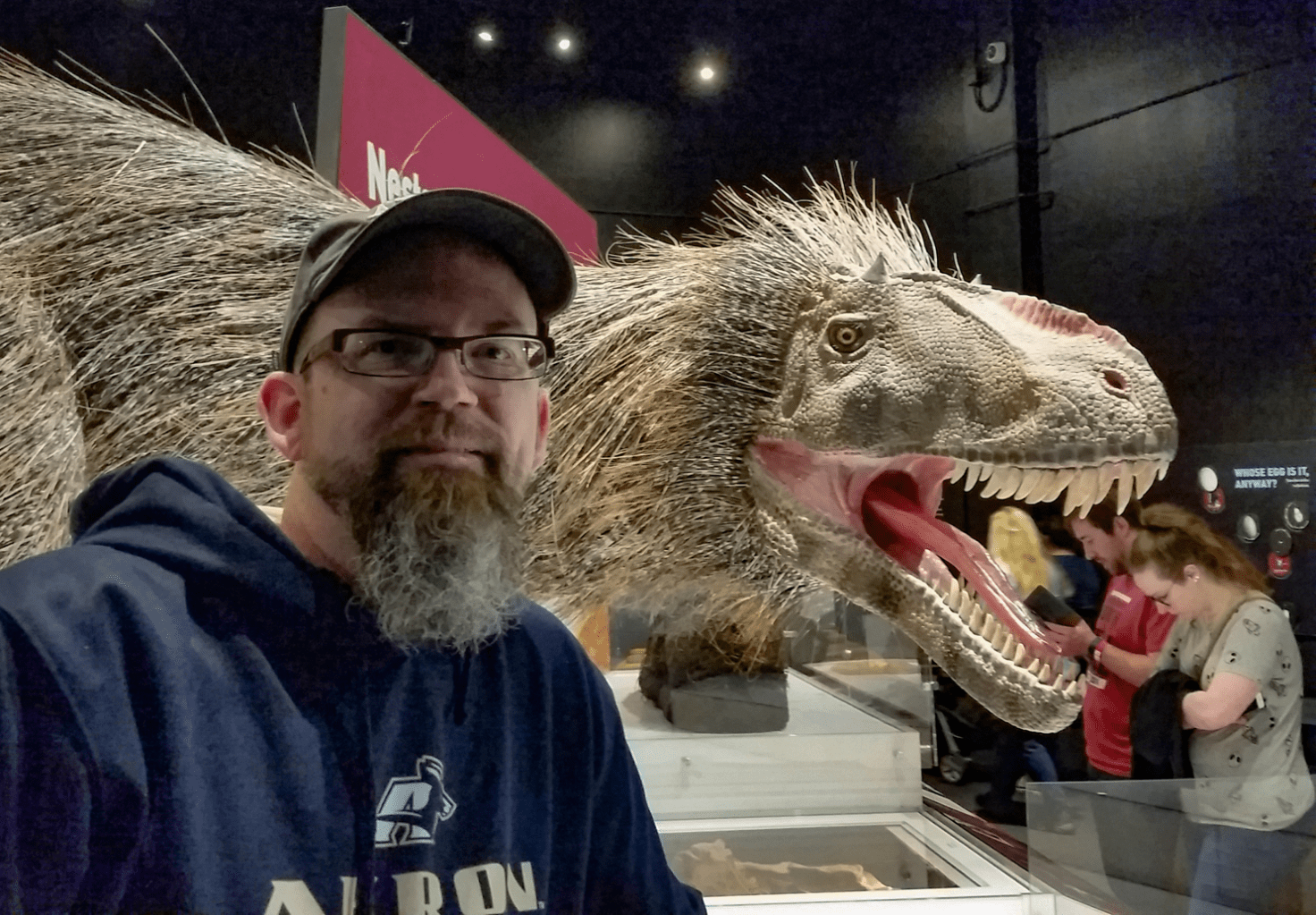
This is also where developmental biology comes into play, because it turns the fossils from a scattered collection into a predicted sequence. In the late 1990s Richard Prum proposed, from the way feathers actually grow out of their follicles, that feathers should have evolved through a series of stages: first a simple hollow tube, then a tuft of unbranched filaments, then a plane of barbs without hooks, and only later the closed, hooked vane of a true flight feather. Prum and Alan Brush laid this out in detail in The Quarterly Review of Biology in 2002.
The striking result is that the fossil record has since produced feathers matching each predicted stage, on the bodies of non-avian dinosaurs, in roughly the order the developmental model requires. The 2016 amber tail fits here too. Its feathers show an open, barb-dominated architecture with a poorly developed central shaft, an intermediate grade, and the branching pattern led the authors to infer that barbules appeared before a strong rachis, again matching the developmental prediction.
The lung that supposedly could not evolve
The respiratory argument is the most technical part of the Creation magazine article, it is also where the cited evidence points most clearly in the opposite direction from the conclusion drawn.
The avian lung is unusual. Instead of inflating and deflating like a bellows, as ours does, it is a rigid structure through which air is driven in a single direction by a set of air sacs acting as pumps, with fresh air passing through fine tubes called parabronchi where gas exchange occurs. Tay and Sarfati describe this as a counter-current exchange system. Strictly, it is a cross-current system: the blood capillaries run at an angle across the direction of airflow rather than directly against it, an arrangement Peter Scheid and Johannes Piiper characterized decades ago. The distinction is small, but it matters for the larger claim, because the argument leans on the premise that this system is a single indivisible design that could not have been assembled in working stages.
Two lines of evidence undercut that premise, and the article gestures at both. The first is written directly into the bones of dinosaurs. In living birds, the air-sac system does not stay in the soft tissue. It invades the skeleton, hollowing out vertebrae and other bones and leaving diagnostic openings where the air sacs entered. This is called postcranial skeletal pneumaticity, and it is essentially a fossilizable fingerprint of the air-sac system.
In 2005 Patrick O’Connor and Leon Claessens reported in Nature that this same pattern of pneumatization, including evidence for abdominal and cervical air sacs, is present in non-avian theropods, in a specimen only distantly related to birds. The air-sac based, flow-through architecture was therefore already present deep within the dinosaurs, not invented at the origin of birds. This bears directly on the article’s argument that a mobile dinosaurian thigh rules out avian air sacs. The bones record the air sacs regardless of the thigh, which means the premise and the fossils are in conflict.
The second line of evidence is the one the CMI article raises and then, in effect, argues against itself. Tay and Sarfati note that some reptiles, including alligators, monitor lizards, and green iguanas, have now been shown to move air through parts of their lungs in one direction, without the full avian apparatus of air sacs and pneumatic bones. They present this as a problem for evolution. But, it is the reverse. When Colleen Farmer and Kent Sanders demonstrated unidirectional airflow in alligators in Science in 2010, the significance was stated plainly: because alligators and birds sit on opposite branches of the archosaur family tree, one-way airflow was most likely present in their common ancestor, back in the Triassic, long before birds or flight.
Later work extended the same finding to monitor lizards and to iguanas, pushing the trait deeper still. What these discoveries establish is precisely the graded series the article says is impossible. Functional one-way airflow exists in simple, bellows-like lungs, in heavy animals that never flew, with the fuller avian system representing a later elaboration of an old and workable design. The article’s own examples are the intermediate stages it claims cannot exist.
Moving the center of mass
The last structural argument concerns balance. A theropod carries its weight over its hips, counterbalanced by a long, muscular tail. A flying bird carries its weight forward, under the wings, with the tail reduced to a stub. Tay and Sarfati, quoting the ornithologist Alan Feduccia, argue that shifting the center of mass this far forward is biophysically impossible, and that natural selection would in any case preserve a heavy tail rather than whittle it away.
Here the fossils allow something better than argument by assertion. In 2013 Vivian Allen, Karl Bates, and John Hutchinson published a study in Nature that did the measurement. They built three-dimensional digital reconstructions of seventeen archosaurs spanning the line from early dinosaurs to modern birds, including Velociraptor and Archaeopteryx, and computed where the center of mass sat in each. The result was not a sudden jump but a gradual, stepwise forward migration of the center of mass along the sequence, driven by the progressive shortening of the tail and the enlargement of the forelimbs and chest, with the pace picking up among the closest bird relatives. The transition Tay and Sarfati call impossible has been reconstructed in quantitative detail, and it looks like a series of workable steps rather than a leap.
The tail reduction that drives this shift is itself a visible progression in the fossils, from the long bony tails of basal theropods, through the shortened tails of oviraptorosaurs and dromaeosaurids, to the fused terminal stub, the pygostyle, of later birds. That progression is worth keeping in mind for what follows, because the tail is one of the traits the article uses to sort specimens into the categories of bird and dinosaur.
The reclassification problem
Now let’s talk (ok, write about) classification. This is were the argument’s central difficulty comes into view. The Creation magazine article maintains that no true feathered dinosaurs exist. It maintains this while discussing Microraptor and Archaeopteryx, which it refers to as birds. This is the move on which the entire claim depends.
Microraptor is not, by the working definitions of paleontology, a bird. It is a dromaeosaurid, a member of the same group as Velociraptor, described by Xu Xing and colleagues in Nature in 2003. It has four feathered limbs bearing asymmetrical, aerodynamically shaped flight feathers, a sickle claw on its foot, and the open dinosaurian hip socket. If it is called a bird, then a dromaeosaur with flight feathers has just been admitted into the category of birds, which concedes the transition rather than refuting it. Archaeopteryx presents the same problem in sharper form. It has feathers and wings, but it also has teeth, a long bony tail, clawed grasping fingers, and belly ribs, a suite of reptilian and dinosaurian traits packaged together with avian ones. The article itself notes that Archaeopteryx lacked the derived shoulder pulley that modern birds use to raise the wing, and suggests it launched from branches instead. That is an admission, in passing, of a flying animal that lacked one of the features the article elsewhere treats as an indispensable part of the flight design. If the pulley were truly required for flight, Archaeopteryx could not have flown. Since the article grants that it flew, the pulley is not required, which is exactly what a stepwise origin of flight would predict.
This is the pattern. Each time a feathered animal turns up with a dinosaurian skeleton, it can be relabeled a bird, and each time a skeletal feature looks intermediate, it can be assigned to whichever side keeps the categories clean. The trouble is that a claim defended this way can never be tested, because it makes no prediction a specimen could violate. The demand for pennaceous feathers on a fully open acetabulum was answered years ago by Caudipteryx and Anchiornis. The response available to the argument is to move those animals across the line into birds. But a boundary that is redrawn every time the evidence crosses it is not a finding about nature. It is a definition being protected.
I’ll add here that not every creationist scientist argues this way. Some have acknowledged that the feathered-dinosaur record is genuinely mosaic and that animals like Archaeopteryx sit uncomfortably between the traditional categories, choosing to grant the observation rather than define it away and suggesting these are just a uniquely separate group from both. That is a more honest engagement with the fossils, and it is a useful contrast with a flat denial that the transitional forms exist at all.
The bird dinosaur connection is a convergence of evidence, not a single character
The reason the dinosaur origin of birds is not seriously in doubt among paleontologists is that it does not rest on any one of these lines of evidence. It rests on their convergence. The skeleton tells one story, through hundreds of shared derived traits from the wishbone to the folding wrist. The microscopic structure of bone tells another, in growth patterns shared between birds and their theropod relatives. Developmental biology tells a third, predicting a sequence of feather stages that the fossils then supplied. The living animals tell a fourth: birds and crocodilians, the two surviving branches of the archosaurs, share features such as one-way pulmonary airflow that are most simply explained as inheritance from a common ancestor. And the exceptional fossils, the compression slabs of Liaoning and the amber of Myanmar, supply the soft tissue that ties feathers directly to dinosaurian bodies.
A separate-origins account has to explain each of these independently, and then explain why they all happen to point the same direction. It has to treat the shared skeletal traits as coincidence, the pneumatic bones as unrelated to air sacs, the graded feather series as an accident of preservation, the shared reptile-and-bird airflow as convergence, and the mosaic animals as either birds or dinosaurs depending on which is convenient in the moment. Each patch might be arguable on its own. Holding all of them together, against evidence that keeps arriving from independent directions, is the harder task, and it grows harder with each field season.
The best version of the challenge, then, runs the other way. The mainstream account made a specific, risky prediction: that feathered animals with unmistakably dinosaurian skeletons should exist, that their feathers should range across a graded series from simple filaments to closed vanes, and that intermediate respiratory and locomotor anatomy should be recoverable from the bones. Every part of that prediction has been met, including in three-dimensional plumage sealed in amber around a tail that no bird ever had. The question left standing is not one for the paleontologists. It is one for an argument that can preserve the claim that feathered dinosaurs do not exist only by agreeing, each time one is found, to call it something else.
References
Allen, V., Bates, K. T., Li, Z., & Hutchinson, J. R. (2013). Linking the evolution of body shape and locomotor biomechanics in bird-line archosaurs. Nature, 497(7447), 104–107. https://doi.org/10.1038/nature12059
Cieri, R. L., Craven, B. A., Schachner, E. R., & Farmer, C. G. (2014). New insight into the evolution of the vertebrate respiratory system and the discovery of unidirectional airflow in iguana lungs. Proceedings of the National Academy of Sciences of the United States of America, 111(48), 17218–17223. https://doi.org/10.1073/pnas.1405088111
Farmer, C. G., & Sanders, K. (2010). Unidirectional airflow in the lungs of alligators. Science, 327(5963), 338–340. https://doi.org/10.1126/science.1180219
O’Connor, P. M., & Claessens, L. P. A. M. (2005). Basic avian pulmonary design and flow-through ventilation in non-avian theropod dinosaurs. Nature, 436(7048), 253–256. https://doi.org/10.1038/nature03716
Prum, R. O., & Brush, A. H. (2002). The evolutionary origin and diversification of feathers. The Quarterly Review of Biology, 77(3), 261–295. https://doi.org/10.1086/341993
Xing, L., McKellar, R. C., Xu, X., Li, G., Bai, M., Persons, W. S., IV, Miyashita, T., Benton, M. J., Zhang, J., Wolfe, A. P., Yi, Q., Tseng, K., Ran, H., & Currie, P. J. (2016). A feathered dinosaur tail with primitive plumage trapped in mid-Cretaceous amber. Current Biology, 26(24), 3352–3360. https://doi.org/10.1016/j.cub.2016.10.008
Xu, X., Wang, K., Zhang, K., Ma, Q., Xing, L., Sullivan, C., Hu, D., Cheng, S., & Wang, S. (2012). A gigantic feathered dinosaur from the Lower Cretaceous of China. Nature, 484(7392), 92–95. https://doi.org/10.1038/nature10906
Xu, X., Zhou, Z., Wang, X., Kuang, X., Zhang, F., & Du, X. (2003). Four-winged dinosaurs from China. Nature, 421(6921), 335–340. https://doi.org/10.1038/nature01342
YEC Source that I am responding to:
Tay, J., & Sarfati, J. (2026, July 1). Did dinosaurs evolve into birds? Creation, 47(2). Creation Ministries International. Extracted and edited from Titans of the Earth, Sea, and Air, chapter 17. https://creation.com/en/articles/dinosaurs-evolve-into-birds
 Naturalis Historia
Many of the article writer’s claims are based on a big assumption; that one kind of animal evolved into a different kind of animal, even though this cannot be demonstrated in a laboratory or seen in nature 🤔 Another big assumption that the author seems to ignore is that certain animals came before or after the other, even though this is based on evolutionary bias rather than factual data. Assumption is not science, it is wishful thinking. All animals and organisms demonstrate stasis in our present world, not macro evolutionary changes, yet it is assumed by evolution proponents that macro changes have occurred, and is even stated as scientifically observable, though these major changes in animals have never been seen.
LikeLike
Evolution of one lifeform into another is not an assumption, it is a conclusion based on multiple independent lines of evidence. True, it cannot be viewed directly in nature or a laboratory due to the timescale. The earth orbiting the sun has never been directly witnessed. It is a conclusion reached long ago by inference and backed up over time by many more indirect confirmations. All historical science is indirect. The sequence of animals are not assumptions either, they too are conclusions, based on independent lines of evidence. A helpful article written by conservative, Christian geologists that walks through some of those converging lines of evidence can be found here: https://www.modernreformation.org/resources/articles/pca-geologists-on-the-antiquity-of-the-earth
LikeLike
It would be nice to have Bob Morales address the basic fact that Joel writes about in this post: the amber capture of a tail that doesn’t belong to a bird yet has feathers on it.
LikeLike