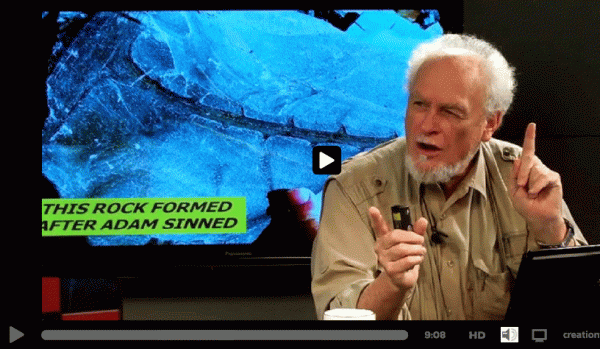
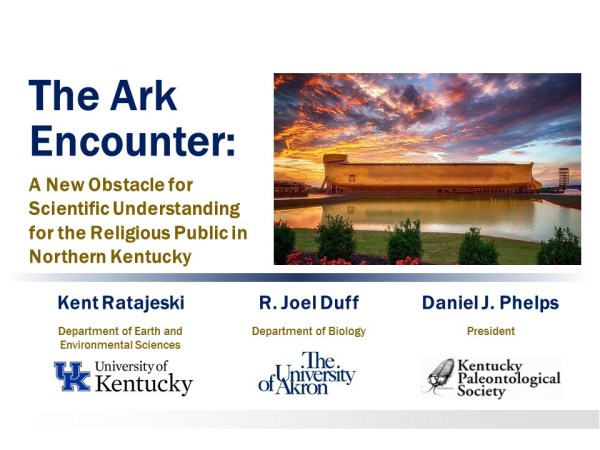
Take a tour of the Ark Encounter with a geologist, paleontologist and myself in this YouTube presentation.  In July I visited the Ark Encounter with geologist Dr. Kent Ratajeski from The University of Kentucky.  After that trip Kent, myself and Dan Phelps (President of the Kentucky Paleontological Society) worked together - my contribution was rather... Continue Reading →
Perceiving Age: Student’s Interpretations of the History of Craters on Mars
Our perceptions of the age of a subject are frequently based on our common experience with similar subjects. Most people have some ability to guess the age of children with seemingly very little prior information.  We might call this ability to guess age our intuition but this "intuition" is the scientific method working automatically in our minds.  Our... Continue Reading →
NH Notes: Todd Wood on Creationism and the Origin of Species
If you have followed my blog for the past six months you know that I have been discussing the feasibility of the young-earth creationist’ (YEC) rapid-speciation model which proposes that hundreds of thousands of species of plants and animals have been formed by natural selection in just the past couple thousand years (YEC Hyper-evolution article archive).  More... Continue Reading →
The Origin of the YEC Hyper-Speciation Model of Biological Diversity
Young earth creationists (YECs) are the most vocal skeptics of evolutionary theory, however, they recognize organisms do change over time. But how much? Everyone agrees that organisms have the capacity to adapt to their environments. This adaptive ability can lead to the formation of isolated genetic lineages we identify as species.  Evolutionary theory posits that continued... Continue Reading →
A Vivid Demonstration of Bacteria Adapting to Antibiotics via Mutations and Selection
The fact that bacteria are able to develop resistance to antibiotics has been a textbook example of evolutionary processes in action. Mutations and natural selection—two primary agents of change—work together to sculpt new genetic combinations allowing individuals to exploit resources unavailable to bacteria previously unable to resist antibiotic chemicals in their environment. Now you can watch a powerful... Continue Reading →
My Trip to the Ark Encounter: Some Pictures and Reflections
Just 10 days after the grand opening of the Ark Encounter on July 7th, I traveled down to Kentucky to pay a visit to Ken Ham's latest evangelistic outreach endeavor. It was a Friday and I arrived less than one hour after opening and spent the better part of six hours on the Ark Encounter premises.  ... Continue Reading →
Ark Encounter Common Ancestors: The Increasing Inclusiveness of Biblical Kinds
Just how many animals where on Noah's Ark according to 6-day creationists?  That answer has varied considerably over the past century.  With the completion of the Ark Encounter, the most visible attempt to show the feasibility of  preserving all land animal diversity from a global flood, more people are being exposed to a modern answer to... Continue Reading →
A 60,000 Year Varve Record from Japan Refutes the Young-Earth Interpretation of Earth’s History
Do places on Earth exist where annual records have been stored for tens of thousands of years and can be accessed today? Ice-cores and tree rings can preserve long records of yearly events but some of the best records come from layers of sediment underlying some lakes which,  if formed under the right conditions, can be read like the annual rings of... Continue Reading →
A Creation Museum Speaker Asks: Do Animals Evolve?
What does it mean to evolve? What is natural selection? Where did the genetic variation come from that allows evolution to happen? Why are there so many species of animals today?  What can mutations do? These are some of the questions that Answers in Genesis speaker Bryan Osborne addressed at public talks given at the young-earth... Continue Reading →
The Ark Encounter: Depicting a Real Flood with Unrealistic Images
Guests at the Ark Encounter will observe many descriptions and artistic impressions of what happened before, during and just after Noah's Flood.  One set of images was especially interesting to me because it visualized different stages of the Flood.  One panel which explains how the Flood waters prevailed over the highest mountains was particularly perplexing because of... Continue Reading →
The Young-Earth Hyper-evolution Hypothesis: A Collection of Critiques
Ken Ham’s Ark Encounter presents it visitors with exhibits with odd-looking creatures and explains that just 4350 years ago these were the common ancestors of  animal species we know today.  How and when did this transformation of "kinds" into thousands of species happen? At present, the consensus among young-earth creationists is that Noah's Ark contained far... Continue Reading →
Ken Ham’s Ark Encounter Opens to a Flood of Press but Fewer Visitors than Anticipated
Ken Ham posts a picture and comment almost daily on Twitter about the thousands or of visitors that are flocking to the Ark Encounter and Creation Museum each day. I would expect nothing less from any leader responsible for the success of a 100 million dollar theme park.  The very existence of the Ark Encounter owes... Continue Reading →
Blocked from Facebook – ICR Removes Another Form of Peer-Review
I am now blocked from commenting on the Facebook page of the Institute of Creation Research (ICR).  This was no surprise to me, nonetheless I felt rather sad that they felt they had to cut me off.  Below is a screenshot of the ICR meme on which I had made what I thought was a substantive comment.  About 20... Continue Reading →
Stalagmite Structures in an Ancient Cave Contradict the Young-Earth Narrative
The pace of discovery of ancient human activities continues unabated. That alone should tell us that that there is much yet to discover and learn. The latest revelation come from deep—more than 1000 feet—inside a French cave.  In the blackness of a large opening there are peculiar "structures" constructed from fragments of stalagmites. Found many... Continue Reading →