A data-driven look at claims of stolen elections in 2020 and 2024, and a question I have for the politicians who keep repeating them.
I believe in checking sources. It is the habit that shapes almost everything I write, whether I am evaluating a young-earth creationist claim about the fossil record or a politician’s claim about the ballot box. So when Speaker Mike Johnson stands in front of a microphone and talks about “election integrity,” or when he and dozens of his colleagues sign a legal brief asserting that the 2020 election was riddled with “unconstitutional irregularities,” I want to see the data behind it. Not a feeling. Not an anecdote. Not an appeal to what people “intuitively” or “instinctively” believe. Instincts can be wrong and how might we determine if our instinct is wrong – look at the data!
I’ve been looking for that data for years. I have a huge folder of reports published by various state and congressional committees along with other investigations. I’ve combined that with a new search of all the legal cases of fraud that have been brought since the year 2000. These include the most rigorous, most-cited research on U.S. election fraud since 2000 such as academic publications, journalism databases, government audits, and the compilations kept by fraud-hunting advocacy groups themselves, including the Heritage Foundation’s own Election Fraud Database. What I found was not what Mike Johnson, Donald Trump, or a long line of other officials have been telling the American public for the better part of a decade.
Yes, fraud happens. It is not zero. But it is not as prevalent we are told on a daily basis
I never doubted that fraud happens. But I wondered how much fraud, and what the nature of that fraud might be. No doubt, election fraud is real. It happens every cycle, somewhere, at some scale. No serious person disputes that. The question that actually matters is not “does fraud exist” but how much, what kind, and whether it has ever been enough to change an outcome.
Here is the scale, as best the public record can establish it. The Heritage Foundation — a conservative think tank whose entire database exists to document fraud — lists roughly 1,465 to 1,500 “proven instances” of fraud going back to 1979. Heritage itself describes this as a “sampling,” not a comprehensive count through few other “proven” case have been found by others. News21, an investigative journalism project at Arizona State University, found 2,068 alleged cases of election fraud nationwide from 2000 to 2012 of which about 46 percent of those were dismissed, acquitted, or never charged, mostly because they turned out to be clerical errors rather than crimes. The Justice Department’s own aggressive fraud-hunting initiative from 2002 to 2007 produced about 120 charges and 86 convictions across five years, nationwide.
Now put that against the denominator. Well over a billion ballots have been cast in the United States since 2000. Depending on which serious study you use, documented fraud incidents land somewhere between roughly 0.0001 percent and 0.02 percent of votes cast, and that is before you even get to the sliver of that sliver that could plausibly have changed an outcome. In-person impersonation which is the one kind of fraud that voter-ID laws actually target, is the rarest of all. Justin Levitt’s exhaustive academic review found 31 credible incidents nationwide from 2000 through 2014, out of a billion ballots cast. News21 found 10.
When the Associated Press sent ten reporters to examine every disputed battleground state after the 2020 election — Arizona, Georgia, Michigan, Nevada, Pennsylvania, and Wisconsin. They found fewer than 475 possible cases of fraud out of more than 25 million votes cast in those states. Joe Biden’s combined margin in those states was 311,257 votes. Four hundred seventy-five cases is 0.15 percent of that margin. It would not have moved a single outcome, in any state, at any level.
The kind of fraud that actually happens does not fit the narrative
If you listen to the political rhetoric, you would picture organized rings of Democratic operatives stuffing drop boxes or bribing non-citizens to swing the presidency. That is almost never what the documented cases look like. The highest-risk mechanism in the real record is absentee and mail-ballot handling — not because it is rampant, but because it is the category where actual manipulation, when it occurs, is most often organized rather than individual. And even there, the numbers are small and the culprits are bipartisan.
Consider the two most consequential documented cases in the last quarter-century. The only fraud scheme that has ever overturned a federal election since 2000 was North Carolina’s 9th Congressional District in 2018 — an absentee-ballot harvesting operation run by a Republican operative, McCrae Dowless, working for the Republican candidate. The state board refused to certify the race and ordered a new election. And in Pennsylvania in 2020, one of the more publicized individual fraud convictions involved Bruce Bartman, a registered Republican, who forged and cast his deceased mother-in-law’s ballot for Donald Trump. These are not isolated details. They point to something the data show again and again: when individual fraud is documented, it correlates with local political motivation and individual desperation, not a party-wide conspiracy. Furthermore, where a clear partisan direction can be established at all, some of the more prominent 2020 cases actually padded Trump’s totals, not Biden’s.
Non-citizen voting: the claim that will not die
This is the claim I most often hear from Speaker Johnson, and it is worth walking through carefully because the evidence trail is so consistent. After the 2016 election, Donald Trump claimed that 3 to 5 million non-citizens had voted illegally, costing him the popular vote. He created a Presidential Advisory Commission on Election Integrity to prove it. The commission collected no such evidence, faced lawsuits over its own transparency, and was quietly disbanded in January 2018. One of its own members, Maine’s Secretary of State Matt Dunlap, said the fraud section of the draft findings was “glaringly empty.”
The Brennan Center’s landmark 2016 survey of 42 jurisdictions covering 23.5 million votes found about 30 suspected, but not confirmed, incidents of non-citizen voting: 0.0001 percent. Ahead of the 2024 election, when non-citizen voting again became the centerpiece of Republican messaging, state after state ran the numbers and came back with the same story. Georgia found 20 non-citizens out of 8.2 million registered voters. Utah reviewed roughly 2.1 million voters and confirmed exactly one non-citizen on the roles and who had never actually voted. Texas opened 33 investigations. Wisconsin clerks referred 46 incidents. Every one of these was local, isolated, and non-systemic. Most had nothing to do with wanting to manipulate votes for president but involved desires to effect other state or local elections or simply didn’t understand voting rules.
And here is the part that should embarrass anyone still repeating the claim (which is now clearly established as a lie): in May 2024, Speaker Johnson unveiled a federal bill to bar non-citizens from voting (something already illegal under a 1996 federal law) and was asked directly by reporters for the evidence behind it. His answer: “We all know, intuitively, that a lot of illegals are voting in federal elections. But it’s not been something that is easily provable. We don’t have that number.” That is not a data-driven policy position. That is an admission, in his own words, that the number does not exist. And where does that “intuition” that people have come from? It comes from repeating a lie so many times that many will think it is true and then that “truth” can be used to justify changes to the system that are not being made to sold any particular problem.
Mike Johnson’s own record on this is worse than “no evidence”
Before he was Speaker, Mike Johnson was one of the most active behind-the-scenes participants in trying to overturn the 2020 result. In November 2020, he told a Louisiana radio station that claims about Dominion Voting Systems using software “from Hugo Chávez’s Venezuela” had “a lot of merit,” and separately said Georgia’s election system was “set up for massive fraud.” Both claims were false. Dominion and Smartmatic later sued major outlets and figures over exactly this conspiracy theory; Fox News alone paid more than $787 million to settle its Dominion suit rather than defend the claim in court. Johnson went on to recruit 125 House Republicans to sign an amicus brief asking the Supreme Court to invalidate the results of four states Trump lost. The Court rejected that request outright. Hours after the January 6th attack on the Capitol was cleared, Johnson voted to reject electors from two of those states anyway.
This is the man now telling the country that election integrity is at risk, without ever pointing to a report, an audit, or a case count that supports it. That is not a partisan observation. It is simply what the public record shows him saying and doing.
The most damning evidence is what Republican-run investigations found — and didn’t find
This is the point I think deserves the most attention, because it flips the usual framing. If systemic fraud were real, the people with every institutional and political incentive to find it — Republican officials, Republican-funded audits, Republican state investigators — would have found it. Instead here are just a few examples of investigations that have looked for fraud:
Arizona’s 2021 “Cyber Ninjas” audit of Maricopa County was commissioned by Republican state senators and paid for in part by pro-Trump donors, at a cost of roughly $5.7 million. It did not find fraud. It found that Biden’s margin was actually 360 votes larger than the certified count. Wisconsin’s nonpartisan Legislative Audit Bureau, ordered by the Republican-controlled legislature, likewise found no evidence of widespread fraud. Georgia performed a full statewide hand recount of five million ballots plus a separate machine recount, both of which affirmed Joe Biden’s win.
And then there is Florida. Governor Ron DeSantis built an entire new state agency (the Office of Election Crimes and Security) specifically to root out voter fraud, funded it with millions of taxpayer dollars, and staffed it with investigators whose sole job was to find cases. After its first year of dedicated hunting, the office’s headline achievement was charging 20 people, almost all of them felons who had been mailed voter-registration cards by the state itself and said, credibly, that they did not know they were ineligible. Several of those cases were later thrown out on jurisdictional grounds. This is what a governor’s own dedicated fraud-hunting police force found in a state where roughly 11 million people voted in 2020: not a conspiracy, but a small number of confused, disqualified felons — and even that modest total drew criticism for how thin and procedurally shaky the cases were.
For me, this is the tell. If Mike Johnson, Donald Trump, or any of the officials who talk about “millions” of stolen votes actually had a report — a real one, from a real investigation, showing real numbers — they would be citing it constantly. Politicians do not sit on good evidence. They hand it out like candy, they put it on television, they read it into the Congressional Record. The fact that none of them ever cites the Arizona audit, the Wisconsin audit, or DeSantis’s own election-crimes office is not an oversight. It is because those investigations, which were run by their own party, funded with their own money, designed to find exactly what they were hoping to find, came back empty.
What accountability should actually look like
I am not asking anyone to take my word, or Mike Johnson’s word, or Donald Trump’s word, for any of this. I am asking for the same thing I ask of any claim: show the work. If a politician says thousands of fraudulent votes changed an election, that claim needs be backed up with evidence that can be shown to you. Either the convictions exist and can be named, or they don’t and can’t. So far, every serious attempt to find that evidence, including the ones led by Republicans, funded by Republicans, and designed to vindicate Republican suspicions, has come back with the same finding: fraud is real, rare, individual, and nowhere near large enough to change a single presidential outcome since 2000.
That leaves a simple, uncomfortable question for Speaker Johnson and others who keep repeating the “millions of votes” line: if the evidence doesn’t exist, why do you keep saying it does? I don’t think that question is unfair, partisan, or unanswerable. I think it is the only question that matters, and I think we are entitled to an answer — or, at minimum, to stop being told a story that the data, including the Republican Party’s own data, does not support.
Disagree? I ask you to show me the fraud and make your case that it was strongly skewed in one direction and mathematically could have changed past election results.
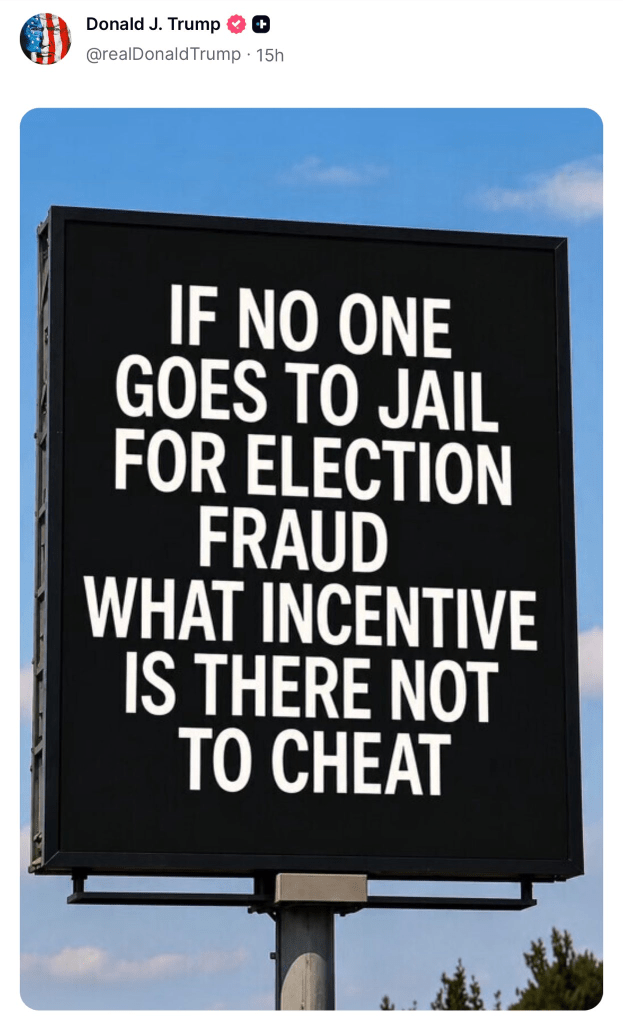
Addendum: Just hours after posting this article Trump posted this image. The fact is that election fraud has resulted in real jail time which is a big discouragement to committing this crime. The fact that there aren’t many people doing time for election fraud isn’t the lack of punishment being dolled out, its the fact that there isn’t much electron fraud to punish. What would help is if he stopped pardoning people guilty of voter fraud.
Overall scale of documented fraud (Heritage, News21, DOJ figures)
• Electoral fraud in the United States — Wikipedia — Heritage Foundation database totals, News21 2,068-case figure, general scale discussion (cited repeatedly across all three reports)
• Comprehensive Database of US Voter Fraud Uncovers No Evidence That Photo ID Is Needed — News21 / Who Can Vote? — Source of the 2,068 alleged-case count, 2000–2012, and the ~46% dismissal/acquittal rate
• ANALYSIS: Heritage Fraud Database — Brennan Center for Justice — Independent breakdown of what the Heritage database actually contains (used to support the point that only ~10 cases involve in-person impersonation)
• Voter Fraud — The Heritage Foundation — Heritage’s own explanation of its database and “sampling” methodology
• Carter-Baker Commission (2005), Building Confidence in U.S. Elections — Named source in the Fable5 report; bipartisan commission quote: “There is no evidence of extensive fraud in U.S. elections…”
• DOJ Ballot Access & Voting Integrity Initiative (2002–2007) — Named source in the Fable5 report for the ~120 charged / 86 convicted federal figure, 2002–2007
In-person voter impersonation is nearly nonexistent
• Justin Levitt — Wikipedia — Source for the 31-credible-incidents (2000–2014) finding, originally published in The Washington Post, Aug. 6, 2014
• Review of States with Voter ID Laws Found No Impersonation Fraud — San Antonio Report
• Voter impersonation — Ballotpedia
• DEBUNKING IN-PERSON VOTER FRAUD (Feb. 2017) — Project Vote
The 2020 AP six-state review (fewer than 475 cases)
• Exhaustive fact check finds little evidence of voter fraud, but 2020’s ‘Big Lie’ lives on — PBS News — Discusses the AP’s original six-state investigation (fewer than 475 cases out of 25.5 million votes, against a 311,257-vote Biden margin); verified directly since the reports cite this AP figure without a live link
• Attorney General William Barr statement (Dec. 1, 2020, AP interview) — Cited in the Fable5 report: “we have not seen fraud on a scale that could have effected a different outcome”
How fraud actually happens: NC-09 (2018) and the Bruce Bartman case
• 2019 North Carolina’s 9th congressional district special election — Wikipedia — Republican operative McCrae Dowless’s absentee-ballot scheme for GOP candidate Mark Harris; the only federal election overturned by fraud since 2000
• Bruce Bartman — Election Fraud Map, The Heritage Foundation — Heritage’s own case file on the Pennsylvania Republican who cast his deceased mother-in-law’s ballot for Trump
• Pennsylvania man sentenced to 5-year probation after voting in name of dead mother — WRAL
Non-citizen voting claims (2016, 2020, and 2024)
• Presidential Advisory Commission on Election Integrity — Wikipedia — Formation and disbanding of Trump’s 2017 commission after finding no evidence of the “3–5 million illegal votes” claim
• Dunlap v. PACEI: Investigating the Voter Fraud Commission — American Oversight — Underlying litigation and documents behind commissioner Matt Dunlap’s “glaringly empty” quote
• Election commission documents cast doubt on Trump’s claims of voter fraud — CT Mirror
• Federal policy on voting issues, 2017–2018 — Ballotpedia
• Noncitizen voters a rarity in US elections, state and private reviews show — Reuters — Source for the 2024 state-by-state figures: Georgia (20 of 8.2M), Utah (1 confirmed, never voted), Texas (33 investigations), Wisconsin (46 referrals)
• Georgia citizenship audit finds few noncitizens on voter rolls — AP News
• Debunking the Voter Fraud Myth — Brennan Center for Justice — Source (via the reports) for the ~30-incidents-out-of-23.5-million-votes 2016 non-citizen figure
The Republican-led investigations that found nothing
• 2021 Maricopa County presidential ballot audit — Wikipedia — The GOP-commissioned “Cyber Ninjas” audit; confirmed Biden’s certified margin was actually 360 votes larger, no fraud found
• Nonpartisan Wisconsin audit finds 2020 election “largely safe and secure” — Axios — Republican-legislature-ordered Legislative Audit Bureau review
• When Audits and Recounts Distract from Election Integrity: The 2020 U.S. Presidential Election in Georgia — arXiv — Georgia’s full hand recount of ~5 million ballots plus machine recount
• Department of Homeland Security/CISA calls election “the most secure in American history” — Axios — Joint CISA/election-official statement, Nov. 2020
Other information relevant to this article
• How Speaker Johnson helped Trump’s attempts to overturn the 2020 election — CNN Politics — Source for Johnson’s Dominion/”Hugo Chávez’s Venezuela” radio quote, the “set up for massive fraud” Georgia quote, the amicus brief backing the four-state lawsuit, and his Jan. 6 vote
• Johnson’s ‘intuition’ clashes with data on illegal voting — Rep. Nanette Barragán — Source for Johnson’s May 2024 “We all know, intuitively…” quote on the SAVE Act
• Speaker Johnson’s ‘intuition’ on illegal voting clashes with data — The Hill — Same quote, original reporting
• 20 were charged for voter fraud in Florida. Advocates say a broken system is to blame — NPR — Details on DeSantis’s Office of Election Crimes and Security and its first 20 arrests
• Gov. Ron DeSantis’ Voter Fraud Office Nets 2 More Arrests — The Daily Signal — Confirms the office’s own report: 1,094 alleged unlawful 2020 votes and 70 for 2022, out of roughly 11 million Florida votes cast in 2020
• DeSantis Still Can’t Find Enough Employees for His Voter Fraud Crackdown — The Intercept — Reports several cases dismissed on jurisdictional grounds and staffing struggles at the office


Thank you for posting this.
LikeLike
Thank you for posting this.
LikeLike
Trump was recently directly asked for evidence. He huffed and stomped off, Ken Ham would have better grace than that. Ken pretends to work with facts and truth, Trump doesn’t really bother. Sorry you had to bother to try debunking what is obviously nonsense, worse that creationists.
LikeLike
It is probably no coincidence that Speaker Johnson is a Ken Ham brand of creationist, so has gobs of faulty baggage in his head he lacks the skill to fact check or jettison.One Bad Method To Rule Them All
LikeLike