I recently watched a video from the Institute for Creation Research with the title “PhD Geologist: These Rock Layers CONFIRM the Bible in a Remarkable Way,” in which host Brian Thomas of ICR interviews the geologist Dr. Christopher Rupe about a single, famous formation. The rock in question is the Navajo Sandstone, that great sweep of honey-colored, cross-bedded stone that visitors photograph at sunrise in Zion National Park. It is roughly two thousand feet thick at its western margin and, counting its lateral equivalents, covering on the order of 800,000 square miles of the American Southwest. It is one of the largest fossil dune fields ever identified on Earth.
Mainstream geologists read the Navajo as a petrified desert, an ancient sand sea turned to stone. For creationist’ flood geology that reading is a genuine problem, and Rupe states the problem clearly: the formation sits between layers that the flood model already interprets as water-deposited. A desert wedged into the middle of a single year-long flood does not make sense. His proposed solution is to deny that it was a desert at all. The Navajo, on his account, was built underwater by rising floodwaters, and laboratory flume experiments, which is work he pursued at Loma Linda University with Monty Fleming, are offered as proof of concept.
At one point in the interview the question is put as plainly as it can be: can you have a desert in the middle of a global flood? The answer given is no. He is exactly right and that turns out to be a serious problem for flood every flood geology hypothesis.
What the Flood Model Gets Right
Before following the argument to its conclusions, let’s see where Rupe is on solid ground. Cross-bedding, by itself, is not diagnostic of wind. Water builds cross-beds too — in ripples, in subaqueous dunes, in the foresets of deltas. The flat truncation planes that separate stacked cross-bed sets, which he calls bounding surfaces, are real features that demand a real explanation. Flume experiments going back to Jopling in 1965 do produce stacked, cross-bedded sets at small scale, and Fleming has refined that apparatus considerably. And there genuinely were debates in the early twentieth century about whether certain sandstones were marine or windblown. None of this is invented by Rupe, and so I need to grant those realities.
Anyone who gestures at the cross-bedding and announces “desert, case closed” is overstating the evidence. The cross-beds alone settle nothing. The eolian interpretation does not rest on them; it rests on a much larger and far more specific body of evidence that the cross-beds merely introduce. That distinction matters, because the whole flood-geology case here depends on collapsing the desert interpretation down to the one feature that really is ambiguous, and then disputing that feature.
How Geologists Actually Read a Dune
Wind and water both move sand, but they do not lay it down the same way, and a century of careful observation has worked out how to tell the difference. The classic reference is Ralph Hunter’s 1977 study of stratification in small eolian dunes, which distinguished three types of lamination that coexist in windblown dunes. Grainfall lamination forms as sand carried over the dune crest settles out of the air in the sheltered lee. Grainflow lamination forms when the lee face steepens past the angle of repose (roughly thirty to thirty-four degrees for dry sand) and avalanches down in tongues. And climbing translatent (add that term to your geological vocabulary!) strata form as wind ripples migrate up the depositional surface. Those three signatures, in their particular geometry, are the fingerprint of air. Subaqueous (below water) bedforms do not reproduce them; grainflow avalanching at the dry angle of repose and climbing wind-ripple lamination are products of wind, not current.
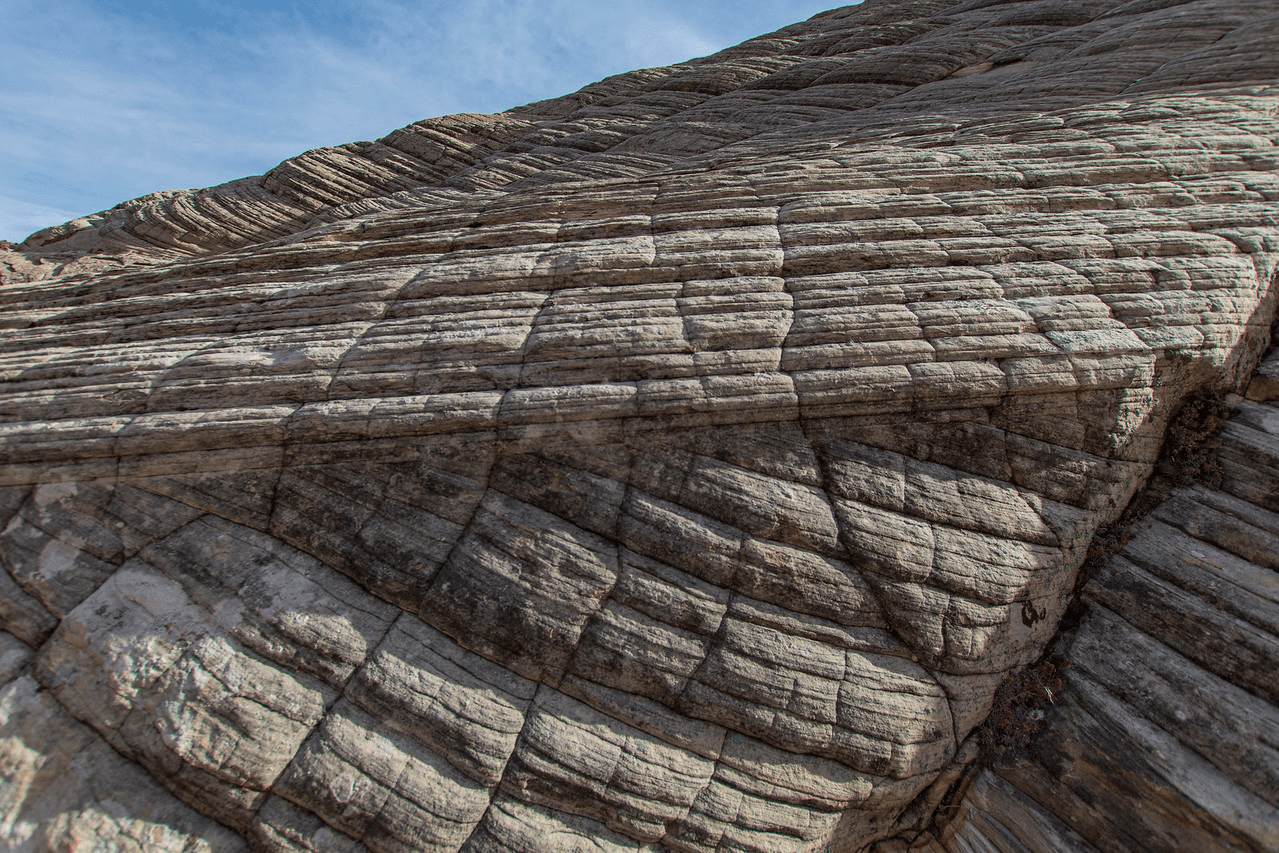
The geometry agrees. Dry sand stands at about thirty-four degrees, and the steep Navajo foresets approach that figure, whereas subaqueous sand waves build at gentler angles. So does the sediment itself: the Navajo is made of well-sorted, well-rounded, frosted fine sand, the texture of grains worked by wind across long distances, not the poorly sorted mixture a turbulent flood would dump and bury. These are not interpretive flourishes. They are measurements, and they point one direction but there is more to talk about first.
The Bounding Surfaces Have a Name
Rupe is right that the flat surfaces separating the cross-bed sets need explaining, and the explanation has been in the literature for decades. William Lee Stokes described them in 1968 as deflation surfaces. These are places where wind scoured the dune field down to the level of the water table and then resumed building. Brookfield, in 1977, worked out the full hierarchy of such bounding surfaces in ancient dune fields. In Rupe’s model these same surfaces are instead lime-mud drapes, settled out during calm intervals in a rising flood. That is a testable proposal, and it fails the test, because the interbeds in the Navajo are not marine lime mud at all. They are interdune deposits — and what they contain is central to the whole question before us.
What Lived in the Spaces Between the Dunes
The low areas between migrating dunes preserve the remains of a living, terrestrial landscape. Parrish and Falcon-Lang documented conifer trees rooted in place in Navajo interdune settings. Reptile and early dinosaur trackways climb the dune faces — the sauropodomorph trace Navahopus among them — recorded by Milan, Loope, and Bromley. There are insect burrows. There are even fish, which lived in interdune ponds long enough to require standing fresh water for more than a single year, and giant stromatolites built by microbial communities in those same wet hollows. Marine lime mud does not grow conifers. And floodwater a hundred meters deep and racing at two meters per second does not pause to let a small reptile walk up a dune slope and leave a footprint that survives instead of being scoured away.
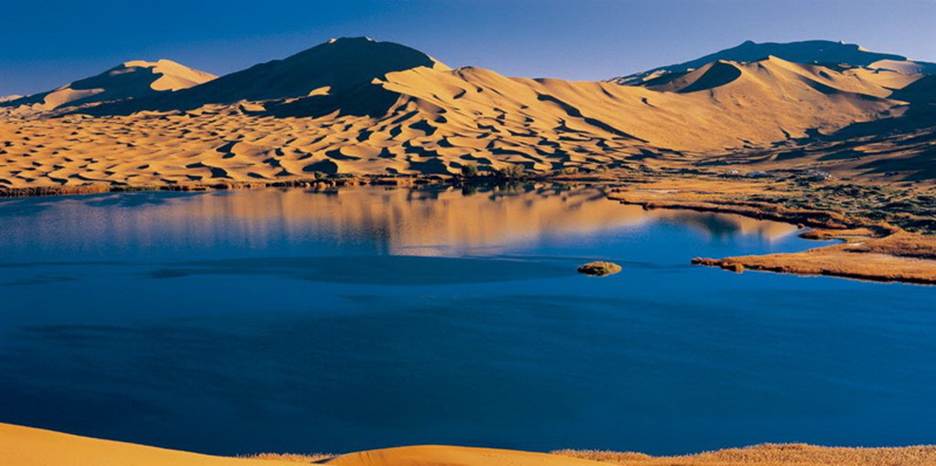
A lake among large sand dunes. Deposition of sediments and remains of organic material in the lake will differ from that of the surrounding sand dunes. Copyright: © Badain Jaran Nature Reserve (China) CC By 3.0
Following the Model to Its Consequences
If the Navajo accumulated underwater during a single flood year, then certain things should follow. Let us take the premises seriously and see where they lead.
Consider first the matter of time. In a 2001 paper in Nature, Loope and colleagues identified twenty-four slump masses recording annual monsoon rains within an interval representing roughly thirty-six years of dune migration — direct physical evidence of yearly rainfall periodicity preserved in the sand. In follow-up work, Loope and Rowe estimated wet “pluvial” episodes lasting on the order of four to five thousand years. If the formation was laid down in twelve months, then it cannot contain dozens of stacked annual rainfall cycles, and it certainly cannot contain episodes of seasonal greening that ran for millennia. Yet that is precisely what the sandstone records. The arithmetic simply will not reduce to a single year.
Consider next the trackways, which create a trap the model cannot escape. To build dunes of Navajo scale underwater, the flood model needs deep, fast water — sustained flows well above two meters per second in water tens to a hundred meters deep. Even on the most conservative figures, those are conditions in which a small reptile could not so much as touch the bed, let alone leave a footprint that would then be preserved rather than instantly erased. The very water energetic enough to build the dunes would destroy the tracks the rock demonstrably contains. The model is at war with the evidence it was built to explain.
Consider, too, that the Navajo is not a lone anomaly to be dispatched with a single flume run. The Colorado Plateau stacks eolian sandstone upon eolian sandstone — Cedar Mesa, De Chelly, Wingate, Navajo, Entrada, Page — interleaved with marine and river deposits. Beyond North America, fossil dune fields span continents and ages, from the Botucatu Sandstone of South America to the Permian dune sandstones of Britain. Each carries the same windblown fingerprints. The flood model therefore does not face one petrified desert; it faces dozens, scattered through the rock column and around the globe, every one of which must be independently dissolved into water, and every one of which sits, inconveniently, between water-laid layers.
And that returns us to the concession. A desert cannot exist in the middle of a year-long global flood; on this the interview and I agree. So the windblown unit must be reinterpreted as underwater. But notice what the reinterpretation costs. The entire flood reading of the rock stack depends on its being one continuous water event. If that is so, why does the Navajo look categorically different from the flat-lying, water-laid units directly above and below it — different bedding geometry, different sorting, different fossils, different structures? A single uninterrupted flood gives no reason for the water to lay down flat sheets, then switch to building giant high-angle cross-bedded dunes complete with climbing reptile tracks and rooted trees, then switch back to flat sheets, all within one year. The abrupt change in depositional character is itself the signal. It is a record of changing environments across time, which is exactly what the desert-between-wetter-chapters interpretation predicts and exactly what one flood cannot accommodate. You may have a desert, or you may have a single flood year. You cannot have both, and the rock plainly shows the desert.
Two supporting claims from the interview deserve a direct answer. The first is scale. The laminae in Jopling’s laboratory deltas are measured in centimeters; the cross-bed sets in the Navajo are measured in tens of meters. Reproducing a feature in a tank does not show that the same process built a structure thousands of times larger, and a lab delta does not generate grainflow avalanching at the dry angle of repose or climbing wind-ripple lamination in the first place. The second is the assertion that we never see dunes accumulate and lithify today. That is not correct. Sand seas in subsiding basins do accumulate — McKee’s global survey of sand seas documented exactly that — and we can in fact watch dunes turn to stone. Quaternary carbonate eolianites in Bermuda, the Bahamas, the Mediterranean, and Australia’s Tamala Limestone are Pleistocene and Holocene dunes already cemented into rock across thousands of square kilometers, preserving high-angle cross-bedding, root casts, land-snail shells, and ancient soils. The modern Sahara, invoked in the interview as the very type of a desert, is also where Loope’s team found the closest living analog for the Navajo’s wet interdunes — the “greening” of the Sahara a few thousand years ago. The present is not silent on how deserts become sandstone. It speaks rather clearly.
Why One Reinterpretation Is Not Enough
The windblown reading of the Navajo does not rest on a single observation. It rests on the convergence of independent lines of evidence: the three diagnostic lamination types; foreset dips at the angle of dry sand; the texture and sorting of wind-worked grains; an interdune terrestrial ecosystem of trees, tracks, burrows, fish, and stromatolites; preserved annual and multi-millennial climate cycles; and provenance studies, such as the detrital-zircon work of Rahl and colleagues, showing that the sand was carried from sources as distant as the ancestral Appalachians before it came to rest.
This is what makes a reinterpretation so expensive. A model that “explains” the cross-bedding with rising floodwater has, at best, accounted for the one ambiguous feature while leaving every other line untouched. Why do the foresets sit at the angle of dry sand? Why are there annual rain cycles inside a single year? Why conifers and reptile tracks in the path of a deep marine current? Each of these requires its own separate rescue, and the rescues do not cohere with one another. Consilience is not a rhetorical flourish; it is the reason geologists find the eolian interpretation compelling and an improvised aqueous one unpersuasive. And, I would add, this has nothing to do with hostility toward catastrophe. Modern geology is entirely comfortable with catastrophic deposition — it recognizes megafloods, debris flows, and turbidity currents readily. It declines to call the Navajo a flood deposit not on principle but on the evidence.
The concession in the interview was the honest one. A desert really cannot exist in the middle of a global flood. The trouble is that this particular desert refuses to give up its status as a desert. It left its annual rains recorded in slumped sand, its conifers rooted in the hollows, the footprints of reptiles climbing its slipfaces, and the bones of fish that lived in its ponds through more than a single year.
So the question anyone weighing the two readings is a simple one: what kind of flood deposits the rhythm of yearly seasons, raises trees, and lets animals walk up its dunes? If you are willing to look at the full set of features in the rock, rather than the single feature that is genuinely ambiguous, the Navajo does not look like the contested case that creationist’s make it out to be and absolutely need it to be. It reads as a desert — one of many, stacked through the record and spread across the world — waiting patiently between the wetter chapters of history on either side of it.
Bibliography
Scientific Literature
Brooke, B. (2001). The distribution of carbonate eolianite. Earth-Science Reviews, 55(1–2), 135–164. https://doi.org/10.1016/S0012-8252(01)00054-X
Brookfield, M. E. (1977). The origin of bounding surfaces in ancient aeolian sandstones. Sedimentology, 24(3), 303–332. https://doi.org/10.1111/j.1365-3091.1977.tb00126.x
Hunter, R. E. (1977). Basic types of stratification in small eolian dunes. Sedimentology, 24(3), 361–387. https://doi.org/10.1111/j.1365-3091.1977.tb00128.x
Jopling, A. V. (1965). Hydraulic factors controlling the shape of laminae in laboratory deltas. Journal of Sedimentary Petrology, 35(4), 777–791.
Kocurek, G., & Dott, R. H., Jr. (1981). Distinctions and uses of stratification types in the interpretation of eolian sand. Journal of Sedimentary Petrology, 51(2), 579–595. https://doi.org/10.1306/212F7CE3-2B24-11D7-8648000102C1865D
Loope, D. B., & Rowe, C. M. (2003). Long-lived pluvial episodes during deposition of the Navajo Sandstone. The Journal of Geology, 111(2), 223–232. https://doi.org/10.1086/345843
Loope, D. B., Rowe, C. M., & Joeckel, R. M. (2001). Annual monsoon rains recorded by Jurassic dunes. Nature, 412(6842), 64–66. https://doi.org/10.1038/35083554
McKee, E. D. (Ed.). (1979). A study of global sand seas (U.S. Geological Survey Professional Paper 1052). U.S. Geological Survey.
Milàn, J., Loope, D. B., & Bromley, R. G. (2008). Crouching theropod and Navahopus sauropodomorph tracks from the Early Jurassic Navajo Sandstone of USA. Acta Palaeontologica Polonica, 53(2), 197–205. https://doi.org/10.4202/app.2008.0203
Parrish, J. T., & Falcon-Lang, H. J. (2007). Coniferous trees associated with interdune deposits in the Jurassic Navajo Sandstone Formation, Utah, USA. Palaeontology, 50(4), 829–843. https://doi.org/10.1111/j.1475-4983.2007.00689.x
Rahl, J. M., Reiners, P. W., Campbell, I. H., Nicolescu, S., & Allen, C. M. (2003). Combined single-grain (U-Th)/He and U/Pb dating of detrital zircons from the Navajo Sandstone, Utah. Geology, 31(9), 761–764. https://doi.org/10.1130/G19653.1
Stokes, W. L. (1968). Multiple parallel-truncation bedding planes—A feature of wind-deposited sandstone formations. Journal of Sedimentary Petrology, 38(2), 510–515. https://doi.org/10.1306/74D719D3-2B21-11D7-8648000102C1865D
YEC Sources Referenced
Clarey, T. (2020). Carved in stone: Geologic evidence of the worldwide Flood. Institute for Creation Research.
Rupe, C., & Sanford, J. (2017). Contested bones. Back2Genesis.
Thomas, B. (Host), & Rupe, C. (Guest). PhD geologist: These rock layers confirm the Bible in a remarkable way [Video]. Institute for Creation Research. June 31, 2026 on YouTube.

