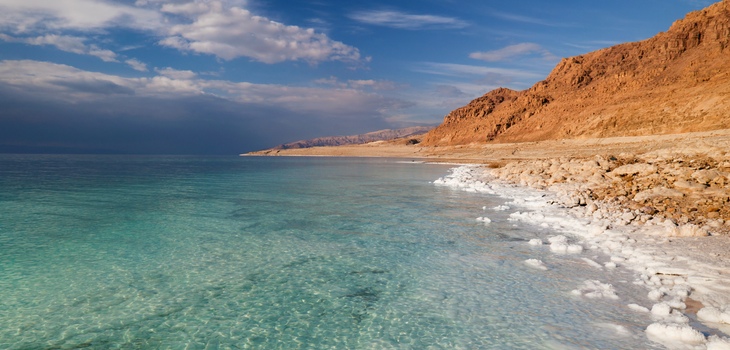
Just 50 miles from the eastern shores of the Mediterranean Sea lies a deep scar in the face of the Earth. Long known as the Valley of Siddam, the vale of salt, or the Jordan Valley, its most famous feature is the Dead Sea, which sits 1,400 feet below the Mediterranean shore. The exceptionally salty waters of the Dead Sea, along with an unusual climate, make it a truly unique place. And, despite its depth, the Dead Sea lake surface continues to fall.
In this 12-part series, we’ll explore the origins and history of the Dead Sea, examining its significance from both geological and biblical perspectives. We will ask questions that have been explored by scientists, historians, and theologians alike: How did the Dead Sea form? What secrets lie beneath its waters? How does its history align with biblical accounts? And what can this unique body of water tell us about Earth’s past and future?
The Dead Sea Today
The Dead Sea is Earth’s lowest elevation on land and the deepest hypersaline lake in the world. in 2021 its surface stood at approximately -435 meters below sea level (-1427 feet), having dropped nearly 1.5 meters per year over the past two decades (Yechieli et al., 2016). This rapid decline is primarily attributed to human activities, including water diversion from the Jordan River and mineral extraction industries.
But the Dead Sea is in trouble. Its waters are receding at an alarming rate, leaving behind a landscape dotted with sinkholes and abandoned shoreline resorts. This crisis offers us a unique opportunity to peer into the Earth’s past and ponder some big questions about science, faith, and the age of our planet.
The unique characteristics of the Dead Sea make it an invaluable climate archive. Its sediments provide a high-resolution record of past climate changes in the drought-sensitive eastern Mediterranean-Levant region. This area has been crucial for the development of human civilization and sits at the boundary of global climate belts.
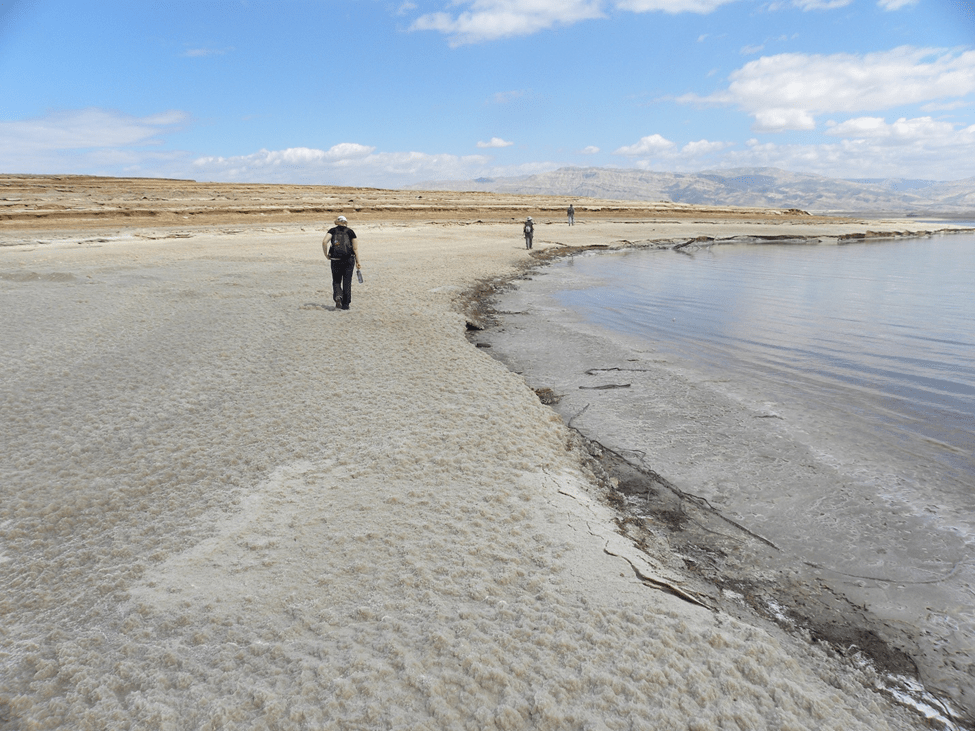
Geographical and Hydrological Context
The Dead Sea drainage basin covers an area of approximately 42,200 km², encompassing several climate zones spanning from sub-humid to semi-arid Mediterranean climate in the north to Saharo-Arabian arid-hyperarid conditions in the south (Langgut et al., 2014). The Jordan River, originating in the north, is the main perennial river flowing into the Dead Sea. Additionally, there are perennial flows from the eastern part of the catchment, and ephemeral streams flowing from the high Jordanian Plateau, the Judean Mountains, and Negev in the east, west, and south, respectively.
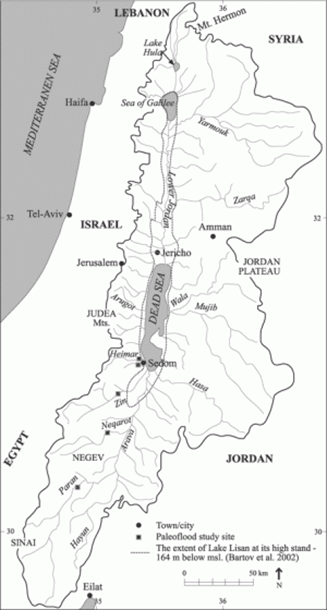
Despite its name, the Dead Sea is not entirely devoid of life. Its extreme salinity (around 34% compared to 3.5% for typical seawater) creates a unique ecosystem that supports specialized microorganisms. These halophilic (salt-loving) organisms, primarily archaea and bacteria, have adapted to thrive in this harsh environment (Oren, 2010). Some of these microbes produce vibrant pigments, giving the water a reddish tint in certain areas.
The shores of the Dead Sea also support a variety of salt-tolerant plants, such as tamarisk trees and salt-loving pickleweed. These plants play a crucial role in stabilizing the shoreline and providing habitat for wildlife. The surrounding desert areas are home to a range of animal species adapted to arid conditions, including ibex, hyrax, and various bird species (Levin et al., 2007). Today, this unique ecosystem is under threat from the Dead Sea’s rapid decline. As the water level drops, it affects the delicate balance of the surrounding environment, leading to changes in local microclimates and wildlife habitats.
Biblical Significance
The Dead Sea isn’t just a scientific curiosity. It’s also a place of historical and biblical significance. The Bible mentions the “Salt Sea” numerous times, most famously as the backdrop for the story of Sodom and Gomorrah. Abraham and Lot gazed upon its waters, and David sought refuge in its surrounding wilderness.
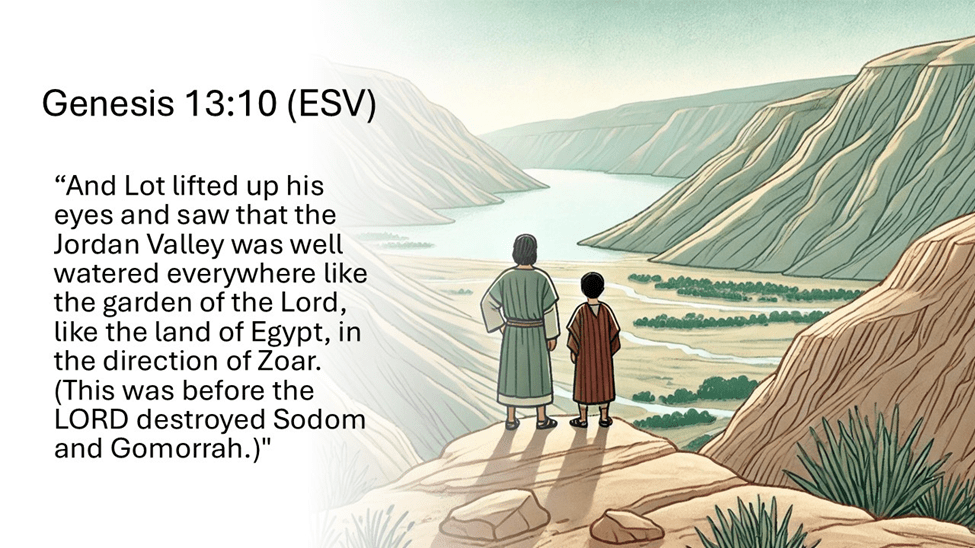
In Genesis 13:10 (ESV), we read: “And Lot lifted up his eyes and saw that the Jordan Valley was well watered everywhere like the garden of the Lord, like the land of Egypt, in the direction of Zoar. (This was before the LORD destroyed Sodom and Gomorrah.)” This description suggests that around 4000 years ago, the Dead Sea and its surroundings were not dramatically different from what we see today in terms of general layout, though perhaps with somewhat more abundant water (Frumkin and Elitzur, 2002). We should note here that the “well-watered” in Biblical times likely doesn’t refer to abundant rainfall but rather the presence of reliable springs and streams used for irrigation for crops. This is true of the Jordan Valley today as it was then.
The Dead Sea also features in the story of David fleeing from Saul (1 Samuel 23:29), and in prophecies by Ezekiel about the future healing of these salty waters (Ezekiel 47:8-9). These biblical references provide us with insights into how this landscape was perceived and utilized in ancient times.
For many, reconciling these biblical accounts with the geological evidence of the origin of the Dead Sea poses a challenge – one that we’ll explore throughout this series. We might wonder, what exactly did Abraham and Lot see when they looked down into the Valley of Siddam? Where were Sodom and Gomorrah and how were they destroyed? These questions invite us to consider how we interpret both scripture and scientific evidence.
Geological Origins
Now, here’s where things get really interesting but also challenging to some Christian views of the origin and subsequent history of geographical features such as the Dead Sea. The Dead Sea, according to the consensus of the scientific community, is a relatively young geological feature, at least in Earth-time. It formed as part of the Great Rift Valley system, which stretches from Syria to Mozambique. This massive crack in the Earth’s crust is the result of tectonic plates pulling apart, a process that likely began millions of years ago and continues to this day.
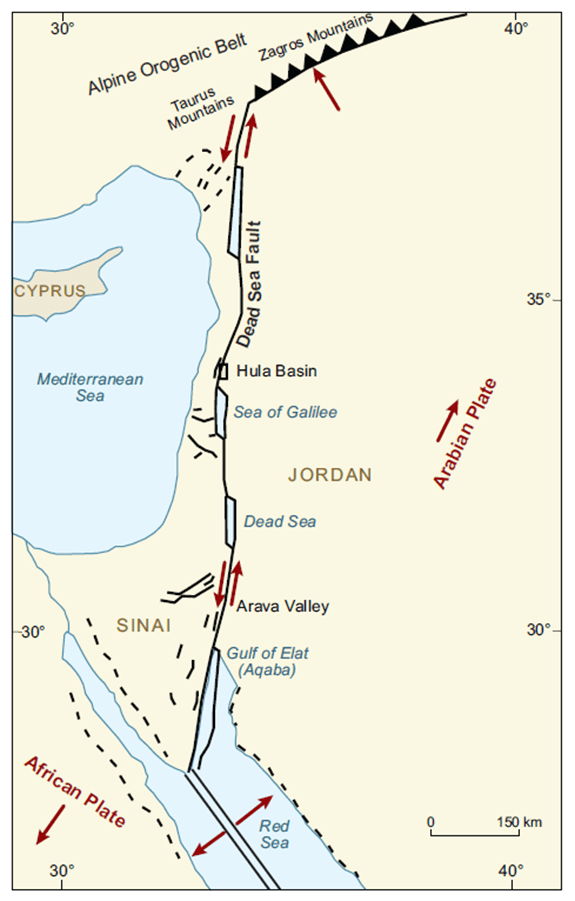
The Dead Sea sits in what geologists call a pull-apart basin along the Dead Sea Transform fault. This fault system marks the boundary between the Arabian Plate to the east and the African Plate (or more specifically, its Sinai sub-plate) to the west. As these plates slide past each other, they also pull apart slightly, causing the crust to thin and sink. This is why the Dead Sea is so deep – it’s literally a depression in the Earth’s surface caused by this tectonic activity (Garfunkel and Ben-Avraham, 1996).
Recent GPS measurements have given us an incredibly precise picture of how fast this motion is occurring. The Arabian Plate is moving northward relative to the African Plate at a rate of about 4-5 mm per year (ArRajehi et al., 2010). That might not sound like much, but over millions of years, it adds up to significant movement!
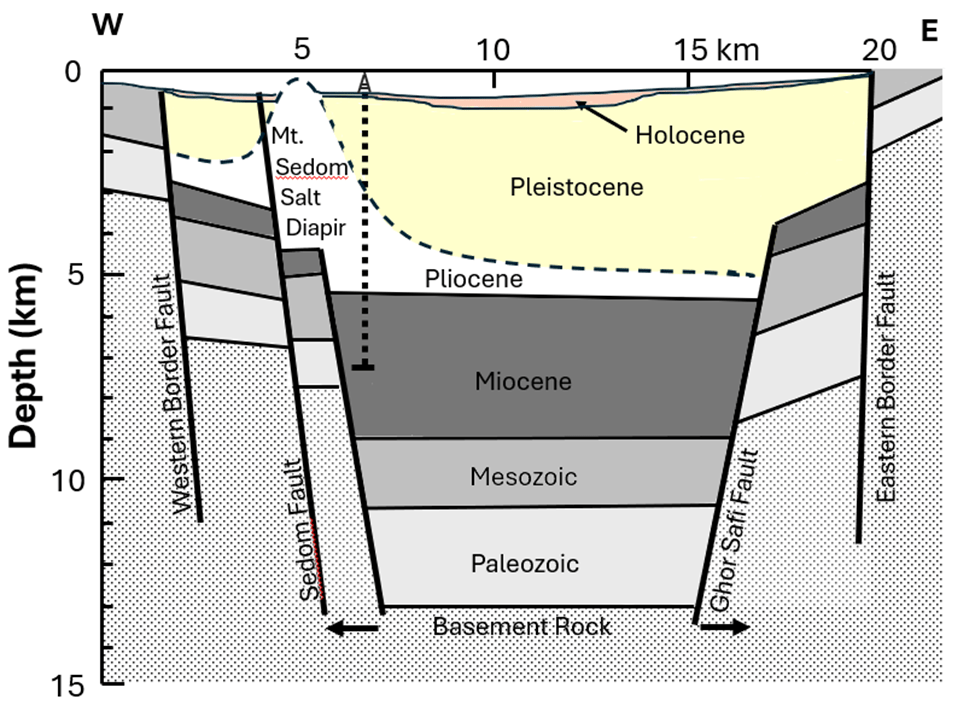
The sediments that have accumulated in the Dead Sea basin over time provide a remarkable record of its history. Deep drilling projects have revealed layers of salt, mud, and other sediments that tell a story of dramatic climate fluctuations and changing water levels over hundreds of thousands of years (Stein et al., 1997).
The Young Earth Creationist Perspective
But wait, millions of years? That’s where we run into a potential conflict with some interpretations of the Bible. Young Earth Creationists (YECs), who believe the Earth is only about 6,000 years old, have to squeeze the entire formation and history of the Dead Sea into a much shorter timeframe – less than 4500 years!
Throughout this series, it will be crucial for you to keep in mind that young-earth creationists believe that the geological features of the Earth are no more than 4,500 years old being products of a global flood during the time of Noah or the result of post-Flood events. This means that, according to their model, the Dead Sea and Jordan Valley has to have had its origins in the recent past—no more than a few thousand years ago rather than millions of years ago.
Can their model account for the extensive salt deposits, the deep sediment layers, and the dramatic changes in water levels of the Dead Sea we observe not only today but infer from ancient shorelines? As we will see, this is a significant challenge for the YEC view, as the geological evidence points to processes occurring over much longer timescales.
For example, the thick layers of salt in the Dead Sea basin would require multiple cycles of the sea filling and evaporating – a process that’s difficult to compress into just a few thousand years. Similarly, the sediment cores from the Dead Sea show annual layers (varves) that number far more than would be possible in a young-earth timeframe (Neugebauer et al., 2014).
Preview of the Dead Sea Blog Series
As we progress through this series, we’ll examine how different models – including the young-earth perspective – attempt to explain the evidence we see in and around the Dead Sea. This will provide us with an opportunity to consider how scientific evidence and religious beliefs interact, and what it means when they appear to be in conflict. Finally, I will share why I believe the observations provided in this series are not in conflict with the message of the Hebrew scriptures.
To understand the Dead Sea’s origins and history, we’ll be taking an interdisciplinary approach, drawing on insights from geology, archaeology, climatology, and biblical studies.
In the forthcoming chapters, we’ll explore:
- The geological and seismic history of the Dead Sea basin, including the formation of its unique salt and sediment layers.
- The climate history recorded in Dead Sea sediments, and what it tells us about past environmental changes in the region.
- The hydrological history of the Dead Sea, including periods when it was much larger (Lake Lisan) and times when it may have dried up completely.
- Detailed examination of biblical references to the Dead Sea and surrounding areas, and how they align with geological and archaeological evidence.
- The challenges posed by Dead Sea evidence to young Earth creationist interpretations, and how different perspectives attempt to reconcile faith and science.
- But what about the Noahic Flood? Where does that fit in the Dead Sea History? A response to how we can understand the origins of Dead Sea in the context of evidence gathered from both geology and scriptures.
Conclusion
The Dead Sea, with its extreme environment and rich history, offers us a remarkable opportunity to explore the intersection of science, history, and faith. It challenges us to think deeply about the age of the Earth, the accuracy of the biblical narrative, and our understanding of God’s creation.
Let’s begin by taking a closer look at the current state of the Dead Sea and the environmental challenges it faces. We’ll explore how human activity is affecting this unique ecosystem and what it might mean for its future. We’ll also begin to dig deeper into the geological history of the region, setting the stage for our dive into the Dead Sea’s deepest past.
Upcoming schedule for the Dead Sea Chronicles Series:
December 2, 2024: Part I: The Origins of the Dead Sea: A Geo-Biblical Exploration
December 9, 2024: Part II: The Lowest Place on Earth Goes Lower: The Dead Sea’s Ongoing Crisis
December 16, 2024: Part III: The Jordan Valley: A Land Literally Torn Apart
December 23, 2024: Part IV: Lake Lisan: The Jordan Valley Under Water
December 30, 2024: Part V: Lake Lisan’s Legacy: What Stromatolites Reveal About Earth’s Past”
January 6, 2025: Part VI: All Dried Up: When the Dead Sea Died
January 12, 2025: Part VII: Sodom, Gomorrah, and the Seismic History of the Dead Sea
January 20, 2025: Part VIII: Mt. Sodom: A Colossal Salt Pillar Challenging Young Earth Chronology
January 27, 2025: Part IX: Ancient Settlements Below Sea Level: Evidence of an Old Earth
February 3, 2025: Part X: Calculating Time: The Dead Sea’s Salt Deposits and the Limits of a Young Earth
February 10, 2025: Part XI: Dead Sea’s Sedimentary Challenge to Young Earth Creationism
February 17, 2025: Part XII: Salt, Seismites, and Scripture: Reconciling the Dead Sea’s Deep History
References:
ArRajehi, A., McClusky, S., Reilinger, R., Daoud, M., Alchalbi, A., Ergintav, S., … & Kogan, L. (2010). Geodetic constraints on present‐day motion of the Arabian Plate: Implications for Red Sea and Gulf of Aden rifting. Tectonics, 29(3).
Frumkin, A., & Elitzur, Y. (2002). Historic Dead Sea level fluctuations calibrated with geological and archaeological evidence. Quaternary Research, 57(3), 334-342.
Garfunkel, Z., & Ben-Avraham, Z. (1996). The structure of the Dead Sea basin. Tectonophysics, 266(1-4), 155-176.
Langgut, D., Neumann, F. H., Stein, M., Wagner, A., Kagan, E. J., Boaretto, E., & Finkelstein, I. (2014). Dead Sea pollen record and history of human activity in the Judean Highlands (Israel) from the Intermediate Bronze into the Iron Ages (∼2500–500 BCE). Palynology, 38(2), 280-302.
Levin, N., Lahav, H., Ramon, U., Heller, A., Nizry, G., Tsoar, A., & Sagi, Y. (2007). Landscape continuity analysis: A new approach to conservation planning in Israel. Landscape and Urban Planning, 79(1), 53-64.
Neugebauer, I., Brauer, A., Schwab, M. J., Waldmann, N. D., Enzel, Y., Kitagawa, H., … & DSDDP Scientific Party. (2014). Lithology of the long sediment record recovered by the ICDP Dead Sea Deep Drilling Project (DSDDP). Quaternary Science Reviews, 102, 149-165.
Oren, A., 2010. The dying Dead Sea: The microbiology of an increasingly extreme environment. Lakes & Reservoirs: Research & Management, 15(3), 215-222.
Stein, M., Starinsky, A., Katz, A., Goldstein, S. L., Machlus, M., & Schramm, A. (1997). Strontium isotopic, chemical, and sedimentological evidence for the evolution of Lake Lisan and the Dead Sea. Geochimica et Cosmochimica Acta, 61(18), 3975-3992.
Yechieli, Y., Abelson, M., & Baer, G. (2016). Sinkhole formation and subsidence along the Dead Sea coast, Israel. Hydrogeology Journal, 24(3), 601.
 Naturalis Historia