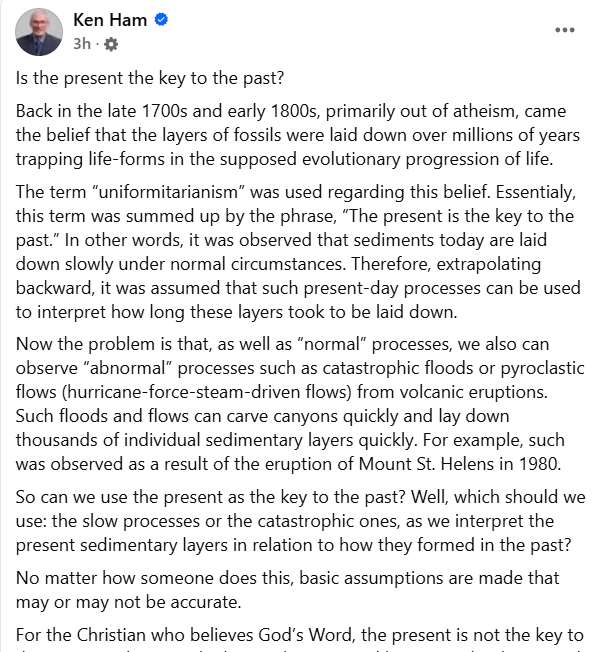
Ken Ham recently posted a short piece on Facebook in which he makes several claims about the history of geology and the nature of uniformitarianism. It’s a compact post, but it manages to pack in a remarkable number of historical distortions and conceptual misunderstandings. It’s the sort of package of words that sound plausible to an audience that has never cracked open a history of science textbook but that crumble under even modest scrutiny. Let me walk through his primary claims.
“Primarily Out of Atheism”? The Founders of Geology Were Overwhelmingly Christian
Ham opens with a breathtaking assertion: “Back in the late 1700s and early 1800s, primarily out of atheism, came the belief that the layers of fossils were laid down over millions of years.”
This is not just wrong — it is spectacularly wrong, and Ken Ham almost certainly knows better. The geological column, the fossil record, and the principle of superposition were not products of atheism. They were, in large part, the work of devout Christians who were trying to understand God’s creation by examining it carefully.
Let’s consider the actual historical record. Nicolas Steno (1638–1686), widely regarded as the father of stratigraphy, established the foundational principles of geology — the law of superposition, the principle of original horizontality, and the principle of lateral continuity. Steno was so devout a Christian that he converted from Lutheranism to Catholicism, was ordained a priest, became a bishop, and was eventually beatified by Pope John Paul II in 1988. He is literally on the path to sainthood. This is the man who laid the groundwork for reading the rock record.
Georges Cuvier (1769–1832), who established the principles of biostratigraphy and demonstrated the reality of extinction, was a lifelong Lutheran who regularly attended church services, helped found the Parisian Biblical Society, and served as Grand Master of the Protestant Faculties of Theology of the French University until his death. Cuvier was so theologically conservative that he rejected evolution — and yet his careful work on fossils and sedimentary layers was foundational to understanding the geological column.
Adam Sedgwick (1785–1873), who named the Cambrian period and co-established the Devonian, was an ordained Anglican priest and remained a committed evangelical Christian his entire life. He held the Woodwardian Chair of Geology at Cambridge for over fifty years while simultaneously serving as a Canon of Norwich Cathedral. Sedgwick so fiercely opposed Darwin’s theory of evolution that he wrote to Darwin saying his book gave him “more pain than pleasure.” And yet Sedgwick’s work was instrumental in building the very geological column Ham attributes to atheism.
William Buckland (1784–1856), the leading English geologist of the 1820s, was an Anglican clergyman who initially tried to interpret geological evidence in light of Noah’s flood. He wrote the famous Bridgewater Treatise which is literally a two-volume work “on the power, wisdom, and goodness of God as manifested in the creation.” He abandoned the flood interpretation not because of atheism but because the rocks wouldn’t cooperate with that model.
The Reverend William Conybeare described the Plesiosaurus. The Reverend John Henslow contributed to understanding the Precambrian. Anglican clergy were so central to the development of the geological column in England and Wales from the 1820s onward that historians sometimes refer to this as the era of the “Reverend Geologists.” The Cambrian, Silurian, Devonian, Carboniferous — the fundamental divisions of the Paleozoic — were worked out substantially by ordained Christian ministers following the evidence where it led.
Even William Smith (1769–1839), the “Father of English Stratigraphy” who produced the first geological map of England and Wales, was a catastrophist, not a uniformitarian. His work on index fossils and stratigraphic correlation had nothing to do with atheism and everything to do with careful empirical observation of the order of rock layers.
Here is the key point that Ham’s audience needs to understand: these men did not abandon a young earth because they were atheists. Many of them abandoned a young earth because they were careful observers of creation who believed that God’s handiwork in the rocks should be taken as seriously as God’s word in Scripture. The evidence compelled them, often reluctantly and over considerable internal struggle, to accept that the earth was far older than a few thousand years.
Ironically, even Answers in Genesis’s own historical articles, and I’m thinking particularly ofTerry Mortenson’s work here, acknowledge the religious affiliations of many of these figures while trying to dismiss their faith as insufficiently orthodox. In AIG’s telling, Cuvier becomes a “nominal Lutheran” and an “irreverent deist,” Sedgwick gets labeled a “semi-deist,” and so on. But more careful historical scholarship, including the work of V. Paul Marston, has shown these characterizations to be misleading. Sedgwick held beliefs that “can only be described as evangelical.” Cuvier was anchored to his Protestant faith. The attempt to retroactively paint these men as closet atheists is a strategy of convenience, not a reflection of historical reality.
Ham Doesn’t Understand Uniformitarianism (And Neither Do Most Creationists)
Ham writes: “The term ‘uniformitarianism’ was used regarding this belief. Essentially, this term was summed up by the phrase, ‘The present is the key to the past.’ In other words, it was observed that sediments today are laid down slowly under normal circumstances.”
This reveals a fundamental misunderstanding of what uniformitarianism actually means. It reveals a misunderstanding that has been a staple of creationist rhetoric for decades and one I have addressed many times on this blog.
Uniformitarianism is not the claim that geological processes always operate slowly. It is not the claim that rates of deposition, erosion, or sedimentation have been constant throughout earth history. Nobody has ever believed that. What uniformitarianism actually asserts is that the same natural laws and processes that operate in the present also operated in the past. Gravity worked the same way 100 million years ago as it does today. Water erosion follows the same physics. Crystal formation obeys the same thermodynamic principles. A particle of a given mass will be suspended in a river only at certain velocities and temperatures — and those physical relationships have not changed.
This distinction matters enormously. When a geologist says “the present is the key to the past,” she is not saying that a river deposited sediment at the same rate in the Cretaceous as it does today. She is saying that the same physical laws governed how that sediment was transported and deposited. She can then use evidence (grain size distributions, cross-bedding patterns, chemical signatures, fossil assemblages) to determine whether a particular layer was deposited rapidly by a flood, slowly by a meandering river, or catastrophically by a volcanic eruption.
Sedgwick himself, back in the 1830s, recognized this distinction clearly. In reviewing the first volume of Lyell’s Principles of Geology, Sedgwick agreed that the “primary laws of matter” were “immutable,” but he criticized Lyell’s assumption that geological processes must have been uniform in their intensity throughout earth history. Uniformity of natural law does not equal uniformity of rate. Even the pioneers of geology understood this, and modern geologists certainly do.
The False Dichotomy: Slow Versus Catastrophic
Ham then presents what he clearly considers a gotcha: “Now the problem is that, as well as ‘normal’ processes, we also can observe ‘abnormal’ processes such as catastrophic floods or pyroclastic flows… So can we use the present as the key to the past? Well, which should we use: the slow processes or the catastrophic ones?”
This is a textbook false dichotomy. The answer is: we use both, because both have always been part of geology. This is not a new insight. This is not a challenge that geologists have been hiding from. Catastrophic processes have been recognized and studied by geologists since Cuvier’s catastrophism in the early 1800s. This was two centuries before Ken Ham’s Facebook post!
Modern geology incorporates an entire spectrum of depositional environments and rates. We recognize that some layers of fine-grained shale represent thousands of years of slow, quiet deposition at the bottom of a lake or shallow sea. We recognize that turbidite sequences represent rapid submarine landslides that deposited meters of sediment in hours. We recognize that volcanic ash layers, called tephra, were deposited catastrophically, sometimes in minutes, and that these layers serve as precise time markers across enormous geographic areas. We recognize that glacial till was deposited by ice sheets, that loess deposits represent windblown dust accumulated over millennia, and that certain limestone formations represent the slow accumulation of marine organisms over millions of years.
The point is that geologists don’t choose between slow and fast. They look at the characteristics of each individual rock layer, its mineralogy, grain size, sorting, fossil content, internal structures, chemistry, and relationship to surrounding layers, and determine what processes formed it. Sometimes those processes were slow. Sometimes they were catastrophic. Often they were both, in sequence.
Ham’s invocation of Mount St. Helens is a perfect example of this confusion. Yes, the 1980 eruption carved canyons quickly and deposited many thin sedimentary layers rapidly. Geologists know this. Geologists studied this. But here is what Ham never tells his audience: geologists can tell the difference between layers deposited by volcanic eruptions and layers deposited by other processes. The sediments around Mount St. Helens look like volcanic deposits because they are volcanic deposits, and they have the grain sizes, mineralogy, sorting characteristics, and chemical signatures that identify them as such. They do not look like the slowly deposited marine limestones of the Midwest, or the ancient desert sandstones of the Navajo formation, or the varved lake sediments of the Green River formation. These are all different kinds of rocks deposited by different processes at different rates, and the evidence for each is written into the rocks themselves.
The whole point of uniformitarianism, properly understood, is that we can use what we know about how volcanic eruptions, rivers, glaciers, oceans, and deserts operate today to interpret the rocks of the past. Mount St. Helens doesn’t undermine uniformitarianism; it confirms it. The eruption produced exactly the kinds of deposits that geologists would expect a volcanic eruption to produce, based on uniformitarian principles.
“Revelation Is the Key to the Past”
Ham concludes: “For the Christian who believes God’s Word, the present is not the key to the past. Revelation is the key to the past.”
This is an admirably honest statement, and I appreciate Ham’s candor here, because it reveals the true nature of the disagreement. Ham is not making a scientific argument. He is making a philosophical and theological one: that the proper way to understand earth history is not to examine the physical evidence but to start with a particular interpretation of Genesis and force the evidence to conform to it.
But notice what this requires. It requires Ham to claim, against all historical evidence, that the geological column was developed “primarily out of atheism,” because if his audience knew it was largely developed by devout Christians and ordained clergy, they might wonder why those believers found the evidence so compelling. It requires Ham to misrepresent uniformitarianism as the naive belief that everything always happens slowly, because if his audience understood that geologists have always incorporated catastrophic processes, his false dichotomy would collapse. And it requires him to frame the entire enterprise of historical geology as a matter of competing “basic assumptions,” as if choosing between careful examination of physical evidence and a predetermined interpretation of an ancient text is just a matter of taste.
As a Christian myself, I find Ham’s framing deeply troubling. The men who built the geological column (Steno, Cuvier, Sedgwick, Buckland, Conybeare, Smith) were not enemies of faith. Many of them were servants of the church who believed they were studying God’s creation. They followed the evidence because they believed that the God who inspired Scripture also made the rocks, and that truth cannot contradict truth. To dismiss their work as the product of atheism is not just historically inaccurate. It is an insult to their faith and their legacy.
The present is a key to the past. Not because rates have always been constant, but because the laws of nature have been consistent. That consistency is, for those of us who are Christians, itself a reflection of the faithfulness of the God who sustains creation. Understanding deep time is not a threat to Christian faith. It is an invitation to marvel at the scope of God’s creative work — a work far grander, more patient, and more intricate than a 6,000-year timeline could ever accommodate.
 Naturalis Historia
There is a demand for the kind of deception that Ken Ham practices, because there are many others who start with his assumptions and therefore agree with his conclusions. Ken Ham supplies the deception that meets this demand. His audience does not want to be challenged by any of the points made by old earth creationists or anyone else who is not a young earth creationist, so they avoid reading those sources as much as possible. I am sure his claims are very comforting to his readers.
LikeLiked by 1 person
I think that you may be putting your own gloss on this issue. Originally uniformitarianism emphasized slow, continuous, law-governed processes operating over immense time as the primary explanation for Earth’s geological features.
This was the view of Charles Lyell, who was nor known for his faith in the God of the Bible.
LikeLike