A Response to Ken Ham on Division, Authority, and the Hills We Choose to Fight Over
Ken Ham has never been one to shy away from controversy, but his recent video (“I Am Willing to Divide the Church Over This”) represents something more than his usual polemic. In it, Ham makes an explicit, scripturally-argued case that Christians should be divisive over the age of the earth and the interpretation of Genesis. Not merely that they may disagree, but that division is a biblical mandate when others refuse to read Genesis his way.
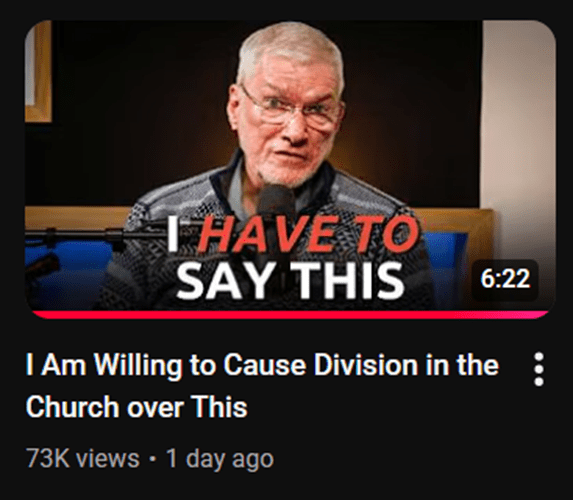
I have been writing about and engaging with young-earth creationism for over thirty years, both as a professional biologist and as a evangelical Christian in the Reformed tradition who takes Scripture seriously. I have watched Ken Ham’s rhetoric escalate over that time from confident advocacy to something that increasingly resembles what the broader Christian tradition would recognize as schismatic behavior. This latest video deserves a point-by-point response. Not because Ham’s arguments are new, but because they are now being stated with a clarity that makes their implications impossible to ignore.
Ham’s Biblical Case for Division
To his credit, Ham does not merely assert that division is acceptable. He builds a scriptural argument, and it is worth laying out his chain of reasoning fairly before examining it.
Ham begins with 1 Corinthians 1:10, Paul’s appeal for unity: “I appeal to you, brothers, by the name of our Lord Jesus Christ, that all of you agree and that there be no divisions among you, but that you be united in the same mind and the same judgment.” Ham affirms this call to unity—but immediately redefines what unity means. For Ham, unity means agreement on “what God’s word teaches,” which in his framework necessarily includes a young earth, six literal 24-hour days, and a global flood approximately 4,500 years ago.
He then layers several additional texts. John 7:24 (“Do not judge according to appearance, but judge with righteous judgment”) preempts the objection that he is being judgmental. Luke 12:51 (“Do you think that I came to grant peace on earth? I tell you, no, but rather division”) allows him to cast himself in the role of a light-bearer dividing light from darkness. John 3:19 and John 1:5 reinforce the light/darkness metaphor. First Corinthians 11:18–19 (“there must also be factions among you, so that those who are approved may become evident among you”) normalizes division as God’s mechanism for revealing the faithful. And Romans 16:17–18 warns against those who teach “contrary to the teaching which you learned.”
The structural logic thus runs as follows: (a) we must be united on God’s word; (b) God’s word clearly teaches a young earth; (c) therefore anyone who disagrees is teaching error; and (d) Scripture commands us to separate from those who teach error.
The age of the earth is not presented as the actual hill—biblical authority is the hill. The age of the earth is the test case that reveals where one stands on authority. This is why Ham frames the question as “Does it really matter if we take God at his word?” rather than “Does it really matter how old the earth is?”
Why This Argument Works—For His Audience
Before critiquing Ham’s argument, it is important to understand why it resonates so powerfully with his young-earth audience. Several features of his presentation make it emotionally and rhetorically compelling.
The authority sleight-of-hand. By framing the debate as “God’s word versus man’s word,” Ham collapses the real question—how should we interpret Genesis?—into a much simpler question: do you trust the Bible? For an audience that already feels besieged by secular culture, this framing is almost irresistible. Nobody wants to be on the side of “man’s fallible word.” I documented this rhetorical strategy as early as 2012, noting how Ham’s approach had the effect of “emboldening the lay person to demand their leaders be orthodox in their views on Genesis 1” while simultaneously ensuring that “silence is tantamount to compromise” (Duff, “State of Creationism in the Reformed Church,” 2012).
The Jesus parallel. When Ham quotes Jesus saying “I came to bring division,” he implicitly casts himself and his audience in the role of those who carry light into darkness. The division is not something they cause. Rather it is something that happens when light encounters darkness. They are passive vessels of truth, not aggressors. This is a powerful identity narrative.
The simplicity of the binary. There are only two categories in Ham’s universe: those who “stand on God’s word” and those who have “compromised God’s word with man’s faulty ideas.” There is no third option. There is no honest disagreement between faithful interpreters, no legitimate hermeneutical diversity. This eliminates cognitive complexity and gives his audience permission not to wrestle with alternative readings, because those readings are, by definition, compromise.
Emotional reassurance. Many in Ham’s audience feel uneasy about the divisiveness they observe in young-earth culture. I saw this firsthand when Ham was disinvited from a homeschool conference years ago and “a large number of home school bloggers felt that Ham was way out of line in his behavior, finding it un-Christian”—but they struggled to articulate their criticism because “most of them were YECs and thus want to support Ham’s work” (Duff, “State of Creationism in the Reformed Church,” 2012). Ham’s video speaks directly to this discomfort: Your unease is misplaced. Division is biblical. In fact, it is commanded. You should feel good about this.
And there is a deeper mechanism at work. Ham has spent decades training his followers to refuse engagement with what he calls “compromiser” literature. When you have convinced people that even reading the other side is dangerous, the binary holds.
What Scripture Actually Says—And What Ham Leaves Out
Ham’s scriptural argument, while superficially coherent, suffers from several significant exegetical problems. Most critically, several of the passages he cites are being used in ways that reverse their original intent, and other highly relevant passages are conspicuously absent.
The 1 Corinthians 1:10 inversion. This is perhaps the most striking problem. Paul wrote this passage to rebuke division, not to authorize it. The Corinthians were splitting into factions—“I follow Paul,” “I follow Apollos”—and Paul is appalled. His point is that Christ is not divided, and factionalism around human teachers and their distinctive emphases is antithetical to the gospel. To use this verse as a launching pad for “we must divide over my reading of Genesis” is a remarkable reversal of its intent. One could argue that Ham is doing exactly what Paul condemns: building a faction around a particular teacher’s distinctive interpretation and then demanding that all Christians conform to it or be cast out.
Romans 16:17–18 in context. The “teaching which you learned” that Paul warns against almost certainly refers to the apostolic gospel itself—the core kerygma about Christ’s death, resurrection, and lordship. Paul is not talking about disputes over the interpretation of Genesis 1. To apply this passage to anyone who reads Genesis differently from Ken Ham requires the prior assumption that Ham’s interpretation is the apostolic teaching—which is precisely the point in dispute. The argument is circular.
Romans 14—the conspicuously absent chapter. This is arguably the most relevant text for this debate, and Ham does not mention it. Paul explicitly addresses a situation where Christians disagree on matters of conscience and practice—dietary laws and the observance of special days. His instruction is not “divide over these” but rather: “Accept the one whose faith is weak, without quarreling over disputable matters” (Romans 14:1). He goes further: “Who are you to judge someone else’s servant? To their own master, servants stand or fall” (Romans 14:4). The entire chapter is a sustained argument that matters where faithful Christians disagree should be handled with mutual acceptance, not division. The parallels to the creation debate are striking—Paul is addressing precisely the kind of secondary matter that Ham wants to elevate to a first-order test of fellowship.
Philippians 3:15 is also relevant: “All of us, then, who are mature should take such a view of things. And if on some point you think differently, that too God will make clear to you.” Paul acknowledges that mature believers may see things differently on certain matters and counsels patience, trusting that God will bring clarity in his own time. The pastoral posture here is one of patience, not purging.
Consider also Acts 5:38–39: “If this plan or this undertaking is of man, it will fail; but if it is of God, you will not be able to overthrow them”—suggests a posture of humility about contested questions that is strikingly absent from Ham’s presentation.
And there is a deeper hermeneutical problem that should concern anyone in the Reformed tradition. Ham’s argument conflates his interpretation of Scripture with Scripture itself. He claims we should be “united on God’s word,” but what he means is “united on my interpretation of God’s word.” The question of how to read Genesis is an interpretive question, not an authority question. Augustine speculated that creation might have been instantaneous rather than sequential. Calvin was cautious about tying theology to specific cosmological claims. B.B. Warfield, the great Princeton defender of biblical inerrancy, accepted an old earth and an evolutionary framework. The Westminster Confession does not specify the age of the earth. By conflating his interpretation with the text itself, Ham makes disagreement with his hermeneutic equivalent to disagreement with God—and that is a category error that the Protestant tradition, with its emphasis on the fallibility of all human interpreters, should be especially alert to (Warfield, 1911; Collins, 2006; Godfrey, 2003).
Theological Triage: Gavin Ortlund’s Better Framework
There is a better way to think about which doctrinal disagreements warrant division and which do not. Gavin Ortlund, in his excellent book Finding the Right Hills to Die On: The Case for Theological Triage (2020), offers a framework that I find deeply helpful and that stands in sharp contrast to Ham’s approach.
Ortlund, building on a concept originally articulated by Albert Mohler, identifies three basic priority levels for Christian doctrine. First-rank doctrines are essential to the gospel itself—the Trinity, the incarnation, justification by grace through faith. To deny these is to compromise the gospel. Second-rank doctrines are urgent for the health and practice of the church and may justify denominational separation—baptism and church governance being prominent examples. Third-rank doctrines are important for Christian theology but should never be the basis for separation between believers.
Significantly, Ortlund explicitly identifies six-day creation as one of his examples of a third-rank doctrine—one that “it almost never makes sense to fight over.” He observes that such doctrines tend to “turn on specific interpretations of obscure passages of scripture, hold less practical import to the daily lives of Christians, and ignore the breadth of Christian history” (Ortlund, 2020, p. 134).
Ortlund identifies two equal and opposite dangers: doctrinal sectarianism and doctrinal minimalism. The first undermines unity; the second undermines belief. Ham’s approach falls squarely into the sectarianism category. And Ortlund is clear about the spiritual danger of this posture: he calls for “careful self-examination” about whether one has begun to feel superior to other Christians on the basis of a doctrinal position. Ham’s entire rhetorical framework positions young-earth believers as “standing on God’s word” while everyone else has “compromised.” That is precisely the kind of identity-forming doctrinal pride that Ortlund warns against.
Most pointedly, Ortlund asks whether a given posture serves the Great Commission. When defending a particular viewpoint begins to displace the gospel from the center of ministry, something has gone wrong. The opening clip of Ham’s own video features a theistic evolutionist noting that young-earth creationism is “an embarrassment creating enormous obstacles to Christian belief among scientifically educated people.” Whatever one thinks of that characterization, the question Ortlund would pose is unavoidable: is the insistence on young-earth creationism as a fellowship boundary helping or hindering the advance of the gospel?
I have wrestled with this question for decades, and the evidence I see—in classrooms, in churches, in the stories of young people who have lost their faith after discovering that the “scientific” claims of creation science do not hold up—suggests that Ham’s approach is doing profound damage to the very cause he claims to serve.
A Personal Reflection: Thirty Years of Watching the Damage
I write this as someone who shares much of Ham’s theological framework. I subscribe to the Westminster Confession of Faith. I affirm the five points of Calvinism. I come from a multi-generational Orthodox Presbyterian background. I believe the Bible is the inspired, infallible, and authoritative Word of God. I take Genesis seriously as real history. Ken Ham and I disagree not about the authority of Scripture but about its interpretation, and that distinction matters enormously.
Over three decades of writing more than 450 blog posts and producing hundreds of videos analyzing young-earth creationist claims, I have documented a consistent pattern. The scientific arguments that organizations like Answers in Genesis present to their audiences are, in many cases, seriously flawed. I have shown this with the salty sea argument, with claims about the fossil record, with misrepresentations of genetics and genomics, and most recently with what I call the “hyperevolution paradox.” This is the irony that young-earth creationism, in order to explain the diversity of life in a 4,500-year post-flood timeline, actually requires rates of biological diversification that far exceed anything mainstream evolutionary biology proposes (Duff, Beatman, and MacMillan, 2020). When Ham insists that Christians must choose between his version of Genesis and “man’s word,” he is presenting a false dilemma built on scientific claims that do not survive scrutiny.
But the damage goes beyond bad science. I wrote more than a decade ago that Ham’s strategy was to “embolden the lay person to demand their leaders be orthodox in their views on Genesis 1,” and that for Ham, “any person of authority in the church must practically swear some allegiance to a young earth theology or face grass roots retribution” (Duff, “State of Creationism in the Reformed Church,” 2012). That dynamic has only intensified. Pastors who hold to an old earth or are simply agnostic on the question find themselves under pressure from parishioners who have been trained by Ham’s materials to view anything short of young-earth commitment as capitulation to secularism.
Meanwhile, the young-earth creationist movement itself has been characterized by internal divisions, personality-driven leadership, and organizational dysfunction that should give pause to anyone who takes Ham’s call for “unity on God’s word” at face value. The original split between Answers in Genesis and what became Creation Ministries International was driven in significant part by concerns that Ham had concentrated too much power in his own hands—concerns that, judging by the organization’s continued opacity about leadership and succession, have never been adequately addressed (Duff, “AIG Organizational Analysis,” 2024). An organization that cannot maintain unity within its own walls is a strange vessel for a message about the necessity of dividing the church at large.
The Confirmation Bias Engine
There is a mechanism at work beneath Ham’s call to division that deserves explicit identification: confirmation bias, operating as organizational strategy.
I have written extensively about how confirmation bias functions within young-earth creationist communities. The cycle works as follows: a believer is told that the Bible mandates a young earth; creation science materials are presented as confirming this reading; contrary evidence from mainstream science or from other Christians is labeled “compromise” and dismissed without serious engagement; each repetition of YEC arguments reinforces confidence in the original presupposition. As I noted in my series on the salty sea argument, “Once a particular viewpoint, or even complete worldview, is established, evidence against that position is consciously or, more likely, subconsciously not given the same weight and dismissed” (Duff, “Confirmation Bias and Creation Evidence,” 2012).
Ham’s call to division is the capstone of this cycle. By telling his followers that they should separate from Christians who read Genesis differently, he is effectively constructing an informational closed system. If you will not read the books, will not engage with the arguments, and will not fellowship with the people who might challenge your assumptions, then your assumptions can never be tested. This is not the behavior of a community confident in its position. It is the behavior of a community that, at some level, recognizes the fragility of its claims and has chosen insulation over engagement.
This is what I have called “gap-dependent faith”—a faith that depends on empirical claims about the world that are vulnerable to disconfirmation. When those claims collapse, and they do collapse with regularity as science advances, the faith that was built upon them becomes fragile. I have heard from too many young people who were told that the truth of Christianity stood or fell with the truth of young-earth creationism, and who lost their faith when they discovered that the scientific evidence did not support what they had been taught. Ham’s divisiveness is not protecting the church; it is creating the very conditions that lead people to abandon it.
A Better Way Forward
What would it look like to handle this disagreement in a way that honored both Scripture and the breadth of the Christian tradition?
It would begin with honesty about the interpretive question. The Reformed tradition has always insisted on the distinction between Scripture and our interpretation of Scripture. The former is infallible; the latter is not. Faithful Christians throughout history, from Augustine to Calvin to Warfield to contemporary evangelical scholars like John Collins, Gregory Beale and others, have read Genesis carefully and arrived at conclusions different from Ham’s. This does not mean they have abandoned biblical authority. It means they have exercised the interpretive responsibility that the Protestant tradition demands of every believer.
It would continue with the humility that Ortlund rightly identifies as the prerequisite for theological triage. As Augustine wrote, “If you should ask, and as often as you should ask, about the precepts of the Christian religion, my inclination would be to answer nothing but humility, unless necessity should force me to say something else.” The confidence with which Ham equates his interpretation with God’s word is precisely the kind of interpretive hubris that the greatest theologians in the Christian tradition have warned against.
And it would culminate in a recognition that the gospel—the death and resurrection of Jesus Christ for the forgiveness of sins—is the center of Christian faith and the proper boundary of Christian fellowship. The age of the earth is not the gospel. The length of the days of creation is not the gospel. The mechanism by which God brought about biological diversity is not the gospel. These are important questions worthy of serious study and respectful debate. They are not hills worth dividing the church over.
Ken Ham is right that there are doctrines worth fighting for and that not all calls for unity are wise. He is right that biblical authority matters. But he is profoundly wrong about where to draw the line. In his zeal to defend his interpretation of Genesis, he is fracturing the body of Christ over a question that the church has never treated as a test of orthodoxy—not in its creeds, not in its confessions, and not in the broad sweep of its theological tradition.
I do not write this with any animosity toward Ken Ham. I write it with sorrow, as someone who has watched this dynamic play out in churches and families for three decades, and who believes that the church deserves better than a false choice between young-earth creationism and faithfulness to God’s word.
Blessings,
Joel
References
Scripture (all quotations from the English Standard Version)
Ham, Ken. “I Am Willing to Divide the Church Over This.” Answers in Genesis (YouTube), 2026. https://youtu.be/7J-MGRGjDXU?si=iNU4rO2MH7AaMG1_
Collins, C. John. Science and Faith: Friends or Foes? Wheaton, IL: Crossway, 2003.
Collins, C. John. Genesis 1–4: A Linguistic, Literary, and Theological Commentary. Phillipsburg, NJ: P&R Publishing, 2006.
Duff, Joel. “State of Creationism in the Reformed Church.” The Natural Historian, March 11, 2012. https://thenaturalhistorian.com/2012/03/11/creationism-yec-reformed-church-ken-ham-john-walton/
Duff, Joel. “The Salty Sea and the Age of the Earth: Confirmation Bias.” The Natural Historian, August 28, 2012. https://thenaturalhistorian.com/2012/08/28/salt-ocean-sea-age-earth-young-confirmation-bias/
Duff, Joel. “The Next Generation of Creation Scientists.” The Natural Historian, December 2012. https://thenaturalhistorian.com/2012/10/28/next-generation-creation-science-future-research/
Duff, Joel. “Web Traffic Data for Reformed and Creationist Web Sites.” The Natural Historian, April 15, 2012. https://thenaturalhistorian.com/2012/04/15/creation-creationist-web-sites-aig-cmi-icr-origins/
Duff, R. Joel, Thomas R. Beatman, and David S. MacMillan. “Dissent with modification: how postcreationism’s claim of hyperrapid speciation opposes yet embraces evolutionary theory.” Evolution: Education and Outreach 13 (2020): 1-16.
Duff, Joel. “Confirmation Bias and Creation Evidence.” The Natural Historian, 2012. https://thenaturalhistorian.com
Godfrey, W. Robert. God’s Pattern for Creation: A Covenantal Reading of Genesis 1. Phillipsburg, NJ: P&R Publishing, 2003.
Mohler, R. Albert. “A Call for Theological Triage and Christian Maturity.” AlbertMohler.com, July 12, 2005.
Ortlund, Gavin. Finding the Right Hills to Die On: The Case for Theological Triage. Wheaton, IL: Crossway, 2020.
Sailhamer, John H. Genesis Unbound: A Provocative New Look at the Creation Account. Colorado Springs: Dawson Media, 1996.
Walton, John H. The Lost World of Genesis One: Ancient Cosmology and the Origins Debate. Downers Grove, IL: IVP Academic, 2009.
Warfield, B. B. “On the Antiquity and the Unity of the Human Race.” The Princeton Theological Review 9 (1911): 1–25.
Young, Davis A. Christianity and the Age of the Earth. Thousand Oaks, CA: Artisan Sales, 1988.
 Naturalis Historia
This is a profoundly important post, that should be read and disseminated widely. The issue of real Christian unity (of the kind you and Ortland promote) is critical for the future of the church. In a foreword to the second edition of the book “The Heresy of Ham” by Joel Edmund Anderson I wrote:
“Ken Ham is not simply advancing a theological narrative that conflicts with established teachings of the Church. The heresy that Anderson accuses Ham of is nothing less than deliberately causing an unresolvable and highly destructive division in the fabric of the Christian religion”.
At the time the first edition of this book came out, many people were upset at the accusation of heresy in the title by Anderson. But what your post shows is that Ham was in fact advocating for a heretical vision that promoted himself above the authority of Christ. In these times especially, this heretical message represents a great danger to the future of Christianity, and we should call on all of our young earth-believing brethren in Christ to reject Ham and his message of intolerance and division as strongly as they would any message that denies the truth of the Gospel.
LikeLike
Whew! THANK YOU! Well-argued. Well-presented.
I “just” wish you wouldn’t be quite so (apparently) “parochial” about “Reformed.”
While I agree that most of your sources are Reformed, they aren’t all Reformed. (Think of Augustine, at least.) And having you kind of “prove your bona fides, with your comment about “the five points of Calvinism” and “multi-generational Orthodox Presbyterian background” [when the OPC is “only” a whopping 87 years old]. . . . –I “just” think it would be nice for you to practice some of the same generosity you would like Ham to demonstrate.
Definitely give “the Reformed” their due. (They deserve it!) But invite others in as well. Especially those who don’t have any idea what “Reformed” or “the five points of Calvinism” even mean! Don’t make those terms become stumbling stones for those among your readers who aren’t as sophisticated theologically as you–and many others among your readers–are. People shouldn’t have to read-up on these side-issues (“Do I subscribe to the Westminster Confession of Faith?” “Do I affirm the five points of Calvinism?” “What is the Orthodox Presbyterian Church?” “Is Duff saying Ham affirms any or all of these theological frameworks?”) in order to know whether they should be comfortable with your primary points.
LikeLike