Ken Ham is at it again. In a recent Facebook post, Ham shared an image with the claim: “The idea of millions of years came primarily out of atheism of the late 1700s–early 1800s. Those atheists rejected the global flood of Noah’s day and claimed the fossil record was laid down slowly over millions of years.” He added the commentary: “When Christians try and add long ages into Scripture, they are really compromising with the atheistic worldview!”
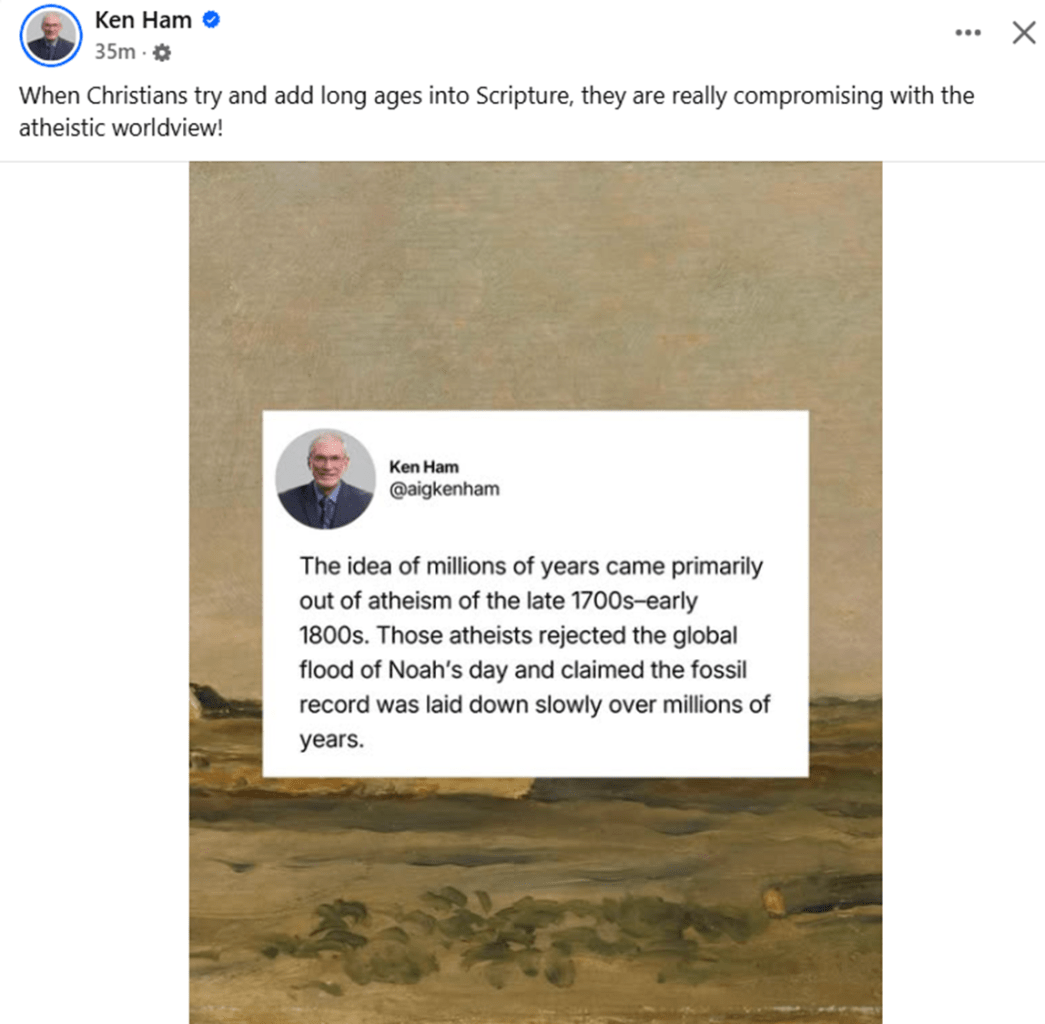
I’ve seen Ham make versions of this claim for years, and every time I encounter it I find myself frustrated—not because it’s a difficult argument to answer, but because it is so easily refuted by even a cursory reading of the history of geology. The historical record is clear, well-documented, and available to anyone willing to spend an afternoon with a good history of science textbook. The idea that deep time arose “primarily out of atheism” is not a nuanced interpretation of a complex historical record—it is simply wrong.
Let me first say that he did include the qualifier “primarily,” which represents a slight softening from some of his earlier statements. But even with that qualifier, the claim fundamentally misrepresents who the key figures in the development of deep time geology actually were, what they believed, and why they came to their conclusions. Although I have written about this before and many before me let’s walk, once again, through the historical record and let the evidence speak for itself.
The Founders of Geology Were Overwhelmingly Men of Faith
If we survey the major figures who contributed to the recognition that the earth is far older than a few thousand years, the picture that emerges is not one of atheists attacking the Bible. It is, rather remarkably, a picture of devout Christians (many of them ordained clergy) who were driven by the evidence of the rocks themselves to conclude that the earth had a long history.
Let’s begin way back in the 17th century. Nicolas Steno (1638–1686) is widely regarded as one of the founders of geology. His principles of stratigraphy—superposition, original horizontality, and lateral continuity—remain foundational to the discipline today. Steno was not an atheist. He was not even vaguely irreligious. He was a devout Catholic who was ordained as a priest in 1675, became a bishop, and devoted the last years of his life entirely to pastoral ministry and care for the poor. He was beatified by Pope John Paul II in 1988 and is currently a candidate for canonization. The father of stratigraphy is on track to become a Catholic saint. That is a rather inconvenient fact for Ham’s narrative.
Moving into the late 18th century, we encounter James Hutton (1726–1797), the Scottish geologist often called the “Father of Modern Geology.” Ham and other young-earth creationists frequently characterize Hutton as an atheist, but this is historically inaccurate. Hutton was a deist—he believed in a Creator who had designed the earth with wisdom and purpose. In his Theory of the Earth (1788), Hutton wrote extensively about the earth as a machine designed with “benevolent wisdom” and described its processes as evidence of divine design. When accused of impiety, Hutton wrote an unpublished manuscript titled “Memorial Justifying the Present Theory of the Earth from the Suspicion of Impiety,” in which he argued that religion and natural philosophy had different but complementary purposes. One can certainly debate whether Hutton’s deism constitutes orthodox Christianity—I would say it does not—but calling him an atheist is simply false. He explicitly believed in a divine Creator.
Now, was Hutton’s deism a departure from biblical Christianity? Yes, and I have no interest in defending deism as a theological position. But there is an enormous difference between deism and atheism, and importantly, Ham’s claim requires atheism—not merely heterodox theology—to be the driving force. More importantly, Hutton’s conclusions about the age of the earth were driven by field observations of rock formations, not by his theological commitments. His deism shaped his philosophical framework, but it was the rocks at Siccar Point and elsewhere that demanded an explanation involving vast stretches of time.
The Clergy-Geologists of the Early 19th Century
But the real problem for Ham’s narrative lies in the early 19th century—the very period he identifies as the source of deep time thinking. Because the most important geologists of this era were not atheists. They were not even deists. They were ordained Christian ministers.
The Reverend William Buckland (1784–1856) was an ordained Anglican priest who served as the first Reader in Geology at Oxford. Buckland described the first dinosaur, Megalosaurus, in 1824. He wrote one of the Bridgewater Treatises—a series of books commissioned to demonstrate “the Power, Wisdom, and Goodness of God as Manifested in the Creation.” Far from trying to undermine the Bible, Buckland spent his career attempting to demonstrate that geology confirmed God’s design. His inaugural lecture at Oxford in 1819 was explicitly devoted to “the Connexion of Geology with Religion.” Buckland was no atheist—he was a clergyman who studied rocks precisely because he believed they revealed God’s handiwork.
The Reverend Adam Sedgwick (1785–1873) was an ordained Anglican priest and Woodwardian Professor of Geology at Cambridge. He founded the Cambrian system and made enormous contributions to our understanding of the stratigraphic column. Sedgwick was not merely a nominal Christian—recent scholarship by V. Paul Marston has demonstrated that his beliefs can “only be described as evangelical.” When Robert Chambers published an early theory of evolution in 1845, Sedgwick attacked it ferociously, calling it a “strange delusion” under the influence of “the serpent coils of false philosophy.” In 1865, he joined over 600 other signatories of a declaration at the British Association for the Advancement of Science expressing concern that Darwin’s theory was “casting doubt upon the Truth and Authenticity of the Holy Scriptures.” This is not a man who was trying to advance an atheistic worldview. This is an evangelical clergyman who happened to be one of the greatest geologists of his era, and who was driven by the rocks—not by hostility to the Bible—to conclude that the earth was very old.
The Reverend William Conybeare (1787–1857), another ordained Anglican clergyman, described the Plesiosaur at the same 1824 Geological Society meeting where Buckland presented Megalosaurus. The irony here is rather striking: two of the most important paleontological presentations of the early 19th century were delivered by ordained ministers of the gospel.
Georges Cuvier (1769–1832), the French naturalist who founded comparative anatomy and paleontology, was raised in a devout Lutheran family and remained a practicing Lutheran throughout his life. He served on the council of the Paris Biblical Society, supervised Protestant educational programs in France, and actively supported his Lutheran congregation. Cuvier’s catastrophism—his recognition that the fossil record revealed distinct epochs of life separated by catastrophic events—was built on careful anatomical analysis, not on any desire to undermine scripture. His family had originally wanted him to become a Lutheran minister.
What About Lyell?
Charles Lyell (1797–1875) is often the figure Ham has most in mind when making these claims, and it is worth addressing him directly. Lyell is sometimes characterized as a deist who sought to “free the science from Moses.” There is some truth to this—Lyell did want to separate geological reasoning from direct appeals to scripture. But calling him an atheist is a significant overstatement. His New York Times obituary in 1875 noted that “though an evolutionist, Lyell was not a skeptic. He lived and died a Christian believer.” By the mid-1820s, scholars describe Lyell as an “ardent liberal Protestant” who saw in science a way to understand God’s creation through natural laws rather than through direct appeals to miraculous intervention. His geological studies, as one historian has noted, “never caused him to waver from his position of staunch Anglican churchmanship.”
Was Lyell’s theology perfectly orthodox by conservative Protestant standards? No. But the question is not whether every early geologist held to a theology that Ken Ham would approve of. The question is whether the idea of millions of years came “primarily out of atheism.” And the answer is clearly no. Even Lyell, the figure most amenable to Ham’s narrative, was a professing Christian, not an atheist.
Even AiG’s Own Writers Know Better
There are many more examples but do I need to go on with more examples to illustrate the dishonesty of Ken Ham’s claim? I could but maybe it’s best to just provide one more example for Ken Ham’s own organization, Answers in Genesis.
Here is what I find particularly frustrating. Answers in Genesis’s own published materials acknowledge these facts. Terry Mortenson, an AiG speaker with a PhD in the history of geology, has written at length about the early geologists. In his article “Deep Time and the Church’s Compromise: Historical Background,” Mortenson explicitly acknowledges that Buckland and Sedgwick were “ordained Anglican clergymen” who “insisted all [their lives] that old-earth theories did not contradict the Bible.” Mortenson tries to reframe this by arguing that these men were “not pious in how they handled… the Word of God,” but he does not—because he cannot—claim they were atheists. Even within AiG’s own literature, the claim that deep time came “primarily out of atheism” cannot be sustained.
Mortenson also acknowledges that Hutton was a deist, not an atheist, and that Cuvier was a Lutheran. He attempts to characterize these men as having “naturalistic (deistic or atheistic)” thinking, but lumping deism and atheism together in parentheses does not make them the same thing. Deism affirms a Creator; atheism denies one. They are fundamentally different worldviews, and conflating them in order to sustain the claim that millions of years came “out of atheism” is historically irresponsible.
The Evidence Drove the Conclusions, Not the Other Way Around
What the historical record actually shows is something far more interesting—and far more challenging to Ham’s narrative—than a story of atheists attacking the Bible. It shows that devout Christians who went out into the field and carefully examined the rocks were compelled by the physical evidence to conclude that the earth was very old. They did not begin with a desire to undermine scripture. Many of them began with an explicit commitment to demonstrating the harmony between geology and the Bible. Buckland’s entire career was built on this premise. Sedgwick devoted considerable energy to reconciling his geological findings with Genesis.
What changed their minds was not atheism—it was the rocks themselves. When Buckland examined the fossil bones in Kirkdale Cave, he initially interpreted them as evidence of the biblical Flood. But careful analysis revealed that the cave had been a hyena den in pre-Flood times, and the fossils were remains of animals the hyenas had eaten over a long period. The evidence forced Buckland to revise his interpretation—not because he had lost his faith, but because the rocks told a story that could not be compressed into a single year-long Flood event. When Sedgwick spent years mapping the Cambrian strata of Wales, the sheer thickness and complexity of the rock layers pointed unmistakably to vast stretches of time. These were not theoretical conclusions imposed on the data by atheistic assumptions. They were empirical observations made by Christian men who took both scripture and the created world seriously.
In fact, one of the most telling details is this: Charles Darwin himself was convinced of millions of years before he ever read Lyell. He learned deep time geology from Adam Sedgwick—an evangelical Anglican clergyman.
Why This Matters
I realize that for some readers, this may seem like an obscure historical argument with little relevance to the church today. But I believe it matters for several reasons.
First, truth matters. Christians of all people should care about getting our facts right. When Ken Ham tells millions of followers that deep time came “primarily out of atheism,” he is bearing false witness against a large number of devout Christians—ordained ministers, no less—who contributed to the development of geology. I am not accusing Ham of intentional dishonesty; I believe he genuinely holds this view. But the information that refutes it is readily available, including in his own organization’s publications.
Second, this false historical narrative serves a rhetorical function. By framing deep time as an “atheistic” idea, Ham creates a false binary: you either accept a young earth and remain faithful to God, or you accept millions of years and have compromised with atheism. But the actual history shows that there is a third option—the one chosen by Buckland, Sedgwick, Cuvier, and countless other faithful Christians—in which an old earth is understood as a discovery about God’s creation, not as a capitulation to unbelief. The false binary is doing enormous damage to young Christians who are told they must choose between the Bible and the clear testimony of the rocks, when in fact no such choice is necessary.
Third, the “atheism” framing inoculates Ham’s audience against engaging with the actual evidence. If Christians have been taught that deep time is an atheistic plot to undermine the Bible, they will never take seriously the geological evidence for an old earth—evidence that was first assembled and championed by their fellow believers. They will dismiss it without examination, exactly as Ken Ham wants them to. But dismissing evidence without examination is not a mark of faithfulness. It is a failure of the very intellectual stewardship that Christians are called to exercise.
The history of geology is not a story of atheists versus Christians. It is a story of Christians—imperfect, sometimes theologically heterodox, but sincere followers of Christ—who took the natural world seriously as God’s creation and allowed the evidence to shape their understanding. We would do well to follow their example, rather than dismissing their work as the product of a worldview they never held.
Blessings,
Joel
 Naturalis Historia
Comments or Questions?