A recent article in Creation magazine by Phil Robinson is titled “The Red Blanket,” a reference to the vivid colloquial description of the red fox’s rapid colonization of the Australian continent following its introduction by British settlers in the 1870s. Robinson makes a straightforward argument: the fox’s remarkable spread across 76% of a continent in fewer than 100 years demonstrates that post-Flood animals could have spread rapidly from the region of Mount Ararat to the far corners of the earth. It is, he suggests, a “well-documented example showing just how quickly animals can spread geographically.”
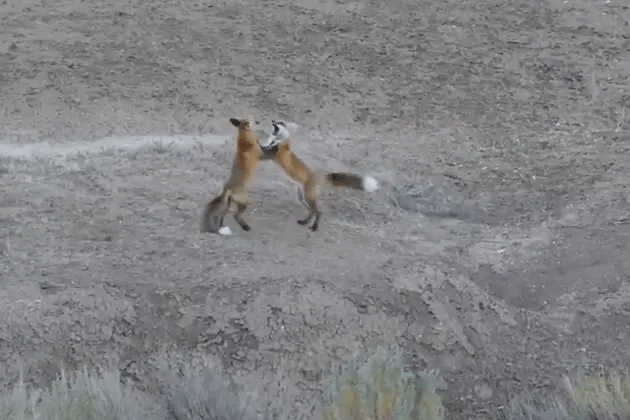
He is not wrong about the dispersal. Red foxes are extraordinary colonizers, and the Australian invasion is among the most dramatic examples of rapid mammalian range expansion in the historical record. I have red foxes come through my backyard here in Ohio and have sat and watched them play in the desert of the Bighorn Basin in Wyoming. They have adapted to every corner of the globe except the forementioned Australian continent. But Robinson’s argument, like a good number of apologetic arguments drawn from nature, proves rather less than it intends — and, looked at more carefully, actually generates a significant problem for the young-earth creationist framework it is meant to support. The issue is not with what the red fox did in Australia. The issue is with what it conspicuously failed to do.
It failed to this point to become something other than a red fox.
What Young-Earth Baraminology Claims About the Canid Family
To understand why this matters, let me remind you of the young-earth creationist model for the origin of species and particularly as it applies to the dog family. The framework goes by the name baraminology, derived from the Hebrew bara (created) and min (kind), and it proposes that God created a limited number of distinct biological “kinds” during the creation week. After Noah’s Flood, the representatives of each kind that survived on the Ark diversified rapidly — through natural selection, genetic sorting, geographic isolation, and perhaps additional mechanisms — into the species we see today.
For the canid family (Canidae), the implications of this model are considerable. Answers in Genesis and Creation Ministries International both teach that all living canids, the 36 recognized species including wolves, coyotes, jackals, African wild dogs, dholes, and all twelve species of foxes in the genus Vulpes, are all descended from a single ancestral pair that boarded Noah’s Ark. This is the explicit teaching found on the signage at the Ark Encounter attraction and in numerous AiG and CMI publications. To that already impressive roster of living diversity, we must add the extinct canids known from the recent fossil record — the dire wolf (Aenocyon dirus), the bush dog ancestors, and dozens of other fossil taxa — all of which, in the YEC framework, must also be post-Flood descendants of that same founding pair.
The numbers here are important. If we conservatively count 36 living species and a comparable number of extinct ones known from Pleistocene deposits (deposits that YEC assigns to the post-Flood period), we are looking at a minimum of 60 to 80 canid species that would need to have differentiated from a single ancestral “kind” within roughly 4,500 years (really from 4100 to 4500 years ago since all known species have been around since the last Ice Age). Some YEC researchers, to their credit, acknowledge the implications of this. Geneticist and baraminologist Todd Wood has noted candidly that the rates of diversification implied by this model are far faster than anything proposed by conventional evolutionary biology — which is precisely the argument I and others have called the “hyperevolution paradox.” YEC requires more rapid speciation than mainstream science proposes, not less.
This background is essential. Robinson’s article invokes the fox’s dispersal speed as evidence that the post-Flood world could accommodate rapid animal movement. But the YEC model requires not merely rapid movement but it requires rapid speciation. Those are very different claims, and the red fox’s actual biological history addresses them in ways Robinson’s brief article does not anticipate.
Australia as an Inadvertent Controlled Experiment
Let us take Robinson’s Australian example as an opportunity to test some creationist ideas. Which is to say, let us ask not merely whether foxes spread quickly, but what happened genetically and taxonomically to those foxes as they spread.
The founding population was small. Genetic studies trace the Australian population primarily to deliberate releases in southern Victoria around 1870–1871 — Werribee, Geelong, and Ballarat — imported from Great Britain. From that narrow genetic bottleneck, foxes expanded across 80% of a continent the size of the continental United States in approximately 60 to 100 years. The expansion was, as Robinson correctly notes, remarkable.
But recent genomic analyses using tens of thousands of SNP markers tell the rest of the story. Australian foxes exhibit moderate genetic diversity — lower than their British source populations due to the founding bottleneck, as one would expect. More striking is the near-complete absence of internal population genetic structure across the entire continent. A study of populations in New South Wales found no significant genetic barriers to dispersal anywhere in the study area, with high identity-by-descent values indicating that the continent-wide population functions as a single, highly connected gene pool. There is, in short, no meaningful differentiation between foxes in Queensland and foxes in South Australia. They are, genetically and taxonomically, the same animal — Vulpes vulpes — as the British foxes that produced them 150 years ago.
Now consider what 150 years represents in the YEC post-Flood timeline. If the Flood occurred approximately 4,500 years ago and the Ice Age lasted perhaps 500 years afterward, then the entire post-Flood dispersal window is roughly 4,000 years. One hundred and fifty years is not a negligible fraction of that window. It is nearly 4% of all the time YEC allows for the full diversification of the canid family from a single pair into 36 or more species. The Australian foxes had abundant opportunity: a new continent, novel prey, novel parasites, novel climate gradients from tropical north to temperate south, severe founder bottlenecks, and geographic isolation from their source population. They had, in other words, precisely the conditions that YEC models invoke to explain rapid speciation elsewhere. The result was not a new species. The result was not even a recognized subspecies. The result was foxes.
A Scorecard of Natural Experiments
The Australian case is not the only data point available to us. The scientific literature on red fox population genetics provides at least four independent natural experiments in isolation and potential divergence, spanning very different time scales. When we lay them out together, they tell a consistent and theologically instructive story.
The Isle of Wight (fewer than 200 years). Foxes were introduced to this small island off the southern coast of England for sport hunting in the mid-nineteenth century. A 2024 analysis by Williams and colleagues of mitochondrial DNA from 53 individuals found that the island population has diverged substantially from mainland England, with a mean FST — a standard measure of genetic differentiation — of 0.53. Two of the four haplotypes found on the island are private to the Isle of Wight, found nowhere else. The tidal waters of the Solent, barely 1.2 kilometers wide, act as a nearly complete barrier to gene flow. This is genetically significant differentiation produced in under two centuries. But nobody — including the researchers — is suggesting that Isle of Wight foxes are becoming a new species. They remain Vulpes vulpes, distinguished from their mainland relatives by reduced diversity and founder-effect signatures, not by the accumulation of reproductive isolation.
Japan (9,000 to 13,000 years). The Hondo red fox (Vulpes vulpes japonica) on the three main islands of the Japanese archipelago — Honshu, Shikoku, and Kyushu — was isolated by rising sea levels following the last glacial maximum, somewhere between 9,000 and 13,000 years ago. A 2025 whole-genome analysis by Amaike and colleagues found island-specific patterns of homozygosity, unique demographic trajectories on each island, and sufficient differentiation that the researchers recommended each island population be recognized as a distinct “evolutionarily significant unit” for conservation purposes. After 9,000 to 13,000 years of isolation — more than twice the entire post-Flood window that YEC allows for the diversification of all canids — Japanese foxes are still foxes. Biologists debate whether they are distinct enough to deserve subspecific recognition. Nobody is proposing they have generated a new species.
North America (approximately 400,000 years). Here we reach the most revealing data point of all. Red foxes first colonized North America during the Illinoian glaciation, approximately 300,000 to 400,000 years ago. These initial colonists were subsequently isolated south of the massive continental ice sheets, evolving in isolation from their Eurasian relatives for hundreds of thousands of years. A second wave arrived from Eurasia via Beringia during the Wisconsinan glaciation, roughly 50,000 to 100,000 years ago, producing the Holarctic lineage now found in Alaska and western Canada. The genetic divergence between the Nearctic (North American) and Holarctic (Eurasian) lineages is substantial — the mean FST between the two continental clades is approximately 0.23, comparable in magnitude to the divergence seen between recognized sister species elsewhere in the genus Vulpes. Some researchers now argue for restoring the name Vulpes fulva to the North American populations, elevating them to full species status. Four hundred thousand years of isolation, in radically different environments, producing animals that some specialists would classify as a separate species — and we are still having a taxonomic debate about whether they cross the species threshold.
Let me state what this scorecard means as plainly as I can. In 150 years, foxes in Australia remained foxes. In 200 years, foxes on the Isle of Wight remained foxes. In 9,000 to 13,000 years, foxes in Japan remained foxes — perhaps justifying distinct subspecific recognition. In 400,000 years, foxes in North America diverged to the point where some specialists debate whether they constitute a separate species. Now YEC baraminology asks us to believe that the ancestral canid pair, beginning 4,500 years ago, gave rise not only to all living fox species, including the red fox itself, but also to wolves, coyotes, jackals, African wild dogs, and many dozens of extinct forms, all within a window shorter than the Japanese fox isolation. The red fox’s own natural history makes this ask extraordinary.
The Timing Problem: Already a Fox Before the Ice Age
There is a further difficulty that Robinson’s article does not address, one that I find particularly challenging for the YEC model. His argument requires that the ancestor of the red fox dispersed from the Middle East after the Flood, spread across Eurasia, crossed Beringia into North America, and reached South America — all within the post-Flood period. But the genomic data place the Nearctic-Holarctic split at roughly 400,000 years ago, well before even the most generous YEC dating of the Flood. And the fossil record places recognizable Vulpes vulpes specimens in European deposits from 1.8 million years ago.
In YEC chronology, the Ice Age follows the Flood within a few centuries, perhaps 200 to 700 years after the waters receded. The land bridges that Robinson invokes as dispersal corridors — the connection across Beringia, the exposure of continental shelves linking islands — are products of the Ice Age. So the sequence YEC needs is something like this: the Flood occurs; within a few decades, the ancestral canid pair diversifies into recognizable red fox populations; within a few centuries, those red foxes cross Beringia into North America before the land bridge closes; and then those North American populations diverge from their Eurasian relatives, accumulating the genetic differentiation we now measure as FST = 0.23. But 400,000 years’ worth of genetic divergence cannot be compressed into 4,500 years without invoking mutation rates that would, as other researchers have shown, produce catastrophic genetic load — a problem John Sanford’s own genetic entropy model makes worse, not better, for YEC.
In other words, the red fox was already a red fox — and had been for a very long time — before the Beringian crossings that YEC needs it to have made as a freshly minted post-Flood species. This is not an external scientific objection imposed on the YEC framework. It is a problem that arises directly from the genomic data on the animal that Robinson chose to celebrate.
The Genetic Variation Paradox
One more dimension of the red fox’s genetic profile deserves attention. The species harbors remarkable genetic diversity. Overall haplotype diversity in European red foxes approaches 0.948, among the highest recorded for any widespread mammal. The basal lineages — the most ancestrally ancient genetic variants — are concentrated in the Middle East, specifically Eastern Arabia and Iran, which is consistent with the Middle East as the center of origin from which the species radiated outward.
Some YEC researchers, particularly Nathaniel Jeanson of AiG, have proposed that this kind of pre-existing genetic variation is precisely what allows post-Flood speciation to proceed rapidly. The ancestral “kind” pair was created with front-loaded diversity, the argument goes, and natural selection and genetic drift sorted that diversity into daughter species as populations dispersed and were isolated. It is a creative proposal, and I have addressed it at greater length in other posts. But it runs into a specific problem here. If front-loaded genetic variation is the engine of rapid post-Flood speciation, and if the red fox has abundant genetic variation distributed across isolated populations on multiple continents and island chains — then why haven’t we observed any new species emerging? The Isle of Wight foxes have been isolated and subject to genetic drift. The Japanese island populations have been isolated for 9,000 to 13,000 years. The Australian population was founded from a bottleneck and exposed to a radically novel environment. If the mechanism works the way YEC needs it to work for canid diversification, it should be working in these populations. We should be watching new species form in real time, or at least watching populations cross recognized species boundaries. We are not.
The red fox’s genetic variation is real, extensive, and well-documented. What that variation has not done, in any of the natural experiments available to us, is generate reproductive isolation at the rate YEC requires. High genetic variation, it turns out, does not by itself produce rapid speciation. This is not a surprise to population geneticists, who have long understood that speciation requires not merely diversity but the right kinds of genetic changes — particularly those affecting reproductive compatibility — in concert with sustained isolation. Red foxes in Australia, Japan, and North America have had geographic isolation. They have had genetic variation. They have experienced strong natural selection in novel environments. And they remain, after all of it, red foxes.
Reading Creation Honestly
I want to be clear about what I am and am not arguing here. I am not suggesting that Robinson’s enthusiasm for God’s creation is misplaced — watching a population of foxes spread across a continent in a human lifetime is genuinely remarkable, and the instinct to see in such things a reflection of divine creativity is a good one. Nor am I suggesting that the question of how animals dispersed after the Flood is a trivial one. These are real questions that deserve careful answers.
What I am suggesting is that Robinson has drawn a conclusion that the data do not support. Rapid geographic dispersal is not the same thing as rapid speciation. A fox that travels 3,000 kilometers is still a fox. A population that colonizes a continent is not thereby becoming a new genus. And when we examine the actual genetic record of red fox populations across multiple isolation events, spanning a range from 150 years to 400,000 years, what we find is a consistent and rather humbling picture: speciation in canids is slow, requires sustained isolation across very long timescales, and nowhere approaches the rates that the YEC model needs in order to generate 36-plus living canid species from a single founding pair in 4,500 years.
The protestant Christian tradition has long affirmed that God speaks through two books — Scripture and creation — and that these two, rightly read, cannot contradict each other. Calvin insisted that nature is a theater of God’s glory, and the Belgic Confession affirms that creation is “before our eyes as a most elegant book.” The elegant book of red fox genomics is telling us something. It is telling us that canid diversification is a slow, deep-time process — one that left its fingerprints in the genetic distances between a fox in Ohio and a fox in Tokyo, in the private haplotypes of a small island population, in the contested taxonomy of a North American lineage isolated for nearly half a million years. That story does not threaten Scripture. It enriches our understanding of the world God made and sustains. It does, however, challenge a particular young-earth model that was not derived from Scripture in the first place, but from a 20th-century interpretive tradition that, as this and many other lines of evidence suggest, has asked creation to say something it is not saying.
We do our brothers and sisters in our churches no favors by telling them that the Australian fox invasion confirms post-Flood biogeography, when the same fox’s genetic history examined carefully, using the same genomic methods that YEC organizations invoke when it suits them, tells a very different story. The fox, it seems, has been a fox for a very long time. And that is its own kind of testimony to the patience and wisdom of its Creator.
Blessings,
Joel
References
Scientific Literature
Aubry, K. B., et al. (2009). Phylogeography of the North American red fox: Vicariance in Pleistocene forest refugia. Molecular Ecology, 18(6), 1056–1070.
Fairfax, R. J. (2019). Dispersal of the introduced red fox (Vulpes vulpes) across Australia. Biological Invasions, 21(4), 1259-1268.
Leite, J. V., et al. (2015). Genetic background of North African foxes and the relationship with the Rüppell’s fox. Organisms Diversity & Evolution, 15(4), 731–745.
Sacks, B. N., et al. (2011). A restricted hybrid zone between native and introduced red fox (Vulpes vulpes) populations suggests reproductive barriers and competitive exclusion. Molecular Ecology, 20(2), 326–341.
Statham, M. J., et al. (2014). Range-wide multilocus phylogeography of the red fox reveals ancient continental divergence, minimal genomic exchange and distinct demographic histories. Molecular Ecology, 23(19), 4813–4830.
Tomlinson, S., & Fordham, D. A. (2025). It took just 60 years for the red fox to colonize Australia. The Guardian, October 14, 2025.
Watanabe, T., Satoh, S. S., Shiraishi, T., Kubota, S., & Yamazaki, Y. (2025). Inter-Island Whole-Genome Comparison Reveals Micro-Evolutionary Dynamics of the Red Fox, Stimulated Through Post-Glacial Sea-Level Alterations. Genome Biology and Evolution, 17(8), evaf152. https://doi.org/10.1093/gbe/evaf152
Williams, N. F., Short, M., Andreou, D., Porteus, T. A., Stillman, R. A., Hoodless, A. N., & Hardouin, E. A. (2024). Ancestry and genetic differentiation of red foxes (Vulpes vulpes) on the Isle of Wight. Mammal Communications, 10, 8-14.
Young-Earth Creationist Sources
Robinson, P. (2018). The red blanket: The red fox in Australia — helping us understand migration after the Genesis Flood. Creation, 40(3), 12–13. https://creation.com/en/articles/the-red-blanket
Wieland, C. (2003). The grey blanket: What the story of Australia’s amazing rabbit plague teaches us about the Genesis Flood. Creation, 25(4), 45–47. creation.com/blanket
Recommended Further Reading
Duff, R. J., Beatman, T. R., & MacMillan III, D. S. (2020). Dissent with modification: how postcreationism’s claim of hyperrapid speciation opposes yet embraces evolutionary theory. Evolution: Education and Outreach, 13(1), 9.
Statham, M. J., et al. (2012). The origin of recently established red fox populations in the United States: Translocations or natural range expansions? Journal of Mammalogy, 93(1), 52–65.
Rick, T. C., Erlandson, J. M., Vellanoweth, R. L., Braje, T. J., Collins, P. W., Guthrie, D. A., & Stafford Jr, T. W. (2009). Origins and antiquity of the island fox (Urocyon littoralis) on California’s Channel Islands. Quaternary Research, 71(2), 93-98. [For a parallel case study of island isolation and the limits of rapid diversification in canids.]


Considering that,red fox, dog, wolf as well as some other canids were already known to the Romans 2000 years ago it means speciation occurred between 4500 years ago and 2000 years ago…virtually reducing evolution time to half.
LikeLike