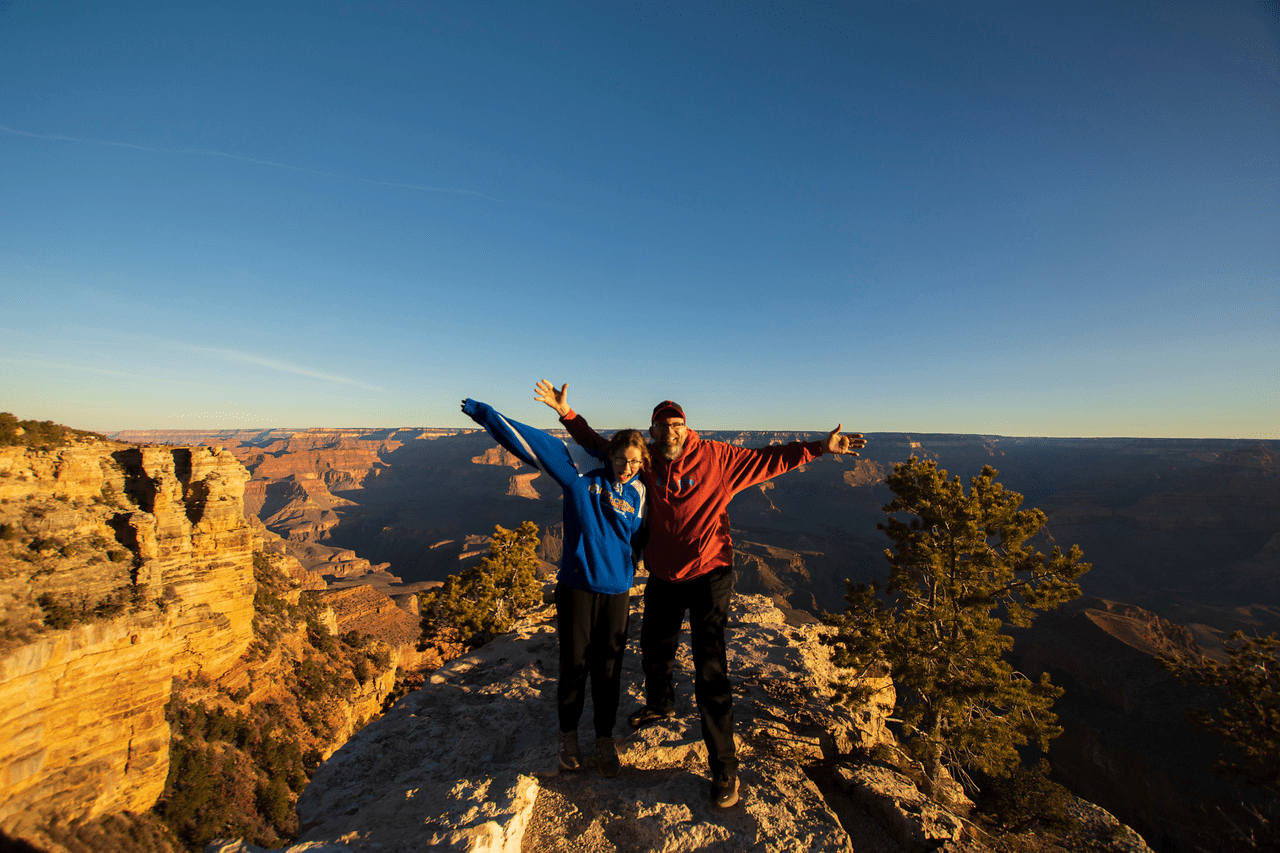
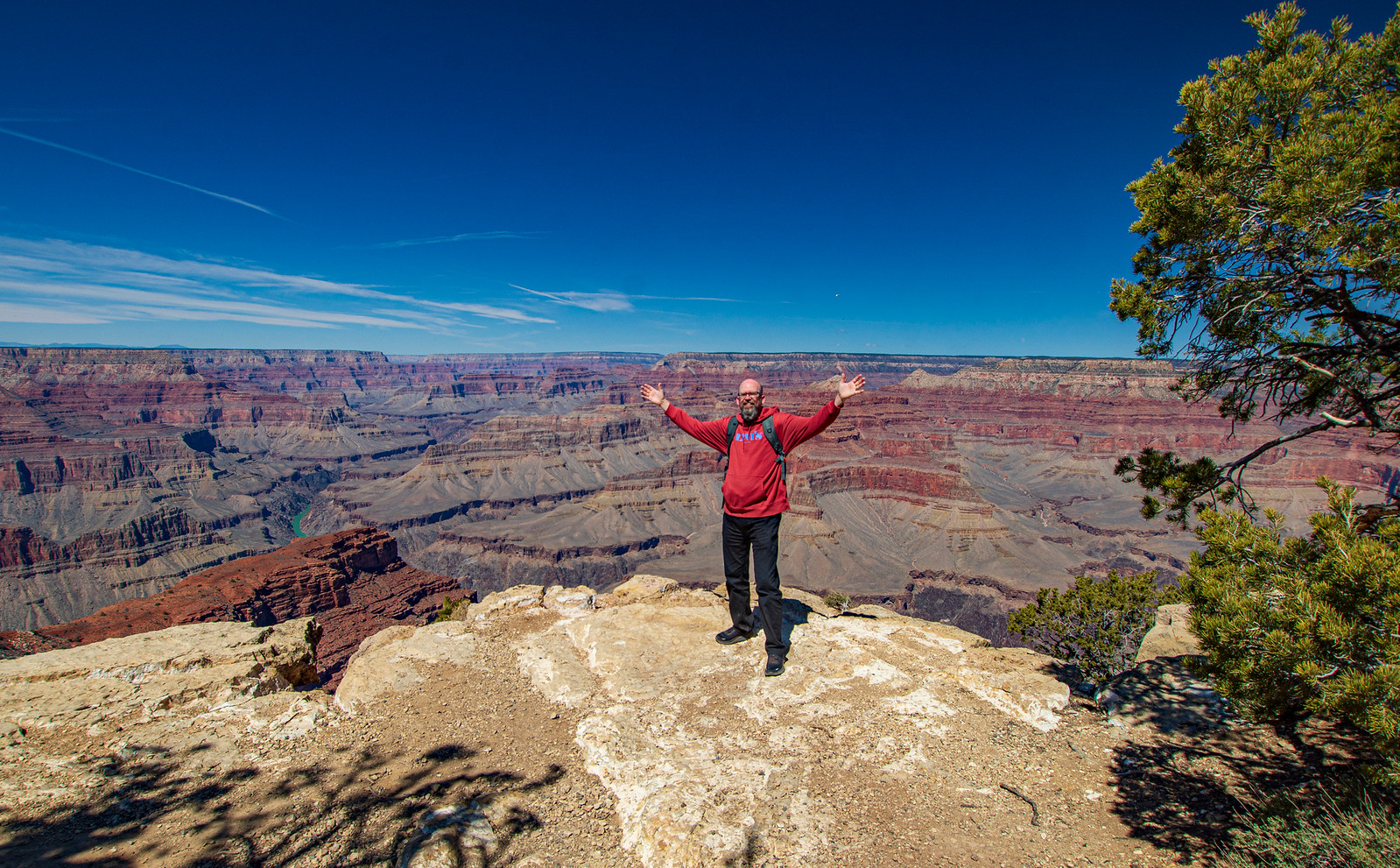
I have spent many hours standing at the rim of the Grand Canyon, watching the Colorado River far slip by far below. I have visited with my family, and photographed the canyon’s strata at sunrise. Every time I return, I am struck anew by the sheer improbability of the place and I expect that most that visit feel some need to understand its origins. The Grand Canyon has, for this reason, become something of a Rorschach test for how different communities read God’s creation. What you see when you look into that abyss tells you a great deal about what you believe the creation is permitted to say on its own terms.
That context is worth keeping in mind as we turn to a significant new paper published this year in the journal Science (and overview can be read HERE). The study, authored by He and colleagues (2026), addresses one of the more enduring puzzles in Colorado River geology: there is good geological evidence that the river existed in western Colorado as far back as 11 million years ago, yet the river’s characteristic sediment signature doesn’t appear at the mouth of the Gulf of California until approximately 5.6 million years ago. Where was all that water going for those 5 million years?
He et al. offer an answer to that question. It’s not a unique or new hypothesis but rather they provide evidence to support one of the hypotheses of the origins of the Grand Canyon. They evidence is grounded in the painstaking analysis of thousands of tiny mineral grains called detrital zircons — and the interpretation of that evidence has implications that extend well beyond the technical literature. Because I am quite confident that this paper will be celebrated in young-earth creationist (YEC) circles as a vindication of their longstanding claims about how the Grand Canyon formed, I want to work through the study before those celebrations begin in earnest.
Let me be clear about my purpose here. I am not writing to dismiss the He et al. study. I’m here to do quite the opposite. I think it is excellent science that deepens our understanding of a complex geological system in genuinely important ways. What I want to do is examine what the study actually shows, contrast that with what YEC advocates will likely claim it shows, and explain why those two things are not remotely the same. If that exercise seems premature (if I am getting ahead of a response that hasn’t appeared yet) I would gently observe that after three decades of watching how the major creationist organizations handle new geological research, I have found that a little anticipation is usually warranted.
What the Study Actually Found
The central contribution of He et al. is methodological as much as it is geological. The researchers analyzed thousands of detrital zircon (DZ) crystals collected from sedimentary formations upstream and downstream of the Grand Canyon. Zircon is a mineral that incorporates uranium into its crystal structure when it forms but excludes lead; because uranium decays to lead at a known rate, zircon crystals act as radiometric clocks that can be dated with extraordinary precision. But beyond their utility as chronometers, zircon crystals from different geological source regions have distinctive age signatures — combinations of ages that reflect the particular mixture of ancient rocks in their drainage area. Those signatures function, in the study’s own language, as geological “fingerprints.”
The fingerprint in question here is the ancestral Colorado-Green River system, which drains a distinctive mix of Precambrian, Paleozoic, and Mesozoic source rocks in the Rocky Mountain interior. When He et al. examined zircon populations from the Bidahochi Formation (a sedimentary unit deposited in what is now northeastern Arizona, in the basin that geologists call the Bidahochi or Hopi Lake basin) they found that Colorado-Green River zircon signatures appear in that formation at approximately 6.6 million years ago (Ma). This is significant. It means the ancestral Colorado River was delivering sediment to a large, long-lived lake that occupied this basin well before the modern canyon existed. The river arrived at the upstream basin, filled it, and eventually (approximately 1.2 million years later) overtopped the Kaibab Arch, the structural high that separates the Bidahochi basin from the downstream drainage. That integration event, which the authors date to between 5.6 and 4.8 Ma, is when the Colorado River “found its way” to the sea and began the long process of cutting the modern canyon.
This model is called the lake spillover hypothesis, and it has a long history in Colorado River geology going back at least to the mid-twentieth century. What He et al. have provided is the most precise and well-documented zircon-based confirmation of that model to date. They have constrained the timing of the river’s arrival in the Bidahochi basin, documented the lag between upstream arrival and downstream integration, and used these data to argue for a coherent sequence of events: river arrives, lake fills over roughly a million years, lake overtops the Kaibab, integration follows, and the Colorado is on its way to the Gulf of California. The downstream canyon we see today represents the subsequent product of millions of years of river incision — a separate and ongoing process that the paper explicitly distinguishes from the initial drainage integration event.
What YECs Will Claim the Study Shows
Now let us turn to the part that will be, I suspect, rather frustrating to the authors of the He et al. paper should they ever happen upon creationists literature. Young-earth creationism has maintained a version of a lake-spillover or dam-breaching model for the Grand Canyon since at least the 1960s, and that model was given its most detailed recent formulation by geologist Steve Austin, whose work has been published by the Institute for Creation Research and whose 1994 book Grand Canyon: Monument to Catastrophe remains the most systematic YEC treatment of the canyon’s geology. Walt Brown’s hydroplate theory offers a related but distinct catastrophic mechanism. The common thread in these models is that one or more large post-Flood lakes — typically called the Hopi Lake and the Canyonlands Lake — catastrophically breached their natural dam at the Kaibab Arch, releasing enormous volumes of water that carved the Grand Canyon in a geologically brief time — on the order of weeks to, at most, a few years.
When He et al.’s paper becomes widely known in YEC circles, I expect we will hear something along the following lines: “Even secular geologists now admit the canyon was formed by lake spillover.” We will hear that mainstream science has finally “caught up” with what creationists have been saying for decades. We will hear that the existence of the large Hopi Lake in the Bidahochi basin — a lake that He et al. confirm was real, was large, and did ultimately overflow — vindicates the YEC model. And we may even hear suggestions that the “catastrophic” language sometimes applied to lake integration events supports the idea of a rapid, violent formation of the canyon itself.
I want to take these claims seriously, because they have a surface plausibility that deserves a direct response. It is true that He et al. use the word “spillover.” It is true that a large lake in the Bidahochi basin is confirmed by the zircon data. It is true that the overtopping of the Kaibab Arch represents a threshold event — the kind of thing that, once started, would have proceeded irreversibly. On each of these points, there is a genuine overlap of vocabulary between the mainstream spillover model and the YEC catastrophic breach model. The overlap, however, is almost entirely superficial. When you move from vocabulary to the actual content of the two models, the differences are so fundamental that calling them versions of the same hypothesis would be like noting that surgery and a car accident both involve cutting and calling them equivalent processes.
Those Troublesome Details: Four Points of Irreconcilable Difference
The 1.2 Million Year Waiting Room. The single most important number in the He et al. paper, from the standpoint of evaluating YEC claims, is not the age of the canyon or the age of the Bidahochi Formation. It is the lag time between the river’s arrival in the basin and its subsequent integration with the downstream drainage. The zircon data show that Colorado River sediments begin appearing in the Bidahochi Formation at approximately 6.6 Ma. The river does not make its way past the Kaibab Arch until 5.6 to 4.8 Ma — a difference of roughly 1.0 to 1.8 million years. That is the duration of the lake-filling phase. The river arrived, the lake filled, and eventually the water level rose high enough to overtop the structural high and integrate with the downstream system.
Let us think carefully about what this means for the YEC model. The catastrophic breach hypothesis requires that we compress this entire sequence (arrival of the river in the basin, lake formation, lake filling, and catastrophic release) into the post-Flood period, which in YEC chronology spans a few centuries to a few thousand years at most. But the He et al. data document a lake-filling phase of approximately 1.2 million years, confirmed by the stratigraphic position of zircon-bearing sediments and corroborated by independent dating of volcanic ash layers in the Bidahochi Formation. There is no geologically reasonable mechanism by which a 1.2 million year filling phase becomes a few centuries. If the radiometric dates are accepted as meaningful, and they would need to be, since they are the basis for claiming the lake existed at all, then the timeline they encode cannot be arbitrarily truncated.
This creates a logical problem that I would invite YEC advocates to address directly: if you appeal to this paper as evidence for your lake spillover model, you are appealing to a paper whose dating methods document a lake-filling duration approximately ten thousand times longer than your model can accommodate. You cannot claim the fingerprint while rejecting the clock that tells you how long the fingerprint took to form.
Integration vs. Excavation: A Distinction That Matters Enormously. The second major problem is that the He et al. paper is not primarily a paper about how the Grand Canyon was carved. It is a paper about how the Colorado River drainage was integrated — how the river found a continuous path from the Rocky Mountain interior to the sea. These are related but distinct questions, and the authors are careful to maintain the distinction. The spillover event they document established the route of the river; it did not excavate the canyon. As He et al. note, the canyon’s depth is the product of subsequent incision — the river cutting downward into the Colorado Plateau over millions of years after the drainage was integrated.
The YEC model, by contrast, requires the breach event to accomplish both tasks simultaneously: the catastrophic release of lake water not only establishes the river’s course but excavates approximately 800 cubic miles of rock in a matter of weeks or a few years. The He et al. study says nothing to support this. In fact, the study’s framework — a lake filling over 1.2 million years, overtopping its dam, and integrating with a downstream system that then incised the canyon over millions of additional years — is precisely the model that requires the YEC catastrophic excavation hypothesis to be wrong. The canyon’s walls, sitting where they do, record the slow accumulation of incision that followed integration. They are not the walls of a drain; they are the walls of a gallery that took millions of years to open.
The Radiometric Paradox. There is a deep irony in YEC engagement with studies like He et al. that deserves explicit attention. The entire evidentiary foundation of this paper rests on uranium-lead (U-Pb) radiometric dating of zircon crystals and on the dating of volcanic ash (tephra) layers laid down within the Bidahochi Formation sediments. The age of 6.6 Ma for the first appearance of Colorado River zircons in the Bidahochi basin is not an estimate or a rough approximation. It is the result of precisely the kind of isotopic analysis that YEC geologists like Andrew Snelling have spent careers attempting to discredit. The age of 5.6 Ma for the integration event is similarly grounded in radiometric data.
Here is the problem: YEC advocates cannot selectively embrace the conclusions of a study while simultaneously rejecting the methods that produced those conclusions. If U-Pb zircon dating is unreliable — if, as many YEC authors argue, radiometric decay rates were dramatically accelerated during the Flood or in the immediate post-Flood period, rendering all radiometric ages meaningless — then the He et al. paper provides no evidence for the existence of a large Hopi Lake at any particular time. The lake’s age, its duration, and the timing of its overflow are all products of the dating methods. You cannot claim the lake while throwing out the clock. And if you accept the clock, you have accepted a lake-filling phase of more than a million years, which is simply incompatible with YEC chronology.
I have watched this pattern recur in YEC literature across many topics: a mainstream paper is cited as support for a YEC interpretation, but the citation depends on the paper’s conclusions while ignoring — or actively contradicting — the methods and timescales that produced those conclusions. This is not a minor rhetorical inconsistency. It is a fundamental methodological problem that ought to trouble anyone who is committed to following the evidence honestly, wherever it leads.
What the Fossils in the Bidahochi Formation Are Doing. The Bidahochi Formation, which accumulated in the lake basin that He et al. are studying, contains fossil fish — specifically, large fish characteristic of stable lacustrine and fluvial environments. These are not the scattered, chaotic remains of organisms swept up in a catastrophic flood and deposited in a transient basin. They are the remains of fish that lived in this lake, that had time to establish viable populations, that inhabited a stable enough environment to leave a meaningful fossil record across the formation’s stratigraphic extent.
A post-Flood catastrophic breach model requires that the Bidahochi basin existed as a transient, chaotic environment. It must have been a short-lived lake formed rapidly after the Flood, filled quickly, and then catastrophically drained. Stable fish populations, thriving over enough time to produce a meaningful fossil record distributed through the formation, simply do not fit that picture. Ecosystems take time to establish. Populations require generations. The biological evidence from the Bidahochi Formation is consistent with the He et al. timeline of a long-lived, stable lake; it is not consistent with a brief post-Flood basin that existed for a few centuries before catastrophic collapse.
The Deeper Pattern: Why This Keeps Happening
If you have read this blog for any length of time, you may recognize the pattern I am describing. A mainstream scientific paper uses methods that YEC organizations generally reject to produce conclusions that, on the surface, seem to partially overlap with a YEC model. YEC communicators then cite the paper’s conclusions — stripped of their methodological and chronological context — as vindication. The audience, most of whom have not read the original paper, comes away thinking that secular science is converging on creationist geology.
I documented a version of this dynamic extensively in my series on the salty sea argument, where YEC organizations continued using a line of reasoning long after the published scientific literature had addressed its central problems — problems that, had they been read and engaged honestly, would have required substantial revision of the argument. The Grand Canyon has been a particularly fertile ground for this kind of selective citation, because the canyon’s formation is genuinely complex, because it does involve a real lake and a real spillover event, and because the sheer drama of the canyon makes it emotionally compelling as evidence for catastrophe.
But I want to be careful here not to attribute bad faith where confusion or motivated reasoning may be a more charitable explanation. I am quite certain that most of the lay Christians who will encounter a YEC response to He et al., in a church bulletin, on a podcast, at a homeschool curriculum fair, will not have access to the original paper. They will hear “even secular geologists now admit lake spillover” and they will file that away as a data point in favor of YEC geology. They are not being dishonest; they are trusting communicators who have credentialed themselves as interpreters of scientific evidence. The responsibility for accurate characterization rests with those communicators, not with their audience.
This is precisely why I think it is important to engage these questions before the secondary literature catches up with the primary literature. The He et al. paper is excellent science. It will be misused. And the misuse will be more difficult to correct once it has been embedded in the enormous infrastructure of YEC popular communication — the books, the websites, the museum signage, the curriculum guides — that shapes how millions of American evangelical Christians understand geological evidence.
What This Study Actually Invites Us to Appreciate
Let me close by returning to the canyon itself, because I think what is lost in the YEC appropriation of studies like He et al. is something genuinely worth mourning. The story that the zircon data tell is, if you allow yourself to follow it, a story of extraordinary beauty and complexity. A river system in what is now Colorado begins, eleven million years ago, to carry sediment westward. It arrives at the Bidahochi basin and fills a lake that persists — stable, biologically productive, geologically active — for more than a million years. The lake slowly rises. Eventually, water crests the Kaibab Arch, and the river, finding a new path, begins the work of integration with the drainage to the west. Then, over the subsequent millions of years, the river cuts downward through the Colorado Plateau, layer by layer, exposing the Proterozoic basement rocks that now form the Inner Gorge. The strata visible in the canyon walls represent not weeks of catastrophic deposition but hundreds of millions of years of Earth history — Cambrian seas, Permian deserts, Pennsylvanian swamps — all of it laid down before the river ever existed, waiting patiently to be read.
I do not see why this story requires compression to be magnificent. Calvin’s doctrine of secondary causes — the conviction that God’s providential governance of the creation operates through the natural processes he has ordained — has always seemed to me a more theologically robust framework for understanding geology than the view that God must have acted in ways that override or shortcut natural processes to make the evidence fit a predetermined timeline. The rocks are not a problem to be explained away. They are, in the language of Psalm 19, part of the speech that pours out day after day — a speech that does not use words, that has no voice or language, but whose proclamation goes out through all the earth.
The Grand Canyon, read on its own terms, read as the He et al. paper invites us to read it, is a six-million-year testimony to a river finding its way home. The zircons embedded in the Bidahochi Formation are tiny, durable witnesses to that journey. They do not vindicate catastrophism. They record patience — the same patience that Calvin attributed to God’s governance of the natural world, and the same patience that honest inquiry into that world requires of us.
I am always happy to hear from readers who are working through these questions. If you have encountered a specific YEC response to the He et al. paper that you would like me to address more directly, please feel free to reach out.
Blessings,
Joel
Note: Thanks to a reader of this blog for pointing me to this paper and suggesting that YECs will likely be talking about this paper soon.
PS. On 4/28/26, just days after I published this article, ICR (Dr. Clarey) wrote an article about how this paper supports a global flood. https://www.icr.org/article/15902/
References and Further Reading
Scientific Literature
He, J., et al. (2026). Late Miocene Colorado River arrival in the Bidahochi basin supports spillover origin of Grand Canyon. Science. Overview can be found here: https://www.science.org/content/article/grand-canyon-s-origin-resolved-ancient-lake-s-flood-may-have-etched-famed-gorge
Karlstrom, K. E., et al. (2014). Formation of the Grand Canyon 5 to 6 million years ago through integration of older palaeocanyons. Nature Geoscience, 7, 239–244.
Crossey, L. C., et al. (2015). Tracking the Colorado River through time: Placing the late Cenozoic river into its geological context. Geological Society of America Special Papers, 515.
Young, R. A., & Spamer, E. E. (Eds.) (2001). Colorado River: Origin and Evolution. Grand Canyon Association.
YEC Sources Referenced
Austin, S. A. (Ed.) (1994). Grand Canyon: Monument to Catastrophe. Institute for Creation Research.
Clarey, T. (2020). Carved in Stone: Geological Evidence of the Worldwide Flood. Institute for Creation Research.
Brown, W. (2008). In the Beginning: Compelling Evidence for Creation and the Flood (8th ed.). Center for Scientific Creation.
Recommended for Further Reading
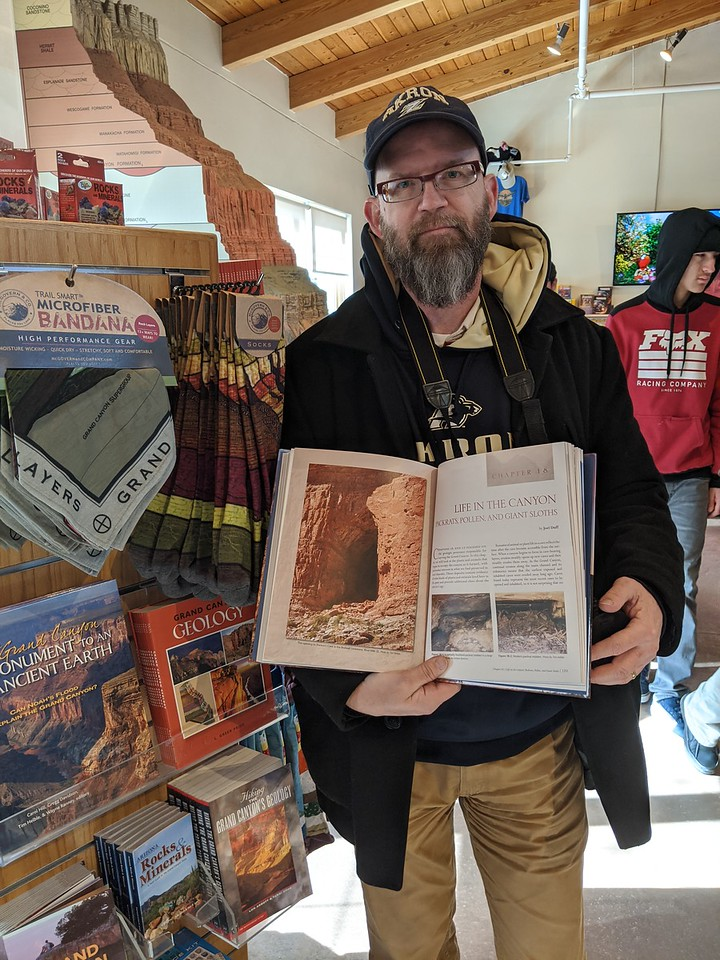
Hill, C., Davidson, G., Helble, T., & Ranney, W. (Eds.). (2016). The Grand Canyon: Monument to an Ancient Earth: Can Noah’s Flood Explain the Grand Canyon? Kregel Publications. [Full disclosure: I contributed to this volume.]


As you know, the YEC RATE project accepts relative radiometric dates, but postulates accelerated decay during the Flood Year. Presumably they would extend this to the period you were discussing, as indeed they must, to include everything older than about 6000 years. I don’t know how they’d dispose of the evidence for the lake ecosystem to have developed, but again they have exactly this problem with the diverse ecosystems of all the separated lakes in Africa.
More importantly, your technique of getting good information out an anticipation of bad is precisely what’s recommended in the Debunking Handbook, by the invaluable Stephan Lewandowsky, John Cook, and colleagues; https://skepticalscience.com/docs/DebunkingHandbook2020.pdf
I refer to the Monument to an Ancient Earth book on every possible occasion
LikeLiked by 1 person
It is precisely that pattern of cherry-picking the bits of science that seem to support their YEC agenda, while ignoring all the methodology and data analysis, that convinces me of the fundamental dishonesty at the core of Evangelical Christianity. As you say, the lay person knows nothing of the actual science, but YEC “scientists,” especially those with legitimate degrees, must be aware of their own dishonesty. I don’t understand how people square that with the idea that their god is the embodiment of truth, but somehow they do. Sad.
As an atheist, I obviously disagree with your conclusion about natural theology, Joel, but you know that I respect your communication of good scientific methodology and understanding tremendously. Thank you for all you do!
LikeLike
Hi Charles, I’ve completed neglected my moderating duties (forgot I had moderation set on the blog) and so just seeing your comments now. Thanks for sharing. Appreciate so much the interest despite our differences.
LikeLike