Jim Stump’s book, The Sacred Chain: How Understanding Evolution Leads to Deeper Faith, is a thoughtful exploration of the intersection between science and faith, particularly questions of evolutionary biology and religious belief. Stump, vice president of BioLogos, who also co-edited How I Changed My Mind About Evolution, builds upon the earlier work, which compiled personal stories of individuals navigating their faith alongside scientific understanding. The Sacred Chain delves deeper. It is a deeply personal voyage that begins in early childhood and progresses through teenage years, college, and into professional life.
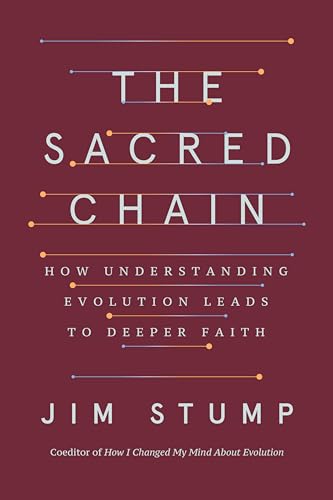
The book presents a series of challenges any Christian could face due to the clash between personal beliefs and scientific understanding. Through detailed accounts of individual experiences, specific scientific discoveries, and analogies, Stump discusses fundamental aspects of creation science, evolutionary biology, and the concept of deep time. He raises essential questions about the compatibility of the Bible as a sacred text with modern science, the implications of being created in the image of God, the lessons evolution teaches us about humanity, and how evolutionary science contributes to our understanding of pain, suffering, and the human soul. Throughout he encourages readers to explore their beliefs, assumptions, and convictions, even when they lead to difficult questions or challenges to traditional views.
Stump’s narrative is not just an intellectual journey but also an emotional and spiritual one. He discusses his transition from a conservative Christian upbringing to a more inquisitive approach to faith, emphasizing the importance of questioning and seeking answers for oneself. The book is rich with examples, analogies, and personal anecdotes that make complex scientific and theological concepts accessible and relatable ultimately challenging the reader to think about creation and how “God didn’t creation things originally the way they were ultimately intended to be.”
“The Sacred Chain” does an admirable job of making scientific concepts accessible and relatable. Stump uses detailed stories, analogies, and descriptions of key scientific ideas—such as creation science, evolutionary biology, and deep time—to engage readers with varied backgrounds. There were many places that he makes references to figures, literature, places that had me saying, Yes, that is just the right image! For example, a reference to a book that may not speak to many of his readers but definitely caught my attention was his mention of “Speaker for the Dead” by Orson Scott Card, in discussing language and symbolism.
The book concludes with a reflection on the value of questioning and the importance of dialogue between theological and scientific perspectives and what makes us human. Stump’s personal pilgrimage to places of historical and spiritual significance, including Oxford, England, to trace the steps of C.S. Lewis, vast redwood forests, the site where the first Neanderthal bones were found, the Ark Encounter and Creation Museums, caves in France to see some of the first artwork of “humans” and so many more places. Those encounters with our history and God’s creation underscores the physical and tangible aspects of his journey of faith and understanding. Stump’s philosophical insights, backed by a PhD in philosophy, through his engaging stories from his travels and interviews, enhance the reader’s understanding of scientific and theological issues.
Stump acknowledges that readers may not always agree with his conclusions, which are presented as part of an ongoing inquiry rather than definitive answers. This open-ended discussion reflects the book’s broader appeal, inviting readers from various backgrounds to engage with fundamental questions about life, the universe, and the interplay between faith and science.
Indeed, I did not find myself in agreement with all of Stumps conclusions and speculations but recommend the book to any seeker who wishes to engage themselves with ultimate questions about who we are and how God has made us and interacts with this world. Many of those with whom I engage will find broad agreement with the early chapters of this book but may find themselves having to step away from some of his latter conclusions but at least Stump will have provided you with a sense of what the assumptions and evidence there is for various viewpoints bringing you to a better understand of your own convictions while being challenged by other ideas.

