The Message and the Messenger, Part 2
In my last post I shared a sentence from a sermon by my pastor that has stayed with me: “The less access we have to someone’s character, the more cautious we should be about giving them sweeping authority over our lives.” I applied it to myself first, by way of five questions anyone can ask of a distant teacher. At the end I promised to put the same questions to the distant voices that have done the most to shape how many evangelical churches read Genesis.
That is what I aim to do in this post.
Let me begin with a concern I share. In 2009 Answers in Genesis published Already Gone, a book built on a survey AiG commissioned from America’s Research Group. The researchers interviewed 1,000 people in their twenties who had regularly attended conservative churches and no longer did. According to the book, 95 percent of them had been attending regularly in elementary school, and only 55 percent were still attending in high school. The authors concluded that the church is losing its children well before college.
That finding troubles me, and it should trouble every parent and elder who reads it. I have spent much of my career listening to young people who walked away from the faith, and I have hinted at many of those stories on my YouTube channel and my blog over the years.
But notice who offered the diagnosis and the prescription. The survey was commissioned, and the conclusions drawn, by a ministry outside every one of those churches. That ministry does not share their pulpits, it does not sit on their sessions, and it does not know their families personally. The question I want to explore is how a distant ministry came to hold so much authority over how local churches read the first chapters of the Bible, and why my own reformed Christian tradition never granted that authority to anyone outside the church’s own courts.
I want to follow my pastor’s example in one respect before going further. When he cautioned us about distant voices, he did not question anyone’s character. I will assume throughout that Ken Ham is a good man who sincerely believes what he teaches. My argument does not depend on anyone’s motives. It concerns the scope of authority relative to access, and it would apply just as well to a ministry that agreed with me.
The Case that Answers in Genesis Makes
Let’s start with what Answers in Genesis actually says. Its Statement of Faith, which all staff and volunteers are expected to affirm, is clear and carefully worded. That statemen has gone through many revisions over the years with the trend being each new version taking a more explicit and detailed stance on a broader array of issues. The one we will focus on here will be on the questions of origins.
On the days of creation it states that “the days in Genesis do not correspond to geologic ages but are six consecutive, 24-hour days of creation.” On the age of creation it states:
“Scripture teaches a recent origin of man and the whole creation, with history spanning approximately 4,000 years from creation to Christ.”
It then closes the door on alternatives:
“Any other views that try to fit evolution or millions of years into Genesis are incompatible with Scripture.”
And it sets the terms on which evidence will be received:
“No apparent, perceived, or claimed evidence in any field of study, including science, history, and chronology, can be valid if it contradicts the clear teaching of Scripture.”
Already Gone applies this framework to the local church. Its authors faulted what they called the “Sunday school syndrome” and argued that doubts about the historical reliability of Genesis lead children to doubt the rest of Scripture. Their remedy was for churches and parents to teach a young-earth reading of Genesis as foundational.
Two years later AiG turned the same lens on Christian higher education. For Already Compromised (2011), America’s Research Group surveyed leaders at 200 Christian colleges and universities, receiving 312 responses from presidents, vice presidents, and the heads of science and religion departments. Among the findings the authors highlighted was a reversal they found troubling: 77.8 percent of theology department heads favored old-earth creationism, while 57.1 percent of science department heads favored young-earth creationism. The authors described much of what they heard as “evangelical Newspeak,” traditional language used with a different meaning.
I share AiG’s conviction that Scripture is the inspired and authoritative Word of God. I share its grief over children who leave the church. Where we differ is on how Genesis should be read and on who has the standing to settle that question for a congregation. That second difference is the subject of this post.
Three Ways that AiG Relocates Authority
In my last post I described my pastor’s principle as a simple grid (repeated below). One axis is access, how much of a person’s life you can actually see. The other is the scope of authority you grant them, from a narrow claim at one end to how you live and whom you trust at the other. Low access joined to sweeping authority is the danger zone.
| Narrow authority (a claim, a lesson, a tip) | Sweeping authority (how to live, which churches to trust) | |
| High access | A friend recommends a book. A colleague corrects your data. Healthy and ordinary. | Elders who “keep watch over your souls” (Heb. 13:17). Appropriate, and accountable to a church court. |
| Low access | A distant teacher whose specific claims you test. Healthy if you act like a Berean. Most of my followers can be found here. | The danger zone. A distant voice telling you which churches are compromised, what a faithful Christian must believe about the age of the earth, whom to distrust. |
Now consider where the age of the earth belongs on that grid. Treated as a question about rocks, tree rings, ice layers, and radioactive isotopes, it sits comfortably in the narrow-authority column. The evidence is public. Anyone willing to do the reading can go backstage and check it, and the messenger matters relatively little. A Christian can learn about varves from a geologist whose name he will never know without handing that geologist any authority over his soul.
Yet in many churches the age of the earth has ended up in the opposite column, as a test of whether a pastor, a college, or a family is faithful. That shift has identifiable causes. As I read AiG’s materials, three moves relocate the question on the grid.
Move one: recast interpretation as authority. The first move changes the question being asked. “How should we read Genesis 1?” is a question about interpretation on which faithful Christians have differed for centuries. AiG consistently restates it as a question of trust: God’s word or man’s word. When I responded earlier this year to Ken Ham’s video “I Am Willing to Divide the Church Over This,” https://thenaturalhistorian.com/2026/03/15/ken-ham-i-am-willing-to-divide-the-church-over-this/ I noted that he frames the issue as “Does it really matter if we take God at his word?” rather than “Does it really matter how old the earth is?” Once the question is restated that way, nobody wants to be on the side of man’s fallible word, and the interpretive question quietly disappears.
Move two: tie the question to the gospel. The second move raises the stakes. The Statement of Faith declares that “the doctrines of Creator and Creation cannot ultimately be divorced from the gospel of Jesus Christ.” Every Christian should agree with that sentence as written, since the God who redeems is the God who created. But when “creation” is understood to include one particular reading of the days and one particular age of the earth, the sentence does much more. Disagreement about the length of a day becomes a disagreement that touches the gospel, and a disagreement that touches the gospel is a reason to separate. Pastor and YouTube evangelist Gavin Ortlund (recently called-out by Ken Ham for compromising the gospel) places six-day creation among the third-rank doctrines “it almost never makes sense to fight over.” Move two lifts it to the first rank.
Move three: evaluate the church from a distance. The third move puts the first two to work. Already Gone diagnoses local churches. Already Compromised grades Christian colleges. More than a decade ago I observed that this approach would “embolden the lay person to demand their leaders be orthodox in their views on Genesis 1,” so that “any person of authority in the church must practically swear some allegiance to a young earth theology or face grass roots retribution.” Earlier this year Ken Ham made the logic explicit in his video on dividing the church. I responded to that video at length in March, seven months before the sermon that prompted this series, and I will not repeat the whole argument here. https://thenaturalhistorian.com/2026/03/15/ken-ham-i-am-willing-to-divide-the-church-over-this/
Put the three moves together and watch what happens on the grid. A question that anyone can check becomes a question of loyalty. A question of loyalty becomes a question of the gospel. And a distant ministry, one that most church members will never meet, ends up in the role of judging which pastors, colleges, and congregations remain faithful. That is low access joined to sweeping authority, the box my pastor warned us about.
When Checking Becomes Disloyalty
There is a fourth consequence of these moves, and it is the one that concerns me most as a scientist. Recall the sentence from the Statement of Faith: “No apparent, perceived, or claimed evidence in any field of study… can be valid if it contradicts the clear teaching of Scripture.” Combine that with the conviction that a young earth is the clear teaching of Scripture, and the outcome of any investigation is settled before it begins. Going backstage to examine the evidence becomes pointless at best. At worst it starts to look like a lack of faith.
In my last post I suggested that claims, like people, have a front stage and a backstage. The front stage is the confident headline, the museum placard, the short video. The backstage is the paper being cited, with its methods, its data, and the cautious qualifications in its discussion section. When checking is treated as disloyalty, very few people ever go backstage. Let me show you why that matters with an example I have written about many times.
The front stage. In June 2015 a team of researchers in London reported microscopic structures in eight Cretaceous dinosaur bones. Ken Ham responded on his blog that “this new find is consistent with the young age of the Earth as described in God’s Word and in no way confirms evolutionary ideas about the past.” He asked, “Now, how could soft tissue survive for 75 million years?” AiG’s own presenters have since gone further. On an Answers News segment, Bryan Osborn described intact soft tissue in dinosaur bones, including blood vessels and red blood cells. For viewers who heard those words, the matter was settled: dinosaur blood cells cannot be millions of years old.
The backstage. The paper itself is open to anyone. Sergio Bertazzo and his colleagues published it in Nature Communications under the title “Fibres and cellular structures preserved in 75-million-year-old dinosaur specimens.” Their abstract is careful. They report “structures consistent with endogenous collagen fibre remains” in one sample, and “structures consistent with putative erythrocyte remains,” that is, possible remnants of red blood cells. They note that the bones they examined “are not exceptionally preserved.” And they conclude that “these putative biological structures can be well preserved over geological timescales, and their preservation is more common than previously thought.”
Notice what was lost between the backstage and the front stage. The words “consistent with,” “putative,” and “remains” disappeared. Remnants of cells became cells. As I explained in my posts on what I have called the Hemoglobin Challenge, what researchers recover from these fossils are degraded and chemically altered molecules: fragments of collagen, which is an unusually stable protein, and breakdown products of hemoglobin. As I put it then, the biomolecules we are finding in dinosaur fossils have changed too much to be just a few thousand years old. https://thenaturalhistorian.com/2024/08/30/challenges-to-conventional-scientific-views-on-dna-and-soft-tissue-preservation-in-fossils/
I do not think most people who repeat the front-stage version are trying to mislead anyone. I suspect most of them have never read the paper. That is precisely the point. When a question has been relocated into the sweeping-authority box, the front stage is all most of the audience will ever see, and those who do go backstage risk being treated as compromisers for reporting what they find.
In fairness, AiG publishes its own technical work openly in Answers Research Journal, and that open backstage is to its credit. It is how I am able to document the gaps between what AiG’s scientists write and what its signs and videos say. And some creationist scientists, Todd Wood and Kurt Wise among them, have long gone backstage and reported honestly what they found there, even when it was uncomfortable for their own position. They show that a young-earth creationist can treat evidence this way. The statement of faith does not encourage it.
The Arithmetic of Distance, Again
In my last post I did some arithmetic on myself. Of the thousands of people who read my blog or watch my videos, I have met in person or know well perhaps 200, which for the video audience works out to something like one person in a hundred, and probably far fewer. Let’s run the same numbers for Answers in Genesis.
In April 2022, AiG announced that the Ark Encounter and the Creation Museum were about to welcome their ten-millionth guest. Guests are not the same as people, since many families visit more than once. So let me be conservative and assume that every visitor came twice. That still leaves five million different people who have walked through those doors, and the count has kept growing since 2022.
Now suppose that Ken Ham and AiG’s other leaders together know 10,000 people well. That is fifty times my own number, and I suspect it is generous. Ten thousand out of five million is one person in five hundred. And that ratio covers only the two attractions. It leaves out the website, the books, the homeschool and Sunday school curricula, the conferences, and the videos, each of which reaches people who will never visit Kentucky at all.
The financial records tell the same story of scale. Answers in Genesis, Inc. reports its finances to the IRS on Form 990, and those filings are public. Across fifteen filings covering fiscal years 2011 through 2024, the organization reported total revenue of roughly $583 million. In 2024 alone it reported about $73.5 million.
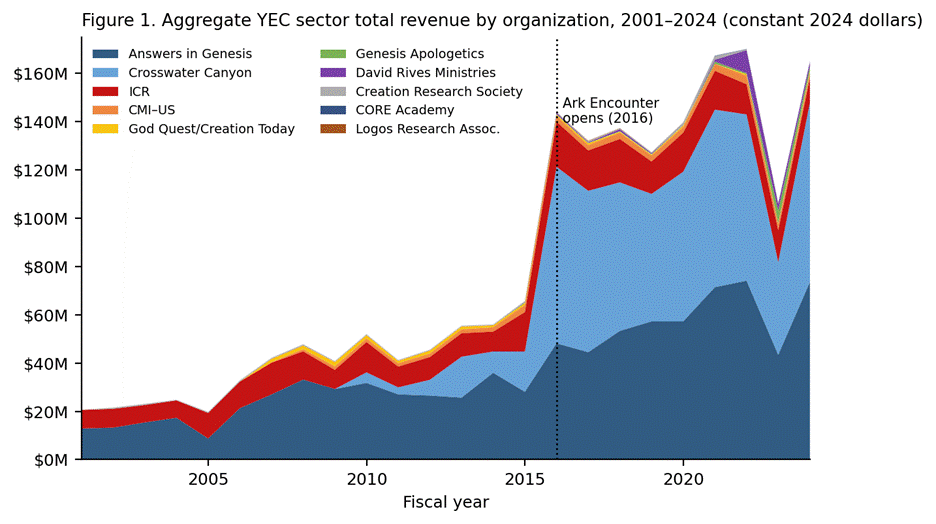
I raise these numbers for one reason, and it has nothing to do with whether the money is well spent. Authority on this scale, exercised at this distance, can only have been built on the front stage. For all but a sliver of AiG’s audience, everything they know about the people behind the ministry comes from what the ministry has chosen to show them. The same would be true of any ministry this large, including one that agreed with me about Genesis. That is exactly why my pastor’s caution applies.
Where the Keys Belong
The title of this post borrows a phrase from Jesus. “I will give you the keys of the kingdom of heaven,” he told Peter (Matt. 16:19), and most of the protestant tradition has always understood those keys as given to the church and exercised through its officers. I grew up in the Orthodox Presbyterian Church, and I still subscribe to the Westminster Confession of Faith, the historic confession of the Presbyterian and Reformed tradition. It says that “the Lord Jesus, as King and Head of his Church, hath therein appointed a government, in the hand of church officers” (30.1), and that “to these officers the keys of the kingdom of heaven are committed” (30.2).
The officers in view are elders and ministers who belong to a particular church, who know its people, and who answer to the courts of that church. In the terms of my pastor’s sermon, they are leaders with a backstage pass. The congregation can “consider the outcome of their way of life” (Heb. 13:7), and they in turn “keep watch over your souls” (Heb. 13:17). The keys were placed where access and authority meet.
Even so, the Confession refuses to give those courts unlimited authority. On the conscience it says:
“God alone is Lord of the conscience, and hath left it free from the doctrines and commandments of men, which are, in any thing, contrary to his Word; or beside it, if matters of faith, or worship.” (20.2)
And on the church’s own assemblies it is remarkably candid:
“All synods or councils, since the apostles’ times, whether general or particular, may err; and many have erred. Therefore they are not to be made the rule of faith, or practice; but to be used as a help in both.” (31.3 in the American edition)
Think about what follows. If properly constituted church courts, made up of elders who know their congregations and who are accountable to one another, may err and must never be made the rule of faith, then a statement of faith written by a parachurch ministry with no ecclesiastical standing at all deserves at least as much caution. It can be a help. It cannot become the rule by which churches are judged.
The Confession itself is silent on the age of the earth. And when a Reformed church court did take up the question of the creation days, it reached a conclusion very different from AiG’s. In 2000 the General Assembly of the Presbyterian Church in America received the report of its Creation Study Committee, which described four interpretations held by respected Reformed theologians: the calendar-day view, the day-age view, the framework view, and the analogical-days view. The Assembly then declared:
“That since historically in Reformed theology there has been a diversity of views of the creation days among highly respected theologians, and, since the PCA has from its inception allowed a diversity, that the Assembly affirm that such diversity as covered in this report is acceptable as long as the full historicity of the creation account is accepted.”
Set that beside AiG’s statement that “any other views that try to fit evolution or millions of years into Genesis are incompatible with Scripture.” The church court, composed of elders who know the congregations they serve, made room for faithful disagreement. The distant ministry ruled it out. If a member of a PCA church is told by a parachurch ministry that his elders hold a view “incompatible with Scripture,” which of the two has the better claim on his conscience?
None of this means parachurch ministries are bad for the church. Mission agencies, publishers, campus ministries, and seminaries have served the church well for generations, and I am grateful for many of them. Their health has always depended on remembering that they serve the church and do not govern it. The trouble begins when a ministry stops serving the church and starts sorting faithful churches from unfaithful ones on questions the church itself has left open.
Both Sides, and Myself
I would be guilty of the double standard I warned against in my last post if I stopped here. The danger zone on my pastor’s grid has more than one occupant.
Some of the most influential voices for young Christians today belong to skeptics on YouTube. A student who begins to doubt what he was taught about Genesis can find dozens of polished channels ready to tell him that his doubts prove the whole faith false. He has no more access to the character of those presenters than his parents have to Ken Ham’s, and yet many young people hand them sweeping authority over the most important questions of their lives. The structure is identical. Only the conclusion they are pushing has changed.
The same caution applies to popular voices who share my view of Genesis, and as I argued last time, it applies to me. I would be troubled to learn that a reader had concluded his pastor was unfaithful because the pastor disagreed with me. If you take only one thing from this series, I hope it is that no distant voice, on any side of this debate, should be handed the keys.
Back to the Pew
So what should a Christian do who belongs to a church where these questions have become tense? My counsel is the same as in my last post. Stay. Love your congregation. Take your questions to your elders, who know you and whom you know. If you disagree with them about Genesis or more likely, simply have doubts, tell them so, with patience and charity, and listen when they answer. Semper reformanda, always reforming, is a calling given to the church, and the church carries it out through people who know one another.
I know that counsel is easier to give than to follow. Christian community is complicated because it is made of people, and people disagree. Most of the time the right response to disagreement is to stay, keep talking, and trust that growth happens slowly and in company. A congregation that can hold two views of Genesis in the same pew is learning what Paul meant by “bearing with one another in love” (Eph. 4:2).
But staying is not always possible. Some churches have made a particular reading of Genesis a test of fellowship, and some leaders cannot hear an honest question without treating it as a sign of unbelief. If you have raised your concerns patiently and the only options left are to affirm what your conscience cannot or to stay silent indefinitely, it may be time to go. Leaving in that case is not a failure of faith or a rejection of the church. It is a search for a community where you can be known, be honest about your questions, and keep growing in Christ. If you go, go quietly, without bitterness, and with gratitude for what that congregation gave you.
And when a distant voice tells you which churches are faithful, put to it the same five questions I put to myself last time. Who could correct this ministry, and does it welcome correction? When did it last say “we were wrong” about something that mattered? How does it speak of Christians who disagree? Can you check its sources, and when you do, do the front stage and the backstage tell the same story? And what is it asking you to do? If the answer to that last question is to distrust your own elders, my pastor’s caution applies with full force.
All of these questions assume there is a person behind the curtain, someone with a character we simply cannot see from where we sit. In my final post in this series I want to consider a newer situation, one my pastor’s sermon did not address but whose logic reaches it. What happens to the message and the messenger when the voice speaking to us may have no backstage at all? Yes, what are we to do with artificial intelligence?
Blessings,
Joel
Links to sources:
AiG Statement of Faith
Ken Ham, “75-Million-Year-Old Dinosaur Blood Cells?” (2015)
Bertazzo et al., “Fibres and cellular structures preserved in 75-million-year-old dinosaur specimens,” Nature Communications (2015)
Your Hemoglobin Challenge post (2024)
ProPublica Nonprofit Explorer: Answers in Genesis, Inc.
Northern Kentucky Tribune on the ten-millionth guest
byFaith on the PCA Creation Study Committee report
Already Gone
Already Compromised


Comments or Questions?