A recent ICR video walks the canyon top to bottom and finds a global flood at every contact. The rocks themselves, and a book eleven scientists wrote about them, tell a more careful story.
I recently watched a short film produced by the Institute for Creation Research, titled “Christian PhDs: These Grand Canyon Discoveries CONFIRM the Bible.” It is filmed where every Grand Canyon argument is filmed, standing at the rim with the layered wall of the inner gorge spread out behind the speakers. The framing is familiar and, I will admit, effective from a marketing perspective. The presenters note that the National Park placards tell visitors how old these rocks are and how long they took to form, and then they offer a different account: that the whole stack was laid down not over hundreds of millions of years but within a single year of Noah’s flood, one layer after another, in what one of them calls pancake stacking.
I’ll address these claims seriously although I find it difficult to think of them as serious claims anymore since they have been refuted many times over many years. The video contributors are surely aware of how weak their claims are and yet continue to promote them. I can say that the video speakers, all PhDs and creationists, are pointing at real features in real rock and asking what those features mean. That is the right question. It is also, as it happens, the question that eleven scientists set out to answer in a book I had the privilege of contributing to, and the answers they reached run almost exactly opposite to the ones in this video.
What the video actually claims
The ICR presenters make several claims in this short video. Their central piece of evidence is the contacts between layers — the surfaces where one rock type stops and the next begins. Where a shale meets a sandstone above it, they observe that the contact is flat and sharp, with no channels or gullies cut into the lower layer. If a million years had passed between the two, they reason, erosion should have carved ruts into the shale that the overlying sand would then have filled. They see no such ruts. Therefore, they conclude, no time elapsed; the layers were stacked in rapid succession during the flood.
From there the argument widens. The flat erosional surface near the base of the canyon known as the Great Unconformity and where flat sedimentary layers rest on ancient rock, either crystalline rock or ancient precambrian rock that has tipped up and eroded off, is sometime said to mark the beginning of the flood, and to appear on every continent at roughly the same level. The sudden appearance of trilobites in the Cambrian rocks, complete with sophisticated compound eyes, is offered as evidence of creation rather than gradual descent; the presenters note, correctly, that Darwin himself worried about the origin of the eye. The Coconino Sandstone, which conventional geologists read as a fossil desert dune field, is reinterpreted as underwater sand on the grounds that its animal tracks look as though they were made in wet sand. The famous bed of cephalopod fossils in the Redwall Limestone is cited as a mass-burial event. And rill-and-gully erosion, they say, forms today only in catastrophic mudflows. The conclusion is that these are not local rocks but continental and ultimately global flood deposits.
Several of these observations are accurate. The layers really are remarkably flat and laterally continuous; you can trace some of them for hundreds of miles. Many of the contacts really are sharp. Trilobites really do appear in the Cambrian with fully formed eyes. And the canyon really was carved by water. The disagreement is not about whether these features exist. It is about what they require.
A book written for exactly this conversation
In 2016, Kregel — a mainstream evangelical publisher — released The Grand Canyon: Monument to an Ancient Earth, written by eleven authors and editors, the large majority of them confessing Christians, and all of them working scientists with earned doctorates in geology, paleontology, biology, hydrology, and related fields. The book takes the canyon as a test case and asks the question in its subtitle directly: can Noah’s flood explain the Grand Canyon? It presents the young-earth position fairly, in young-earth authors’ own words, and then works through the geological evidence formation by formation. I mention the makeup of the author list not to win the argument by counting heads as if science could be settled by polls, but because the ICR video leads with the credentials of “Christian PhDs,” and it is worth knowing that a larger group of Christian PhDs has examined the very same rocks and reached the opposite conclusion.
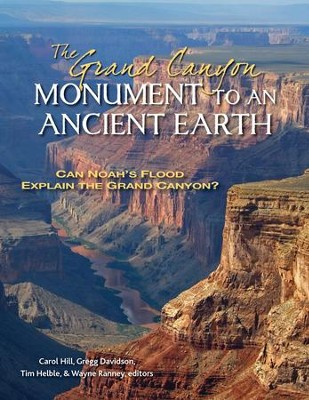
My own contribution to the book is a chapter on a subject that sounds modest and turns out to be devastating: pollen and spores. It is titled “Tiny Plants — Big Impact,” and it concerns what is not in the canyon’s rocks. I will return to it below, because it speaks directly to the pancake-stacking claim in a way that no amount of arguing about contact surfaces can evade.
“No erosion ruts” is a claim that proves too much
Let’s start with the most consequential argument, the flat contact. The reasoning runs: if time had passed, we would see channels cut into the lower layer; we see no channels; therefore no time passed. The trouble is that the first premise is false. Flat contacts are not evidence of no time. Geologists have a name for surfaces where a great deal of time passed without leaving an obvious channel, a paraconformity, and they form routinely when a shallow sea advances across a low-relief landscape and wave action planes the surface smooth before new sediment arrives. A flat contact tells you the surface was flat. It does not tell you it was young.
But the deeper problem is that the ICR criterion, taken at face value, refutes the very model it is meant to support. Suppose we grant the rule: a sharp, flat contact means no time elapsed, and any sign of an exposed, weathered, or eroded surface means time did elapse. Apply that rule consistently to the whole column and watch what happens. The top of the Redwall Limestone is not flat at all. It is a buried karst landscape — an ancient surface riddled with caves, sinkholes, and channels dissolved into the limestone by fresh rainwater, then filled in by a later formation called the Surprise Canyon Formation. Caves do not dissolve underwater in a raging flood; they form when slightly acidic rainwater percolates through exposed limestone over long periods. By ICR’s own standard, this surface screams that a great deal of time elapsed in the middle of the supposed flood year, on dry, rained-upon land, exactly where their model forbids it.
This is the recurring shape of the flood-geology argument, and it is worth emphasizing. A criterion is introduced because it seems to support rapid deposition at one spot, and then the same criterion, applied honestly elsewhere in the same canyon, points the other way. If sharp contacts prove rapid deposition, then karst surfaces, mudcracked layers, animal trackways, and root-bearing horizons — all of which appear in the geologic record and several of which appear in the canyon itself — must prove exposure and time. You cannot keep the first inference and discard the second.
The flat unconformity has tilted, eroded rock beneath it
The same difficulty undoes the claim that the Great Unconformity marks the clean opening of the flood. In much of the eastern canyon, the flat-lying Tapeats Sandstone does not rest on crystalline basement at all. It rests on the Grand Canyon Supergroup — a thick stack of sedimentary layers that were deposited horizontally, then tilted to steep angles, then eroded flat, and only afterward buried beneath the Tapeats. This is an angular unconformity, and it is one of the oldest and most decisive arguments against flood geology, recognized since the eighteenth century.
Walk through what a single flood year would have to accomplish here, in order. First, deposit thousands of feet of sediment. Then somehow tilt those still-soft layers to angles of ten or twenty degrees without them slumping into formless mud. Then erode the tilted edges to a flat plane. Then resume horizontal deposition on top. Each step requires conditions that contradict the others, and the whole sequence has to be squeezed into part of one year while the entire planet is underwater. The conventional reading — deposition, lithification, mountain-building, erosion, and renewed deposition, each over long spans — asks nothing of the rocks that we do not watch happening today. The flood reading asks soft sediment to behave like solid rock and solid rock to erode like soft sediment, as the moment requires.
The pollen that should be everywhere, and is not
Here is where my own small corner of this subject becomes, I think, the hardest single fact in the whole conversation. If the fossil-bearing layers of the Grand Canyon record the destruction of the pre-flood world — a world the model describes as lush, forested, and teeming — then the sediments laid down in that flood should contain a representative sample of that world, thoroughly mixed by the most violent year in Earth’s history. Pollen and spores are the ideal test of this, because they are produced in astronomical numbers, they are nearly indestructible, they travel on wind and water into every environment, and a single flowering tree releases millions of grains in a season. If flowering plants were alive and being buried, their pollen should be everywhere in the flood deposits.
It is not. In the lower half of the canyon’s sedimentary column — the Cambrian through the older Paleozoic layers — there is no flowering-plant pollen at all. None. The pollen and spores that do appear, higher in the section, appear in an order: spore-bearing plants first, then conifers and their relatives, then, much later, the pollen of flowering plants, matching the same sequence found in rocks all over the world. A global flood thrashing a fully stocked biosphere has no mechanism to sort pollen this way. Hydraulic sorting can separate grains by size and density, but a fern spore and a pine grain and an oak grain are close enough in both that no flood could file them into clean, worldwide, bottom-to-top succession. The only known process that produces this pattern is time — the actual appearance of these plant groups, one after another, across hundreds of millions of years.
This is the argument the ICR video cannot touch, because it never leaves the question of contact surfaces. You can debate forever whether a given contact is sharp enough to require rapid burial. You cannot debate away the absence of an entire category of fossil from rocks where the flood model demands its presence. The missing pollen is not a matter of interpretation. It is a matter of what is in the rock.
I’ve written about plants and pollen and the challenges they present to the young-earth model several times but most notably in my own PSCF article Flood Geologies’ Abominable Mystery in 2008 and more recently on this blog: What to Do with the Plants? A Survey and Critique of Young-Earth Creationist Models for the Plant Fossil Record.
Desert dunes do not become wet dunes because we wish them to
The Coconino Sandstone claim deserves an answer, because it is the one place the video offers a positive reinterpretation rather than a doubt. The presenters say the Coconino’s animal tracks look as though they were made in wet sand, and that its large cross-beds are therefore underwater dunes. I expect they are thinking of the Brand and Tang 1991 publication suggesting this possibility. But the features of this formation are a checklist of dry-desert deposition, not a marginal call. The cross-beds dip at the high angles characteristic of wind-blown dunes, not the gentler angles of underwater sand waves. The individual sand grains are frosted and well-rounded, the signature of grains that bounced across a dry surface in the wind. The trackways climb up the steep faces of the dunes, which is what small reptiles do on dry sand and what no animal does on a dune submerged under fast, deep water. There are even raindrop impressions preserved on some surfaces — marks that require an exposed surface struck by rain, not a seafloor under a global flood.
And there is a quantitative trap in the underwater reading. To pile sand into dunes the size of the Coconino’s under water, you need a current moving on the order of two meters per second through water perhaps a hundred meters deep. At those flow rates, a small reptile could not touch the sand surface, let alone stroll across it leaving a tidy trackway. The very tracks the video offers as evidence for water are evidence against it: they can only have been made on a firm, subaerial, walkable surface. The wet-sand impression the presenters describe is real, but a footprint pressed into slightly damp dune sand at dawn is not a footprint made underwater.
For a much more thorough critique of the creationist’ Coconino sanstone hypothesis see Tim Heble’s excellent and detailed article in Perspectives on Science and Christian Faith titled: Flood Geology and Conventional Geology Face Off over the Coconino Sandstone. https://doi.org/10.56315/PSCF9-24Helble
Trilobite eyes and a bed of cephalopods
Two of the remaining claims can be handled more briefly, though they are not trivial. The first is the Cambrian “explosion” and the sudden, sharp-eyed trilobite. It is true that trilobites appear in the Cambrian with complex compound eyes, and it is fair to note that the eye troubled Darwin. But the Cambrian explosion is not the instantaneous event the word “explosion” suggests; it unfolds over roughly twenty million years, it is preceded by the soft-bodied Ediacaran organisms and by a sequence of small shelly fossils, and trilobite eyes themselves range from simple to elaborate across different lineages, with some trilobites secondarily blind. A sudden creation predicts no precursors and no sequence. The rocks supply both.
The second is the cephalopod bed in the Redwall, a favorite of young-earth geologist Andrew Snelling, who has described it as a layer crowded with billions of nautiloids and read it as a single catastrophic burial spanning the region. The bed is real and it does record an event — a local mass mortality of the sort that happens in ordinary oceans more than once in their history. But the reported densities have not held up to independent checking; the actual concentration of fossils is far lower than the billions claimed, and the shells are not all aligned in the single direction a unidirectional flood current would impose. An event bed within a thick limestone is evidence of an event. It is not evidence that the entire limestone, with its karst surface and its in-place fossil reefs, formed in an afternoon.
The case does not rest on any one layer
What makes the ancient reading of the canyon so durable is not any single observation but the way independent lines of evidence converge on the same answer. The pollen succession, drawn from paleobotany, places the plant groups in a fixed order. The eolian features of the Coconino, drawn from sedimentology, demand a dry, wind-blown surface. The karst atop the Redwall and the buried channels of the Surprise Canyon Formation, drawn from carbonate geology, demand long subaerial exposure. The angular unconformity beneath the Tapeats, drawn from structural geology, demands an entire cycle of deposition, deformation, and erosion before the Paleozoic layers began. And radiometric dating, drawn from physics and applied through several independent isotopic systems to the volcanic rocks and ash layers, supplies absolute ages that agree with the order the other methods establish.
Each of these comes from a different discipline, with different instruments and different failure modes, and they were not coordinated to produce a common story. They produce one anyway. A flood model can sometimes be stretched to explain one of them in isolation — a special pleading for the cross-beds here, an ad hoc current for the nautiloids there. What it cannot do is explain all of them at once with a single consistent set of physical conditions, because the conditions each feature requires contradict one another within the span of a single year.
The question the video leaves standing
I would put the matter to the makers of this video not as an accusation but as a standing question, the kind a model has to answer if it wants to be taken as science rather than as illustration. Your account predicts that the flood-deposited layers contain the buried pre-flood world, mixed and sorted by water. Where, then, is the flowering-plant pollen in the lower half of the canyon? It is produced in unimaginable quantity, it survives under many different conditions, and it should be impossible to keep out of sediments laid down by a planet-covering flood. Its complete absence from rocks where your model requires its presence is not a gap to be filled by future research. It is a prediction that has already failed.
For anyone who wants to spend real time with these rocks, layer by layer and claim by claim, I can do no better than point to the book itself. The Grand Canyon: Monument to an Ancient Earth was written for precisely the reader this ICR video is aimed at — someone standing at the rim, looking at the placards and then at the alternative, and trying to work out which account the rock actually supports. Eleven scientists spent that book answering the question the video raises, and they brought to it a great deal more evidence than a few minutes at the rim can hold. The canyon will reward the closer look.
References
Scientific Literature
Brand, L. R., & Tang, T. (1991). Fossil vertebrate footprints in the Coconino Sandstone (Permian) of northern Arizona: Evidence for underwater origin. Geology, 19(12), 1201–1204.
Duff, R. J. (2008). Flood geology’s abominable mystery. Perspectives on Science & Christian Faith, 60(3).
Loope, D. B. (1992). Antidunes, eolian deposition, and the interpretation of ancient cross-bedded sandstones. (Review discussion of eolian versus subaqueous bedform criteria; recommend confirming exact citation details before publication.)
Middleton, L. T., Elliott, D. K., & Morales, M. (2003). Coconino Sandstone. In S. S. Beus & M. Morales (Eds.), Grand Canyon Geology (2nd ed., pp. 163–179). Oxford University Press.
Billingsley, G. H., & Beus, S. S. (Eds.). (1999). Geology of the Surprise Canyon Formation of the Grand Canyon, Arizona. Museum of Northern Arizona Bulletin 61.
Erwin, D. H., & Valentine, J. W. (2013). The Cambrian Explosion: The Construction of Animal Biodiversity. Roberts and Company Publishers.
Helble, T. (2024). Flood geology and conventional geology face off over the Coconino Sandstone. Perspectives on Science and Christian Faith.
Hill, C., Davidson, G., Helble, T., & Ranney, W. (Eds.). (2016). The Grand Canyon, Monument to an Ancient Earth: Can Noah’s Flood Explain the Grand Canyon? Kregel Publications. (Written for non-specialist Christian readers; Duff’s chapter, “Tiny Plants — Big Impact: Pollen, Spores, and Plant Fossils,” addresses the pollen evidence discussed above.)
Karlstrom, K. E., et al. (2018). Cyclic stratigraphy and the Great Unconformity of the Grand Canyon region. (Detrital zircon and unconformity studies; recommend confirming exact volume and page details before publication.)
Marshall, C. R. (2006). Explaining the Cambrian “explosion” of animals. Annual Review of Earth and Planetary Sciences, 34, 355–384. https://doi.org/10.1146/annurev.earth.33.031504.103001
Ranney, W. (2012). Carving Grand Canyon: Evidence, Theories, and Mystery (2nd ed.). Grand Canyon Association. (Accessible overview of how the canyon was actually carved.)
YEC Sources Referenced
Institute for Creation Research. (n.d.). Christian PhDs: These Grand Canyon Discoveries CONFIRM the Bible [Video]. ICR YouTube channel. https://youtu.be/TxlJzfHrHqo?si=SZFPGsLA5wawUNLP
Snelling, A. A. (2008). A catastrophically deposited nautiloid mass-kill bed within the Redwall Limestone, Grand Canyon, Arizona. (As summarized in Answers Research Journal and ICR materials; recommend confirming exact citation before publication.)
Mortenson, T. (2020). The Grand Canyon, Monument to an Ancient Earth: Deceptions. Answers Research Journal. answersresearchjournal.org/grand-canyon-monument-ancient-earth/


I’m a little confused by your representation of the great unconformity in flood geology. I thought yecs believed that the supergroup was deposited in the first days of creation and the tilted and eroded during the flood.
LikeLike
Thanks for pointing that out. You are right. I totally blanked out on that. I’ve edited that section a bit to acknowledge the variation in thought and also to fix the fact that it doesn’t only on crystalline basement rock but prior sedimentary rock in places.
LikeLike
Thank you. I was aware of the YEC Grand Canyon: Another View, by Tom Vail. I was unaware of your book. I look forward to reading it.
LikeLike