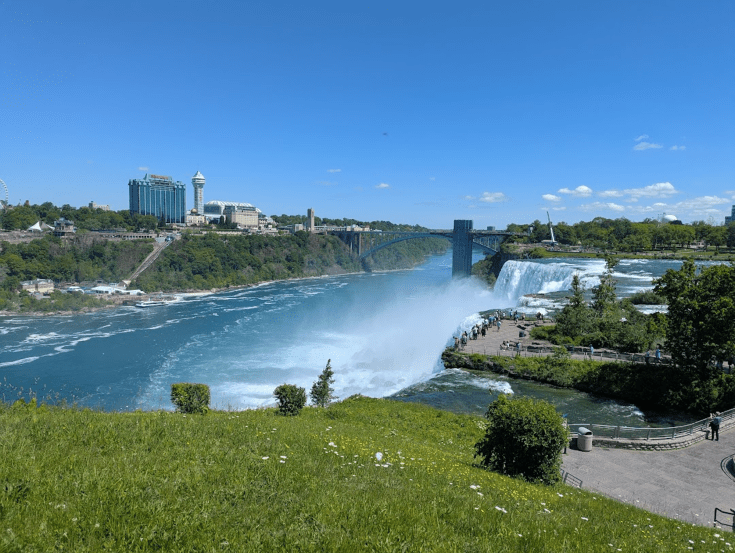
I have been reading some Intelligent Design literature lately. A small question has nagged at me over the years when I encounter that literature. A recent visit to Niagara Falls caused me to think about it a bit more leading me to write this reflection on Intelligent Design.
The movement’s leading advocates point to the bacterial flagellum. They point to the information encoded in DNA. They point to the molecular machinery inside the living cell. They point to the fine-tuning of the physical constants that make a life-permitting universe possible. They almost never point to a waterfall. Or a crater. Or a river delta. Or a sand dune. Or a snowflake. Or an ordinary slab of sedimentary rock. I found myself wondering why. If nature bears the fingerprints of a designing intelligence, why does that intelligence seem to sign its work only inside the living cell? Why only at the first instant of the cosmos? Why never, as far as I can tell, at Niagara Falls?
My confusion may come from my church background. I am a confessional Reformed Christian. I confess, along with the Westminster divines, that God upholds and governs all creatures, actions, and things, from the greatest to the least. That confession stands behind everything that follows. I am not asking whether Niagara Falls was somehow left to itself while God attended to more promising projects like flagella. For a Christian in my tradition, that question does not even arise. I am asking something narrower. Something more revealing.
Why does Niagara Falls not count as detectable design? Even for those of us who believe the falls exist exactly where and how they do, under the sovereign will of God?
Design and the detection of design
We need to separate two questions first. The word design quietly runs them together. I made this argument at greater length in an earlier post, the one responding to Ligonier Ministries on theistic evolution and creationism. (https://thenaturalhistorian.com/2026/05/08/when-i-dont-know-disappeared-a-response-to-ligonier-ministries-on-theistic-evolution-and-creationism/) The distinction is worth restating here. It is central to understanding the narrow kind of design the ID movement actually cares about.
The first question is the one Intelligent Design asks. Can we identify certain features of the natural world, by empirical means, as the products of an intelligent agent? Or are they simply the outcome of law-like or chance processes? That is a restricted question. It asks about the detection of design, not whether all things result from design. The Discovery Institute describes its own program this way. It searches for signs of intelligence. It looks for patterns in nature best explained by an intelligent cause rather than an undirected one.
William Dembski’s version supplies the machinery. His explanatory filter sorts any event into one of three bins. First it asks about regularity, meaning natural law. Then it asks about chance. Only if the event is both highly improbable and matches an independently specified pattern does it land in the third bin: design.
The second question is the one my question about Niagara Falls asks. Does everything in creation exist under God’s intentional and sovereign governance? Here the Reformed answer is far broader than anything ID offers. Niagara Falls may be entirely explicable through glaciation, drainage reorganization, differential erosion, and rock mechanics. It took a great deal of time. And at the very same moment, it can be wholly encompassed within divine providence. These are not the same question. Much of the confusion in Christian conversations about science comes from treating them as if they were.
I need to be careful with Intelligent Design here. The temptation is to caricature it. It would be satisfying to say that ID advocates believe God designed the flagellum but handed the waterfall over to blind chance. That would also be false.
The more careful ID writers draw a clear line. They distinguish divine action, which they affirm extends to everything, from the detection of design, which they claim only for some things. Several of them affirm without hesitation that God works through secondary causes. Their claim is not that waterfalls are godless. Their claim is narrower. Waterfalls simply do not carry the particular empirical marker that would let a scientist, working as a scientist, infer an intelligent cause. On its own terms, that is a coherent position. I do not want to pretend otherwise. But it raises a series of questions its defenders, and especially its admirers, rarely stop to ask.
Why the filter stops at the water’s edge
Consider what happens when we actually run Niagara Falls through Dembski’s filter. The falls are the product of an intelligible sequence of ordinary causes. About twelve thousand years ago, the Laurentide Ice Sheet retreated northward. This happened at the close of the last glaciation. Meltwater reorganized the drainage of the emerging Great Lakes. It sent a river across the Niagara Escarpment. There the water met a layer cake of sedimentary rock. A hard, resistant caprock of Lockport dolostone sits on top. It is roughly four hundred and thirty million years old, built largely from the ground-up remains of an ancient tropical reef. Beneath it lies much softer Rochester shale. The soft shale erodes and undercuts. The hard caprock is left overhanging until it collapses under its own weight. Then the falls retreat upstream. They have retreated this way for eleven kilometers over twelve millennia. The historical rate runs near a meter a year. Human engineers eventually diverted much of the flow for hydroelectric power. That has slowed the retreat to a crawl.
Every step of that is regularity. Gravity, hydrology, the differential hardness of rock, fracture propagation, the timing of an ice sheet’s retreat. When Dembski’s filter meets an event so thoroughly explained by natural law, it stops at the first bin. It attributes the event to regularity. It never reaches the design node at all. This is not a failure of the filter. It is the filter working exactly as designed. (See what I did there?) And that is the point worth dwelling on. In this framework, design is what is left over after law and chance have been ruled out. Design is the residue. It is defined, quite literally, as the complement of regularity and chance. It is the set of things natural explanation cannot reach.
Notice what this quietly implies. If design is only ever the residue, then everything natural explanation does reach gets consigned, by the same logic, to the not-designed. The better we understand how something formed, the less it can serve as evidence of design. The waterfall is not undesigned because someone examined it and found no designer. It is undesigned because we understand it too well.
The corollary that does not follow
Here is where the popular version of the argument slips. I think this is where a reader attracted to ID most needs to slow down. ID’s formal claim is modest. This biological structure, it says, is not adequately explained by known natural processes. Therefore it is best explained by an intelligent cause. Officially, that is all. But the rhetoric often gets pressed much further than the formal claim. In that extended use, it picks up a corollary its authors would disavow if pressed. The corollary runs like this: this geological structure is adequately explained by natural processes, therefore it is not evidence of design.
That corollary does not follow. Natural explanation and divine intention are not opposites in classical Christian theology. Treating them as opposites is the whole mistake. Yet the mistake is easy to absorb. The structure of the design inference trains the imagination to look for God only where explanation runs thin.
Over time this cultivates a two-tiered picture of nature. On the upper tier sit the objects that resist explanation. The molecular machines. The informational sequences. The fine-tuned constants. These come to feel spiritually charged. On the lower tier sits everything else. The waterfalls and dunes and deltas and craters and snowflakes and sedimentary layers. By quiet implication, these become mere products of natural process. A Reformed, and broadly evangelical, theology of nature should refuse that partition. It should refuse it firmly. There are no lower-tier creatures. The dune is no more abandoned by God than the flagellum.
A watchmaker who must mend his work
There is an old exchange that captures the trouble better than anything I could invent. In 1715 Gottfried Leibniz wrote to Samuel Clarke, who was speaking for Isaac Newton. Leibniz complained about a feature of Newton’s cosmology. Newton had suggested that God must occasionally intervene to adjust the solar system and keep it stable. Leibniz found this beneath the dignity of God. He said so in words worth quoting in full:
Sir Isaac Newton, and his followers, have also a very odd opinion concerning the work of God. According to their doctrine, God Almighty wants to wind up his watch from time to time: otherwise it would cease to move. He had not, it seems, sufficient foresight to make it a perpetual motion. Nay, the machine of God’s making is so imperfect, according to these gentlemen, that he is obliged to clean it now and then by an extraordinary concourse, and even to mend it, as a clockmaker mends his work; who must consequently be so much the more unskilful a workman as he is oftener obliged to mend his work and to set it right.
I think this logic is exactly right. It cuts in a direction the modern design movement may not feel comfortable with. A craftsman who must keep stepping in to repair his own work is a lesser craftsman. Compare him to one whose design runs faithfully by the order he first gave it. The more you need God to intervene where nature falls short, the smaller the God you are describing. Leibniz aimed this at Newton’s occasional adjustments to the planets. But the same argument turns against a design argument that locates God most confidently in the gaps of biological explanation. Such an argument makes the evidence for God shrink every time a biologist or astronomer succeeds. It ties our confidence in the Creator to the current boundaries of our ignorance. Those boundaries have a long history of moving.
I should add, in fairness to Leibniz, that he was no deist. He is sometimes misread as pushing God out of nature. But he explicitly denied that the world runs like a machine without God’s continual concurrence. His objection was the opposite of deism. A God who must return to mend his work is not too involved for Leibniz’s taste. He is too clumsy. That is very nearly the Reformed doctrine of providence, stated in seventeenth-century mechanical terms. God’s glory shows more brightly in the faithful regularity of the order he sustains. It shows less in any emergency repair.
A tension ID does not notice in itself
There is a further irony here. ID’s own literature rarely addresses it. The movement is happy to infer design from the fine-tuning of the physical constants. But fine-tuning locates the design in the laws themselves. It sits in the initial setup of the cosmos, in gravity and the strength of the nuclear forces being poised just so.
In its cosmology, then, ID finds design in the very law-structure of the universe. In its biology, it finds design in the failure of that law-structure to account for some feature. These are opposite arguments. Yet they run under the same banner of ID. And they collide precisely at the waterfall. If the laws that make water run downhill and rock resist erosion are themselves finely tuned and designed, as ID insists when it discusses cosmology, then the waterfall those laws produce is designed output. It is not an undesigned leftover. You cannot celebrate the design of the laws in one breath and dismiss their lawful products as mere nature in the next. Niagara Falls is simply what the fine-tuned constants actually do.
What a waterfall teaches that a flagellum cannot
I have come to think a waterfall is a better teacher here than a flagellum. It refuses to behave the way design rhetoric wants nature to behave. Consider a few of its stubborn features.
A waterfall plainly has order. Its location and form are not random visual noise. They follow with real precision from bedrock stratigraphy, contrasts in rock resistance, glacial history, drainage geometry, and the constant pull of gravity. Yet no one is tempted to run it through a design filter. Order, it turns out, is not the same thing as detectable design. The waterfall makes that unmistakable.
A waterfall appears purposeful without serving any obvious function. We often call organisms designed because their parts do jobs. The eye sees. The wing flies. A waterfall does no comparable job. And yet it produces real consequences without end. It carves gorges. It forms habitats. It raises microclimates. It blocks the passage of fish. It generates electric power. It stops human beings in their tracks with something very like awe. This raises a genuinely interesting question. Is function intrinsic to a thing? Or is it assigned by observers after the fact? Or intended by God? These are not the same question.
A waterfall is temporary. Niagara is retreating. It will not exist in its present form forever. Eventually it will consume its way back toward Lake Erie. It will cease to be the falls we know. This is awkward for any account that equates design with optimization or permanence. But living systems are no different. They decay. They malfunction. They carry the scars of their history. They go extinct. The waterfall makes it hard to insist that a designed thing must be stable and perfected.
And a waterfall’s precise form is contingent. No law of physics required this waterfall, here, in this shape. The laws constrain what can happen. But the particular falls depend on a long and unrepeatable sequence of events. So a single natural object can be, all at once, many things. It is produced by regular physical processes. It is historically contingent. It is staggeringly improbable when described in full detail. It is richly meaningful to those who behold it. And within Christian theology, it is providentially intended. Law, chance, and design are not the tidy, mutually exclusive bins the filter needs them to be. Niagara Falls sits comfortably in all of those descriptions at the same time.
Providence, not a gap
The Reformed tradition offers something sturdier than a search for gaps. Classical Reformed theology does not divide the world’s events into the ones God causes and the ones nature causes. God’s providence does not compete with secondary causes. It establishes them. The Westminster Confession places all things under God’s government. Yet it is careful to preserve the liberty, or contingency, of second causes. It does not abolish them. Calvin flatly refused the notion that tracing a storm to ordinary natural causes strips it of being God’s work. The rain that falls by natural process is still, for Calvin, rain that God sends.
This yields a very different set of questions from the ones ID asks. ID asks where intelligence can be detected as a distinct causal category. Which objects bear special marks? Where do law and chance run out? Reformed providence asks something else. How does the whole created order, in all its ordinary causality, depend moment by moment on God? What creature or event could possibly lie outside his governance? The second set of questions never has to retreat when science advances. It was never lodged in the gaps to begin with.
Much of the trouble comes from a single confusion about the word chance. In a scientific model, chance can mean stochastic behavior. It can mean sensitivity to initial conditions. It can mean contingency among several possible outcomes. Or it can simply mean variables we have not measured. None of those meanings places an event outside God’s governance. A Reformed Christian can say, without contradiction, that an event is random relative to a scientific model and purposeful relative to divine providence. When we fail to keep those two levels distinct, we end up imagining that a natural explanation has somehow crowded God out. It has done nothing of the kind.
This exposes what I take to be the deepest problem with resting our confidence on the gaps. Why should God receive more credit when we cannot explain an event? Why less credit when we can describe, in extraordinary detail, the whole network of causes through which he brought it about? The erosional history of Niagara is not a screen hiding God from view. For a doctrine of providence, that history is the very means through which God governs the falls. The Lockport dolostone, the Rochester shale, the retreating ice: these are not God’s competitors. They are his instruments.
There is a reason ID reaches so naturally for the language of engineering. Machines, motors, codes, blueprints, information-processing systems. Those analogies are intuitively powerful. In biology they are nearly irresistible. But creation may not be best imagined as a collection of artifacts. It is not assembled by an external technician who steps in wherever the mechanism would otherwise fail. The older Christian picture is different. It pictures a world continuously dependent upon God for its very existence, its order, and its causal powers. God is not the engineer we summon when the creaturely machinery breaks down. He is the Creator whose providence works through the ordinary existence and efficacy of that machinery. That is a larger vision than the design inference can supply. I would add that it is a more worshipful one.
The waterfall and the flagellum
So let me return to the question I began with. Must a Christian choose between Niagara Falls produced by natural processes and Niagara Falls intended by God? Within the theology I confess, that is a false choice. Recognizing it as a false choice is the whole lesson of the waterfall. The falls are the work of glaciation and gravity and differential erosion. Geology describes them down to the last detail. And they are also the work of God, willed and upheld and governed. Both, entirely. Neither at the expense of the other.
I do not raise all this to attack Intelligent Design. I want to credit the seriousness with which its best thinkers pursue their questions. My aim runs closer to the opposite. I want to enlarge the Christian imagination beyond detectable design. I want to recover a vision of creation in which God’s wisdom shows itself not only in the handful of structures we cannot yet explain. It shows itself in the whole intelligible, lawful, and beautiful order. Waterfalls and flagella alike. The danger in the design inference is not that it looks for God. The danger is that it teaches us to look for him most confidently in the shrinking territory of our own ignorance. It teaches us to feel a quiet disappointment whenever an explanation succeeds.
The believer who learns to see the falls rightly has learned something they can carry everywhere else. If a waterfall can be at once fully explained and fully intended, then so, in principle, can a great deal more that troubles us. Including the long natural history of life itself. The God of the Reformed confessions does not grow smaller as the map of natural causes grows larger. He is the one in whom all those causes hold together, from the greatest to the least. That is not a God we detect in the gaps. It is a God we confess over the whole.
Blessings,
Joel
 Naturalis Historia
This piece is a valuable caution against a possible mistake in thinking that could arise from ID thinking: confusing design detection with design itself. Unfortunately, the article does exactly that, repeatedly. E.g. “Law, chance, and design are not the tidy, mutually exclusive bins the filter needs them to be.” Replace “design” with “detectable design” here, and the critique makes no sense. The entire ID project is about apologetics to those who don’t necessarily believe in God, as well as the corollary strengthening of faith among those who do. The three bins are explanatory bins for those who don’t already explain everything by reference to the Creator. For that case, the three bins are mutually exclusive.
Questions: Would God carefully craft creation so that someone who is not already a believer in God would never detect his design? Are you willing to state that there is any aspect of creation that a non-believer might find is a convincing example of the third bin, best explained by design rather than natural laws and chance? Does Romans 1:19-21 refer only to unwitting God-of-the-gaps arguments?
LikeLiked by 1 person
Thanks for the feedback. I don’t think God would “design” a world in which we would could not detect His design. We are by our very nature created with the image of God and thus capable of seeing the creators hands in all things that He made. The unbeliever chooses not to see that design. So, yes, design is seen in the whole of creation. I look to the skies and see God’s handiwork and I look at the waterfall and I detect his design there as well and I expect that all are capable of seeing that as well but many choose not to acknowledge it.
LikeLike